Showing posts with label history of technology. Show all posts

Friday, August 7, 2026

Von Braun's Lost Ideas

Model of von Braun Moon Spacecraft

At this time of a renewed Space Race with China, to get to the Moon's South Pole, we might want to look backward a bit. In the late 50s and early 60s, NASA's Wernher von Braun presented several ideas for long-term visits to the Moon. There's a good article that outlines the concepts from the US and USSR here

The German engineer's enormous lunar landers look dated, but far more stable and feasible than SpaceX's Starship Human Landing System. There were also plans for Project Horizon, with habitats buried under the lunar regolith. NASA moved away from these plans given the then-enormous expenses that lifting so much weight from Earth to orbit and beyond would incur.

Now launch costs are lower and we have several ideas for constructing building materials out of what we find on the Moon. I should be optimistic, Child of Apollo that I am. Yet I fear we are heading for disaster.

What von Braun proposed, but that got dropped then in order to beat the Russians and is not on the table now: build a reusable Moon or Mars exploration ship in orbit. The Russian space agency had such a plan, once, when their government was on friendly terms with the US. You can read about the Marsport plan here at Wikipedia. I've critiqued the idea of Starship and giantism before, but building a big ship that would go back and forth from Earth to the Moon or Mars makes great sense. The trick? Use small reusable rockets to build it from components in orbit, as we did with the ISS.

NASA currently plans a risky landing near the lunar South Pole, something Astronaut Victor Glover has critiqued, when he called instead for an equatorial landing where spots are safer and a quick return to Earth, in case of a medical emergency, more certain. The hastiness of the US/China race, as well as the political imperative to get American bootprints on the lunar before our current President leaves office, seems to be pushing the agenda. I'd have preferred an international mission led by the big space powers and a United Nations flag on the Moon this time.

Dr. von Braun's 1952 lander concept, and the real ones that followed two decades later, had broad legs for uncertain terrain. Allen B. Ury built a fabulous model of the idea.

Model of 1952 concept lander, by von Braun

I fear that the SpaceX's tall, narrow lander will simply topple over and kill its crew, ending the Artemis program and ceding space leadership to Beijing.

Images: Fantastic Plastic Models. They should build the real thing! 


Images 

Friday, January 16, 2026

Giantism and The Moon Race

NASA rockets 1960s

The race is on, with the Artemis 2 mission coming as soon at early next month. I'm hoping to see it and future endeavors work well, so humanity begins a long voyage to the stars as a multi-planet species. I know that sounds odd in a blog about minimalist living and self-reliance for rural life, but to me the space program has always been about learning new techniques for doing things here on Earth, about new materials, for instance, that went into cordless tools I use as a DIYer or insulation I use to cut our energy costs. Splitting-maul and Moon rocket? Why not?

I've spoken at length about this with futurist Bryan Alexander, who shares my love for space travel. We are both puzzled by a rejection of human exploration by many on the Left and from the environmental movement. It amounts to a form of neo-Luddism at a time when many nations and companies are pursuing reusable launch vehicles. NASA's big SLS Moon rocket is not, save for the Orion capsule.

What critics ignore is how money is already being made in the heavens and how seemingly silly tourist flights resemble early aviation's first paying passengers. I don't think there's any way to stop this next Space Age, save for a Kessler Event (the film Gravity depicts that) making launches untenable and sends telecom back to the 1960s. 

I'd claim that moving human energy and heavy industry into space would be a godsend for our home planet's ecosystem, especially when cleaner rocket fuels come into play. You'll find a few ideas about that here. As much as I dislike the billionaire associated with SpaceX, he has one thing right: we need to begin moving some of our people and energy off-planet. That does not mean abandoning our world to the slow ecocide currently under way.

At the same time, I've written of his megalomaniacal plans for Starship at my other blog; I suspect the derivative called the Human Landing System (HLS) will prove a disaster the first time it tries to land on an unprepared lunar surface. To me it's as bad an idea as von Braun's Nova rocket of the late 1950s, also marketed to NASA as a Moon rocket when its maker was really trying to build a Mars rocket in disguise and with public monies. Both Nova and HLS would try to land a skyscraper-sized rocket on the Moon.

The current US President, who pays no attention to details save those concerning his enormous ego, is pushing us to land by 2028, the final year (I hope) of his Administration. Doing that would beat China's measured program, which plans to land astronauts by 2030. I suspect the Chinese will make that deadline, and we'll lose an HLS lander or, worse, lives trying to beat that arbitrary date. 

Perhaps Jeff Bezos' Blue Moon, an alternative lander from Blue Origin of less monstrous proportions, can get American (and I hope international partners') boots on the Moon safely and even begin the work of building a permanent settlement there. If we think small about getting there (to stay this time) we might do better than SpaceX's giantism.

By the time we make that next giant leap, we may also have national leadership that is not anti-environmental yet still pro-Space. We may then have both well-funded science and human exploration / settlement happening beyond orbit.

It's one of the things that still gives me hope in a difficult time. 

Tuesday, May 7, 2013

Deformed: Virtual Worlds & 1970s Computing History

Mother of All Demos
Location: Watching Douglas Engelbart's "The Mother of all Demos"

image credit: New Media Consortium at Flickr

Many of us who have dabbled with virtual worlds have wondered how they could form a constellation of networked systems, in much the same way as the Internet's servers do today. Whatever the fate of this niche technology called virtual worlds, from the failure to run on mobile devices to the inherent boom-bust cycle of Second Life's particular brand, the road not taken always beckons.

There is an historical precedent here, and it's one that has a happy ending. Could the same be true for virtual worlds?

Today's Internet: Clarke's Law in Action

For a moment, consider the complex and delicate magic that occurs whenever we use the Internet. My university server talks fine to Google, for work such as the just-completed Usher project. Whenever the Outlook mail client randomly eats student file attachments sent to me, I smile. Ah, Microsoft's wonderfully Byzantine and wonderfully doomed, technology, eating even its own Word files. Cue Apple and Google, as the Ottomans on the horizon, slowly gobbling up a once mighty empire.  Good riddance.

Then, because of the lack of monopoly that Microsoft coveted and almost got, I have the students try, try again with Gmail. Excede's servers send me the results and, once I type, transmit my thoughts--profound or inane--from home travel via satellite to Google.  When I send notice of this post to interested folks at Twitter or Facebook, the servers hosting that data all "talk" to one another.

Types of Gardens and a World-Wide Web, 1975?

Compare that to virtual worlds technology, ostensibly part of the Internet since that is how we access it. Second Life, InWorldz, and many others that share core technologies could, in theory, speak to each other. Had development not branched off as it has done, Linden Lab and a few other grids might have pioneered a system for avatars and inventory to travel from world to world.  That happens with OpenSim Hypergridding, a technology that John Lester promoted, before his work for Reaction Grid turned to Jibe-based 3D worlds.  But "interoperability" died years ago at Linden Lab, and it seems unlikely to return.

It's curious, this set of walled gardens. If today the Internet resembles Borges Garden of Forking Paths, Virtual Worlds resemble something else: the road taken in the 1970s toward personal computing.

I realized that while reading John Markoff's What the Dormouse Said, a history of early computing got influenced by the American Counterculture:
When personal computing finally blossomed in Silicon Valley in the mid-seventies, it did so largely without the history and research that had gone before it. As a consequence, the personal-computer industry would be deformed for years, creating a world of isolated desktop boxes, in contrast to the communities of shared information that had been pioneered in the sixties and early seventies. (179)
The Internet did not begin with Al Gore, whatever he may have claimed. It did not begin in Jobs' family garage and with Steve Wozniak's brilliant hardware hacks. It did not begin at Xerox PARC with the Alto. The personal computer with a GUI and mouse? Yes, we can credit or blame Xerox and Apple for that.

But years before, nearly every element of the modern Internet would have been possible with the Augment system, developed under the leadership of Douglas Engelbart. Yet that development stalled and ended, a revolution stillborn.  I think we can see an analogue for what is going on, at this cultural moment, with user-generated virtual worlds.


Engelbart's Mouse

Want to see what might have been for the Internet? I am convinced that had something like Augment  been made less opaque for casual users, we'd have had an academic, and perhaps consumer Internet in 1975. Engelbart gave a show-stopper of a demo in 1968, with mouse, text-editing with clipboard and copy/paste, multiple files, graphics on screen, electronic mail, hyperlinks tagged to graphics, and remote visitors via a network.  You can see what he was doing with Augment at these videos from Stanford.

The reasons for Augment's failure are complex; Markoff's book does justice both to the creator's vision and his ultimate failure to produce a widely adapted product.  What happened, however, for consumers was the emergence of walled gardens and proprietary systems from Apple, Microsoft, Digital, Tandy, and other competitors forgotten except by historians of technology.

When the Internet emerged, it came late to a culture of desktop boxes that could not, generally, talk to one another.

What if the personal computer revolution had begun with networking? And similarly...

What if Virtual Worlds Had Begun with Interoperability?

I'm writing an article about one group of USENET hobbyists who have made the jump to Facebook, because the old .alt group proved too chaotic and full of spammers, trolls, and other bottom feeders. They also made the leap because, frankly, .jpgs and text import and export well between applications. Text did in Engelbart's day.

Little aside from these, plus Collada files and some other graphic formats, can move between different virtual worlds.  Standards for inventories, for avatar meshes, and for "land" templates are different. In this technology landscape, OpenSim grids serve as today's Augment. Managing a bunch of avatars and a region in OS is hard to master, not stable in my experience except in the hands of a pro, but interoperable. Running an entire campus-hosted grid would be lovely, but it's beyond my time or expertise to learn.

Other products with potential beyond SL's technology, such Unity 3D and Jibe, produce elegant worlds, but they don't talk to other worlds and expert designers need to craft objects. They do offer vast potential, according to OpenSim pioneer Adam Frisby, for scaling, running on mobile devices, and improved grahics.

That sounds great until one considers faculty skills-sets and what it takes to build with Unity or Jibe. As noted  before in this blog, developing for these platforms may be within reach for architecture and engineering students, but at my university, it's challenge enough to get students to juggle multiple e-mail accounts and embed files from YouTube into their blog posts. We faculty lack time and incentives to do more with them, let alone learn 3D applications such as Maya or Blender.  Yet nearly all of us at my school have created content, mostly with text and images and sometimes digital video, and shared it on the Internet.

For all its limitations and toxicity as a brand, Second Life and, lets amateurs with a copy of Photoshop build easily. I'm told that Cloud Party does too, and I will soon try again with Cloud Party's latest build tools. Scripting remains something for those not faint of heart and projects to make visual scripting tools, such as MIT's Scratch for SL, remain as stillborn as Augment.

What it will Take to be Disruptive

Here comes a sweeping generalization, and I'm ready to fall on this sword if some wise person can prove me wrong. Virtual worlds will never be a disruptive technology, in Tim Wu's sense of the term, until they become an interoperable and popular tool for everyday life, as the Web and e-mail have become.

Had virtual worlds begun with a series of collaborative academic ventures rooted in common standards, rather than a group of for-profit start-ups from The Valley, we might have that disruption and a 3D Web today.  Then the profits would follow, because in 1968, who could have foreseen eBay or Amazon or Facebook?

Right now, however, it's still 1968 and we've all seen the potential of a disruptive technology, as those who watched Engelbart's presentation did.

So today, who will build the 3D Web?


Wednesday, May 1, 2013

Leaving Las Vegas: 6 Years in Virtual Worlds, Farewell

VWER 25 April 2013
Location: Grading Finals

During the Spring Semester of 2007, this fool rushed into Second Life, something he felt would not only change education but the world beyond. Virtual worlds looked like a utopian technology with lots of zealous folks ready to evangelize the masses.

Six years later, grading what may be my last-ever student projects about virtual worlds and somewhat wiser, this educated fool wonders why SL did not change the world or even higher ed. I've written elsewhere about why SL failed to become that "3D Web" of yore.  Meanwhile, the bandwagon has moved on, the cheerleaders yelling "hurrah!"and "higher education will never be the same!" for MOOCs.

I'll sum up what I've learned about utopian narratives and would-be transformative technologies here, based on not only the last 6 but the last 25 years of studying and writing professionally about technological change, especially that which generates legions of enthusiasts.
  1. Look past the message to the messenger
  2. Wait for results unless you are an entrepreneur or venture capitalist
  3. Be a trailing-edger
  4. Find community locally, not just online
  5. Consider what students have in their hands
Lesson one: Look past the message to the messenger

I first head about Second Life in a story from Wired. That is not a sedate or juried publication; it's the Popular Mechanics of the digital era. Ever the sucker for flying cars and moon bases, I decided "I need to get in early with this technology," not considering that one company, with a closed platform not built for education, held the cards. I trusted the vision of Magic Koolaid provider, Philip Rosedale. Linden Lab's corporate culture and Rosedale's wandering vision both disappointed this educator, along with many colleagues.

Who is pushing MOOCs today? College faculty members? Technologists who embrace the new without considering pedagogy of large classes with little or no contact with faculty? Right-wing lawmakers eager to dilute the power of those "tenured radicals" supposedly in charge of Higher Ed? Boards of Visitors eager to promote a school "brand" without a clear sense of what it will do to curriculum, staffing, or the long-term value of that "brand"?

Ask yourself, and take a deep breath before jumping on the band wagon.

I do wish I'd looked past the euphoria about virtual worlds in 2007 to see who was cheering most loudly.

Lesson Two: Wait for results, unless you are an entrepreneur or venture capitalist

I was not in virtual worlds for the money. As noted just now, I wanted to be in on "the next Web," as many were then pitching SL. In 1993, when I first saw a moving weather-pattern on the Mosaic browser in Dickie and Cindy Selfe's lab at Michigan Tech, I knew I was seeing something historic. In 2007 I thought so again, without applying the very critical-thinking skills I teach my students.

From 2003-06 or so, it made sense for venture capitalists to take a bet on this new technology. It might have become the next Web. Educators, however, need to always place sound pedagogy ahead of tech, which is a suspicious I have about the euphoria over MOOCs at the moment. I saw that same brand of enthusiasm for MOOs in the late 80s and early 90s, literary hypertext a bit later, glove-and-goggle VR from the 80s to the present, and of course, virtual worlds.

While one might reasonably claim that virtual worlds are going to become significant culturally, I'd suspect lots of Magic-Koolaid drinking by an educator who claimed SL will ever again be more than a niche-product in years to come. AJ Kelton of VWER rightly called SL "The AOL of virtual worlds" to the disdain of several Linden Lab staff. AJ was correct, and the Lab staff in question now work elsewhere, after being fired during the first stages of Second Life's ongoing and palpable decline.

Bottom line for me: waiting to see if SL lived up to its hype would have cost me nothing in 2007, and would have saved me time. Had I first taken a class in-world in 2009, I'd have been ready for the myriad frustrations and technical issues that bedeviled a product that seemed very much in Beta up to that point.

Lesson Three: Be a trailing-edger

During the summer I spent with the Selfes and their grad students at Michigan Tech, Richard "Dickie" Selfe, co-founder of that school's CCLI humanities lab, along with wife and fellow scholar Cynthia Selfe, once told me only to adopt trailing-edge tech for teaching and learning. The Selfes were among a group of 1980s pioneers with personal computing in the classroom, and Dickie's lab at MTU was a playful space, with stuffed animals, a coffee machine, snacks, and weekend gaming sessions with Doom and similar titles.  I'm sure that at Ohio State they continue this practice, so influential to young scholars of writing pedagogy in writing-intensive curricula.

At every step, while the Selfes liberally experimented with leading-and-bleeding-edge applications, in the classroom they proceeded more carefully with undergraduates. The older technologies were stable, easier to support, and grounded in best practices for teaching.

My experiences in 2007-8 in SL, and then in 2011 with OpenSim's Jokaydia Grid, taught me the dangers of being on the bleeding edge. My students and I bled. Only Jokay's personal help saved the final exam in 2011, but it left a bitter taste in my mouth for teaching with OpenSim. As for SL, only by 2009 was it stable enough for a class to appreciate. That class was, ironically, my last one to focus on the technology, rather than using it for a single project.

Today, SL as a product is fairly stable, and critical and scholarly work about virtual worlds has emerged to guide our pedagogy. One would be far better off starting today as a SLer with students, given these two changes. Those on the bleeding edge, however, get cut by it.

Lesson Four: Find community locally, not just online

My years with the Virtual Worlds Education Roundtable have been good ones, and I cherish the faculty contacts I have made there. That said, the weekly meetings and constant advice did not compensate for a lack of interest in virtual worlds on my campus. With other innovations, from our Writing Consultants program to First-Year Seminars, we meet in person and I have lunch with folks in the flesh. There is no substitute.

Our technologists all had avatars before I did, but they never convinced more than a handful of faculty to try SL. The learning curve, the oddness of avatar-based education on a residential campus, and the lack of incentives for faculty all worked against us.

In the end, SL was an experiment that failed at Richmond. When Linden Lab renewed the 50% discount for education (if you ask the right person!) we declined. Why spend even $150 monthly for a product that might be used once every few years by one faculty member? Meanwhile, our technologists have other more tasks, from supporting Blackboard and other meat-and-drink software to  new initiatives with mobile apps.

Mobile may turn out to be the "new shiny object" for education, but it's not a niche application for students. As for MOOCs? I will wait to see comparative studies of students' learning outcomes in them and outside them. That should have been done for virtual worlds.

Lesson Five: Consider what students have in their hands

The transition to smart phones as students' primary communications tools has changed everything for us. While laptops abound, students use them like big phones: never plugging in the AC adapters, perching them in nooks where Millennnials gather to collaborate, plastering them with stickers to personalize them. I suspect that with a better keyboard, students would do their content creation on fast tablets, since we have ubiquitous and fast wireless everywhere on campus.

None of that I could have foreseen in 2007, since I did not even slow down enough to consider how poorly SL would run on many laptops, especially those not hard-wired to an Ethernet port or plugged into a AC outlet.

Even with desktop connections, students loathe SL's lag. I saw that last week in the finals. Perhaps server-side baking from Linden Lab will make SL run better on what my students still use for content creation--laptops--though not on phones, where virtual worlds simply cannot display with any sort of grandeur.

But by then, Iggy will have left the virtual building.

Coda:

I'm thankful for an experiment of six years, even if the experiment failed. At least virtual worlds generated two publications for me, as well as a forthcoming anthology I'm co-editing with some chapters about virtual worlds. I don't write the rules, but publications and teaching evaluations are the currency of academia, despite the best wishes of utopians that it be otherwise.

It is always possible that my teaching load will shift again, and my Chair and Department will call on me to teach my course about the history, culture, and future of Cyberspace. In such an event, Iggy and his students will be back. Look out.

Thursday, March 28, 2013

Historical Precedent: Mobile Computing & Our Unease?

Location: In front of a large screen

image credit: U Penn Library Exhibit, "John W. Mauchly and the Development of the ENIAC Computer"

It's a common complaint that any mention of virtual worlds has ebbed in the popular media, and one reason given has often been the shift to mobile devices and tiny screens. Certainly that describes my students' preferences for online devices: about 90% of the e-mail I get from students comes from their phones.

I have met stiff resistance from colleagues wedded to desktop and laptop computers when suggesting that we need to make mobile computing the focus for our efforts with virtual worlds and more. For some historical precedent about this, consider an argument put forward by John Markoff in What the Dormouse Said: How the Sixties Counterculture Shaped the Personal Computer Industry.  In this, Markoff clearly realizes, as Tim Wu did a few years later in The Master Switch, that some technologies overturn entire industries and ways of communicating:
Indeed, the hallmark of each generation of computing has been that its practitioners have resisted each subsequent shift in technology. Mainframes, minicomputers, PCs, PDAs--at the outset of each innovation, the old guard has fought a pitched battle against the upstarts, only to give in to the brutal realities of cost and performance.
As Moore's Law makes our hand-held devices more powerful, I suspect this will happen again. For the latest shift, it will mean that something the size of a smart phone will be our primary computing device on the go or, when attached to  virtual keyboards and easily accessed monitors, nearly everywhere else. Here's a picture from the year 2023:

You enter your office and look at something like a large-screen television hung on the wall above the desk. You speak a login keyword. The phone, linked to the global data-cloud, remains in your pocket as you begin to work, using gestures in the air while in range of the television's scanner.  Windows for e-mail, a spreadsheet, and a calendar appear and you move them around with your hands while you issue voice commands. To input text you simply speak, and the voice-recognition software in the phone translates this to text. You finish just before a face-to-face meeting with colleagues, and walk down the hall. In the conference room, there's another big television, and with voice alone, you begin to talk. The notes taken in your office appear on the wall.

I will be a very late-comer to mobile computing, when I get a smart phone this fall. I don't fancy my iPad all that much, finding it must useful for quick browsing to, say, check the weather or read an e-book.  That may well change. For the longest time, Markoff notes, printing was one of the biggest hurdles for personal computing. When these puzzles get solved, such as providing big screens and input devices for mobile computing carried in a pocket, progress happens rapidly.

In a world with haptic and voice interfaces, as well as a robust data-cloud, we should get ready to say farewell to both desktop and laptop in fewer years than we might imagine. Then, imagine the students' gesture of neurotically clutching their smart phones to see as antique as clutching a magical talisman.

Tuesday, February 12, 2013

Sherry Turkle and Virtual Worlds


Location: Prognosticator's Chair

My students are in the midst of Alone Together, Sherry Turkle's jeremiad about the dangers of technology that throughout her book she calls "always on" and "always on you."

Though few Second Life or World of Warcraft users carry these imagined worlds around in their palm, given the beefy nature of the client software, many do spend lots of time in-world. Turkle's subjects mostly find escape there, and she freely admits that one can use these imagined spaces for "embarking on a potentially 'therapeutic' exercise" (212).  Mostly, however, she focuses on gamers like Adam, on the verge of losing his job, or Pete, who cheats on his wife with in SL, having a relationship with an avatar named Jade.  My students had their worst stereotypes of these immersive environments supported by Turkle's book, which otherwise does such a fine job of critiquing the other from of addiction to online activities, the augmented self of texts, apps, and phones glued to the users' palms.

It would be been interesting to see what she'd make of Fran, the 85-year-old Parkinson's patient, who with her daughter created SL avatars. As Wagner James Au reports, Fran was able to visualize herself standing again unaided, while watching her avatar Fran Seranade do Tai Chi or dance. Soon enough, Fran recovered some mobility.

Tom Boellstorff, author of Growing Up in Second Life, has met Fran and her daughter. He and other researchers are studying what has occurred. It's a heart-warming story of the sort rare in Turkle's book.

I will speculate a bit here, something I warn my students against since for them, the art of extrapolation from solid data may be safer for their grades.  I'll let you readers grade me.

Alone Together began as Turkle's "letter" to her daughter Rebecca. In Paris, Rebecca had spent her time texting and on Facebook, instead of taking in the city's many delights. Turkle was disappointed and has crafted one of the best critiques I've encountered of our relationship with our machines and the loss of such things as "the rewards of solitude" (3).

I hope that my class will remember Joel, Turkle's research subject who is an SL builder, both of content and community. Yet I fear Pete or Adam will stay in their minds instead. I do not possess the professional expertise to question how Turkle's bias might have influenced her writing about virtual worlds, but as a reader, I would have liked more Joels, and maybe a Fran, to balance the negative and all-too-common stereotypes of gamers as addicted, soon-to-be-unemployed, social castoffs.

In fact, I'd go so far, an an educator who has used Second Life and OpenSim grids and SimCity 2000 in class settings, to make another claim. Whatever the validity of Turkle's data, her method of presentation about gamers weakens for this reader her critique of social media, texting, and other potentially addictive behaviors.

That may be my bias, given the ease with which users of those apps can get a regular fix.

Work Cited:

Turkle, Sherry. Alone Together: Why We Expect More From Technology and Less From Each Other. New York, Basic: 2011.

Saturday, February 2, 2013

The Phone Book's Here! The Phone Book's Here!

Location: Front Porch

Verizon's phone book landed on the porch a day or two ago, and only this morning did I get around to unwrapping the skinny little thing. It's like the Ghost of Phone Books Past, to this techno-Scrooge.

In another era, the arrival of the new edition would cause quite a flutter. Misplacing the phone book was also unthinkable. They were not easily or cheaply replaced, and my father guarded it like the Dead Sea Scrolls. In an otherwise chaotic Lebanese-American household, the phone book held court on the telephone table. Nowhere else.

Now phone books are incomplete and small. Verizon banishes residential listing entirely to a Web page, a crowning irony since most of the land-line stalwarts I know are so old that a broom provides the interface for web access in their homes.

Once, however, the phone book provided all sorts of diversions. I've three degrees of separation from musician Frank Zappa, but only one from his phone book. A grad-school friend named Rick, when living in Los Angeles, once had the job of delivering the huge directories to the homes of the famous and crazy in that star-studded town.

At one address, he was ringing the bell when a hippie "who looked like a madman" stuck his fuzzy head out of an upstairs window. "What the hell you want?" he challenged Rick.

"Phone books!" Rick replied, and the hippie's face brightened and he came running, shouting "Oh man! The phone book's here! The phone book's here!" Rick quickly found out he'd delivered Frank Zappa's phone book.  Lord knows what chemically enhanced games were played with the directory.  I know that my friends and I played geeky games of generating random names for role-playing games by picking, in the I-Ching manner, examples from the phone book and mixing examples from white and yellow pages. Names such as "Lorenzo Plumber" or "Scrap Metal O'Malley" resulted, to our geeky delight.

Now the I Ching is online, so I asked of it "What is the fate of the phone book?" With six casts of the stones, I received this answer:
"Waters difficult to keep within the Lake's banks: The Superior Person examines the nature of virtue and makes himself a standard that can be followed. Self-discipline brings success; but restraints too binding bring self-defeat."
History of technology there? Tim Wu's The Master Switch, the text just completed in my course on The History, Culture and Future of Cyberspace, is all about those who establish standards for an entire industry, like Bill Gates, though not just for themselves. Some geniuses such as Steve Jobs foresee needs we don't yet have, and they push others to and past the breaking point to make the vision real and the consumer's need materialize.

In the era of mobile technology, where most of my students carry area codes from faraway lands, there's no sense in a phone book. Discipline is needed, however; my students get so lost in a web of constant texts and other inputs that they do not give sufficient priority to e-mail about classes, and they suffer as a result.
 
So as be blunder forward, without much direction or a good directory, into this connected era I will miss the nigh-sacred tome on the "telephone table" in my, and perhaps Frank Zappa's, dining room. 


Or, perhaps, another room in his hippie mansion.

Wednesday, January 9, 2013

Channeling My Inner Geek

Location: Google Sites

Once again, I'm stepping into the fray to teach first-year students in my seminar Cyberspace: History, Culture, and Future. I get my share of geeks in the course, which is wonderful fun. Today I worked on an "about me" disclosure for the syllabus. It will be a romp, with Ernest Cline's Ready Player One and the Second Life House of Usher simulation as a final exam project.

Setting the tone is everything for such a class, from scaring off lazy-bones who won't want to exert themselves and luring in my fellow geeks. I think my description, that follows, does pretty well. I only forget to add that "Han shot first" to solidify my geek cred.

About Me 

I'm a Richmonder by birth and a lifelong geek, free-lance writer, hobby farmer, model-builder, and non-computer gamer (board games and role-playing games). I lived in Spain after college and have traveled a good deal overseas, especially in the U.K. In Spain I was attacked by a pack of wild dogs while reading James Joyce. Knowledge of Jack London's Call of the Wild saved my life, whereas Joyce provided no help at all. I now advocate that everyone read a lot.

In terms of my tastes in futurism, it's either dark stuff like Cyberpunk and post-apocalypse or, on the brighter side, Star Trek (original series) not Star Wars, please, save for Lucas' original films I & II. I'm decent with graphics, basic Web design and HTML coding, and hacking farm and older computer hardware. I fool around with cars, some of them quite fast, and I used to street race until it nearly killed me enough times to make my brain mature.

I listen to a lot of music, often loud and mostly on CDs or vinyl; I also rip tunes from these tactile media and make playlists, though I find ripped music on tiny devices tinny. I'm fond of first-gen Metal, Glam Rock, old-time music, some Americana, traditional country, and electronica by artists like Brian Eno. I don't have time for most TV or pop culture of the present era. I am easily bored but if interested in something, I will recall every detail for years. I cannot code my way out of nested loop. Facebook is for saying respectful things to family and stupid things to my friends. I am not very professional online.

The best student evaluation I ever got read (about a lit course on Invented Worlds) "this class is crazy, but Doctor Essid is just the man for the job."

Though in terms of birth-year I should be a Boomer, I find that generation smug and entitled. I was young enough to think I could ride my bike to Woodstock, and Vietnam was something that adults fretted about (until my older brother got drafted). After seeing America peak in 1969 with the Apollo 11 landing (I'm serious) I watched the slow slide of things, coming of age in the dreadful 70s with other Gen Xers, when everything sucked except Led Zeppelin.

As I grow older and crankier, and though I have published an article about Millennials and online engagement, I find your generation's online habits bizzarre, overly serious, and frightening. Worst of all, I consider most of you addicted to those little boxes in your palms constantly. I have a flip phone and don't text. If I don't know who is calling by voice, I also do not answer.

Stay the hell off my lawn, too.

Unless you have read Jack London when I call the dogs out on you. Hint: find the alpha and challenge.

Wednesday, November 28, 2012

A Novel Way to Market a New Virtual World

Glitch: Getting Started 
Location: Watching one door close as another creaks and threatens to open

I read Iris Ophelia's post that Tiny Speck's Glitch will close, joining the ranks of Google's Lively and Raph Koster's Metaplace in the bin of might-have-been sensations. Will Cloud Party be next?

I loved Glitch for a short while, but did not spend a great deal of time there after the funny concept grew a little tired. I never found community as we ran about squeezing chickens, planting seeds, and donating goodies to appease the giants and curry favor with them.

Iris noted that she too had tried it and stayed away until she heard the world was going under. She also noted the beautiful content she'd found. It was not enough, since not too many folks even knew that Glitch existed.

I'll quote at length from the company's closing announcement about why it failed to attract a user base large enough to sustain the world:
And, given the prevailing technological trends — the movement towards mobile and especially the continued decline of the Flash platform on which Glitch was built — it was unlikely to do so before its time was up. Glitch was very ambitious and pushed the limits of what could be done in a browser-based game ... and then those limits pushed back.
I have said, many times, to colleagues still vainly cheerleading for virtual worlds that I see the future daily: students using handheld devices, not heavy-duty desktops or even, increasingly, laptop computers. I feel sorry for virtual-world evangelists today, especially though naive enough to think that Linden Lab's bizarre corporate culture will pull off some miracle and make our media landscape that of 2006 again. Virtual-world evangelists remind me of me and my geeky Apollo-era friends, waiting for the Moon Base and our flying cars. Going on toward 50 years later, we are still waiting.

So does Glitch's closure mean that the virtual world concept is doomed to failure? Unlike SL, Glitch was fast and ran in a browser. So Flash or not, what could the next starry-eyed designer do to bolster the success of a virtual world with user-generated content?

How about market the world outside the echo-chamber of those who use and write about virtual worlds?

There's My Flying Car! A Vision For Marketing a Virtual World

No world with big aspirations is going to get enough users by cannibalizing SL's user base. Not Glitch or Cloud Party. None of these, including Google's Lively or Koster's Metaplace, advertised.

Compare that to the big games. I saw lots of adverts for Mass Effect III and now for the Assassin's Creed series, including ads on television. Would such expensive TV blitzes help a new virtual world? I don't know, but I have a notion that something different might.

I am about to read Ernest Cline's Ready Player One, a novel I'll teach next term in my first-year seminar Cyberspace: History, Culture, and Future. The novel's setting is largely a near-ubiquitous virtual world called Oasis, and today I began to think: what if an author worked with a game designer from the start to let readers of the book enter the book's world? And what if the book contained clues and puzzles that might be of use in the virtual world?

Cline beat me to the punch, partly. He announced that:
I’ve hidden an “Easter egg” in the text of both the hardcover and paperback editions of Ready Player One. If readers can find this hidden clue, it will lead them to the first of three increasingly difficult video game challenges. The first video game challenge is an Atari 2600 game that contains another Easter Egg that will lead you to the Second Challenge. Completing the Second Challenge will lead you to the Third and Final Challenge.
A winner, Craig Queen, won an actual DeLorean car. While Cline did not take the audacious step of trying to get someone to build Oasis, he's on the road to it.

His contest is pure marketing gold, the sort of thing that Linden Lab could have done but never did, in their assiduous attempts to avoid advertising their world. Imagine giving away a real automobile in 2007, at the height of the SL frenzy, for a Premium member who had solved an in-world riddle. It would have made national news, and Linden Lab would have easily parted with a Porsche or two.

The Lindens relied on free media buzz and insider hipness to pump up SL. We are more harried and tethered to our mobile devices now than five years ago, so cutting through the smog of information would be harder. And hip? That's no longer the case for virtual worlds, so it escapes me why Tiny Speck, with a platform both more obscure and more stable than Linden Lab's, did not promote their game.

If someone can figure out how to create an immersive space that can be accessed by the computers we carry in our hands, it will still need marketing, where Tiny Speck, Rezzable, Linden Lab, Raph Koster, and Google all failed. It will take a tie-in to the broader geek culture, and it will take something like what Cline is pioneering: cult book and world released together.

Thursday, November 8, 2012

Political Post 2012: Party of Disaster

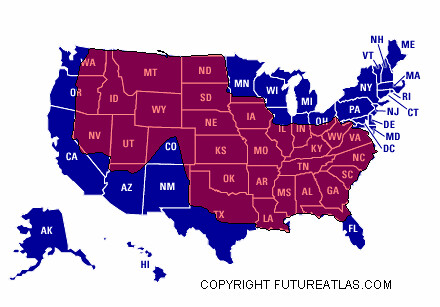
Future Americas? 
Location: Desk, gloating a bit about George Allen's defeat

Image rights (share with attribution) by futureatlas.com


I can sum up my attitude toward today's Republican Party with some comments left in response to a column by David Brooks of the New York Times. Brooks  critiqued the "hyperindividualist" ethos on display at the Tampa GOP convention, but he also critiqued today's Democrats as lacking an agenda. My remarks follow.

My NYT Response

I thought, at one time, that Governor Romney might have offered disenfranchised moderates like me a way back to voting GOP, as I did faithfully for John Warner and other men and women not beholden to the extremists and corporate money.

With the rise of the anti-logic, anti-science, and and anti-everything Tea Party and American Taliban that make up the GOP base today, I suppose it only natural that they'd consume an ambitious man like Romney.

For those like me, who favor both a strong military and strong environmental laws, who consider climate change to be the greatest threat to civilization since the rise of Nazism and the Soviet Bloc, who would confront the Islamists forcefully while fearing any mingling of church and state, what's left?

Certainly not today's GOP. Today's Democrats look, however, more like the GOP I once respected: an agenda to fix our environmental problems, invest in education and research, be forceful but pragmatic in geopolitics.

Where's the lack of agenda there? If Obama has failed--and I fear he has--it has been through the Limbaugh/Rove strategy of blocking everything, even what were once GOP ideas.

The President should have cracked heads, but instead he played the historic role of the nice black man. Pity. We need a head-cracker in such times.

The Way Back to GOP Relevance

So much for what I said in answer to David Brooks. The GOP took a modest pounding, not so much in terms of the popular vote as in their failure to capture increasingly important slices of the voting public: the young, the female, the non-white, the educated, the urban. Today, in USA Today, a disappointed fellow Virginian who is a "prepper" says he plans to stock up on ammunition before Obama outlaws all the guns.

As a fellow firearms owner, I find this laughable. But these same aging white rednecks ran out in 2008 to scoop up so much ammo that stocks ran low.

If the GOP wishes to survive in  a changing America, they need to, in no particular order past point one:
  • Recognize the existential threat of human-influenced climate change and propose a response, with lots of free-market focuses, on curbing it. Denial is no longer an option.
  • Work to enact a Constitutional amendment to undo the People United decision. I have some bitter, better feelings about that one. If I could, I would amend the Constitution to permit only publicly financed campaigns for all national offices. They would begin in October of an election year. Candidates would either be chosen by party-member votes in a nominating convention or in state primaries with a one-month campaign, again publicly financed, before the vote.
  • Apply a Libertarian philosophy to social issues that are matters of individual religious beliefs, such as gay marriage or the nutty idea that the earth is only 6,000 years old.
  • Champion government support for R&D in new industries and high technology while fighting for on-shore manufacturing that will empower those without college degrees. Modern manufacturing requires advanced skills such as computer programming, so support for our community colleges and vocational schools becomes essential.
  • Recognize that fossil-fuel-based "Energy Independence" is a myth that both parties embrace. Wind and solar will never replace dirty fuels in our lifetime. Investment in energy conservation, building a reliable and speedy, if not high-speed, rail net powered by electricity will be a start. Natural gas, produced by the dubious practice of fracking, may buy us 30 years to make a transition to new sources of energy: both candidates talked about 100 years of gas, but clearly they don't read the geologists who write for The Oil Drum.
  • Return to principles of small government that empowers small business, not major corporations who reduce payrolls by outsourcing.
  • Ramp down the military-industrial complex by mothballing half of the Nimitz-class carriers to replace those that retire after 2020. Aggressively develop AI for unmanned combat aircraft and reserve military force to protect only our most vital interests. 
  • Reinstate the Glass-Steagall Act, to put a firewall once again between consumer and investment banking.
  • Turn away the racists. A tragedy of Virginia politics is that George Allen, the former governor whose racist "Macaca" remark, leading to a revealing YouTube video that cost him his Senate seat in 2006, could once again be nominated to run. He lost, but that Allen would even be considered today shows how bankrupt modern conservative thinking has become.
If Conservatives wish to survive, they should read more David Frum and David Brooks and James Fallows. Leave Limbaugh, Coulter, Donald Trump, and their ilk behind in the cave, and move ahead.  Will they? I doubt it, and as James Howard Kunstler has often noted, the GOP seems destined to join the Whig Party in the dustbin of history. I differ with him only in his prognosis that "[Hurricane] Sandy was a kind of preview of coming attractions for a different sort of wreckage to come." We still have time, and we may end up poorer and humbled from changes to our economy and climate, but Tuesday's results show that a plurality of Americans still want what Obama, and not the GOP, offers.

Wednesday, August 29, 2012

A Killer App That Killed iPhone for Me

Location: Verizon Store

image credit: screen capture from Google Streetview, on my campus near Westhampton Lake.


I'm not a gadget boy, but soon I'll make the shift from a flip-phone to a smart one.

And it won't be an Apple product. Why? Google Street View.

When Apple, for perfectly logical reasons, dropped Google Maps from their iOS 6 plans, they dropped me. I tend to by loyal--fanatically--to the Mac OS, and I'm a long-time hater of stodgy, backward Microsoft (Kinect and their fabulous two-button USB mice excepted).

As a tech user, there are some features that I refuse to abandon, and Street View is one of them. I have used it when traveling abroad to find a car-rental place or hotel that I'd never have found in the maze of York, England's medieval streets. Before Street View, I once walked to the wrong town looking for my car, just outside Bath. After Street View, I led a bunch of friends directly to the right restaurant in Istanbul, London, New York City, and San Francisco. My e-mail to Apple reads:
I am about to get my first-ever smart phone. My wife loves her iPhone 4, but without Street View being integrated into the OS tightly, Apple has lost me as a customer. I'm a 20+ year loyalist to the Mac OS, but I'm drifting away with iOS.

Just a word of advice to the geniuses at the Genius Bar: give me back Street View...now.
So yeah, it matters, Apple. I don't want to have to leap through three hoops to get Street View. I want it instantly, when I click on an address. The Phone app on the iPhone does that so well, with a "call" button in Google searches on Safari.

Instead of working with a competitor or launching a bunch of Apple vans to canvas and photograph the planet (how DID Google manage that?), Apple gives us a "flyover" view that won't help me find a restaurant or business from a human's-eye perspective.

Make my new phone an Android, please, Mr. Verizon Man. And if you show me a Windows Phone, my next post here will be written from jail after a headline reads "Professor arrested after stomping on crappy phone from stodgy company late to party where they never innovated anyway."

But Google? Bring  it on.


Sunday, July 8, 2012

Abandoned Tech: The Saturn Rockets

Location: Day-Dreaming about a 1985 Mars base

image source: Encyclopedia Astronautica's entry about the Saturn V rocket

What might have been, had Richard Nixon been a different man, possessing an optimistic vision that matched his calculated-but-brilliant realpolitik demonstrated by the opening to China and the bombing of Hanoi's government to the negotiating table.

I've been thinking of this occasional series since I began shaving with my grandfather's safety razor. It still works great and costs me very little, months into my experiment. Now I own two of these antique Gems (the trade name that fits well). They demonstrate that corporations seeking new markets often over-engineer products and make dubious claims about their improvement. I wish government could do better, but history shows otherwise when it comes to manned space travel.  Odd for me to propose such flights of fancy. I call myself a Neo-Luddite, though as one friend pointed out, I'm better described as a "Reform Luddite" more interested in appropriate technology than in getting rid of technology or curbing its use drastically.

I hope to explain why this Neo-Luddite thinks the US needs its manned program badly, and why it needs NASA for the sort of deep-space ventures that both Presidents Bush and Obama championed.  Both Presidents had NASA contractors scramble to re-invent something we gave up nearly 40 years ago: a heavy-lift rocket suitable for deep-space exploration.

When Nixon canceled the last three missions of the Apollo program, it put the world's most effective--then or now--space transportation system on its way to the scrap heap.  It's a myth that the Saturn V rocket's plans were scavenged from NASA dumpsters, though as Dwayne A. Day noted, records were lost or destroyed along the way. In any case, once the assembly lines for the Saturn IB and V shut, engineers moved on, and the tooling got dispersed or scrapped, there was no practical way to rebuild the mighty F-1 engine or other components without reverse-engineering from a museum piece at huge cost.  Rocketdyne did, as Day notes, save their records and record information from Engineers involved in the F-1 program. Much of the rest of the Saturn, however, would not meet modern standards for alloys and other technologies. A similar rocket today would weigh less and have the benefits of computer-assisted design. That's my hope for Dragon's proposed heavy-lift rocket.

But what if Saturn and its mighty engines had stayed in production, to be incrementally improved or parted out to new NASA and private vehicles?  Most of the pieces for a Mars mission were in place by 1970.

Boeing, in 1968, studied the technology needed to go to Mars by the mid-80s: a Nerva nuclear third stage lofted into orbit by a Saturn V, followed by assembling a Mars spacecraft there. Instead, we got Skylab, then an expensive and tragically flawed pickup truck to low orbit called the Space Shuttle.

Our nation badly needs unity now, and my optimistic side favors a multi-year mission scientific mission to Mars, using the International Space Station if possible to assemble our Mars ship, all this with the aim of resolving the questions about past or present life on the Red Planet. Such a program, paid for by deep cuts in defense spending and, yes, more debt, would have pay-offs in the hiring of technicians and engineers whose work would develop the sorts of spin-off technologies that came from Apollo, including the small computer on which I am writing this post.

We need deep space missions, not merely planting the flag but searching thoroughly and with tools greater than those carried by the Martian rovers. Finding out if we are alone or not in our solar system would, I'd hope, make the texting masses look above the horizon again. NASA's lead can help private industry follow, not to do science but to pioneer, as the pioneers came in the wake of Jefferson's expedition to the Pacific.

And if profit is to be had in space, profit that requires humans to live there, the masses will do more than look up.

They'll go there and we'll become an interplanetary species.


Wednesday, June 27, 2012

Like Jilted Lovers?

VWER_120614_008  
Location: Virtual Worlds Education Roundtable

image credit: Grizzla Pixelmaid at Flickr


I forget who at one of our VWER meetings told AJ Kelton, aka AJ Brooks, that he acted like a jilted lover when Linden Lab fired its education team and hiked our tier prices. But the simile is apt for me too; it explains some of our community's enthusiasm for Cloud Party, noted in my last post. There's not much at Cloud Party yet. When you cannot sit on your new couch, that shows we have a ways to go. But the will to "go" is there.

Slowly but surely, my own wonder and love for Second Life drained away. For students it was too hard to learn, too slow to use on wireless and their laptops. For me, it meant 200 hours of development for The Virtual House of Usher, a project that we ran a few classes through before my co-developer lost his job, our island closed in SL, and I needed to move on to other pursuits.

I get as much credit, and probably more, in my annual review for a published article. I could have written a few in those 200 hours.

Some of the reaction by SLers trying Cloud Party's new virtual world is predictable: soured on Linden Lab's mismanagement of a once-revolutionary online space, we either wish to punish the Lab or simply try some competition that is easier to master than the largely DIY spaces of OpenSim grids.

At our most recent Roundtable, I found myself spouting these words:

"I have come to hate Linden Lab and don't want them taking my money any more." You can read the rest of our exchange here in the transcript.

I did not get crucified by the assembled educators for saying this. Few SLevangelists were present, so the remarks were civil as we discussed what "special sauce" SL still has. The answers? Good content and community.

Linden Lab is repsonsible for neither of these. Stability, a third common answer, is their doing, but Cloud Party offers that one already with only a few weeks since they opened their world in open beta. The other two will follow.

So how can a firm such as Linden Lab win back our trust? To continue the romantic simile, they cannot or cannot in any span of time worth noting. If we look for exceptions in the history of technology, there is one.

It took decades for Detroit car makers to woo back those jilted by their crappy 1970s cars.

Linden Lab did not sell us a Chevy Vega or similar lemon. It sold us a lovely but doomed Corvair Monza and refused to listen to customers who bought into that dream or decided that they really wanted a Mustang instead. Recent efforts, such as Linden Realms or Wilderness, brought only yawns from our group of educators.

Clearly, Linden Lab lacks Detroit's time and government support. If Cloud Party flops, it's just a start-up firm, but Linden Lab's failure would make big news, even in media outlets that have at best sniggered, and mostly ignored it, since 2008.

Sunday, March 25, 2012

Technologies Overengineered, Ruined, or Abandoned: An Occasional Series

Location: Staring at the Shaving Mug

I'm getting ready to shave again. Some time ago, I switched from an expensive and over-engineered Sensor razor to my grandfather's 1920s Gem Micromatic razor.  I wrote about my reasons here and I still love it. With only one small nick in two months of fun, shaving has again become a manly and pleasant ritual, not a forgotten act as I prepare to do other things or--shudder--try the rapid task-shifting that some mislabel "multitasking."

Given the lack of news about virtual worlds, other than that reported well by other bloggers, and my lack of teaching there, I'm going to diversify the blog again.

I'm looking at an idea that James Howard Kunstler has popularized for a while, one that preceded my meeting Jim and getting caught up in his ideas. Jim is about to publish a new nonfiction book about the diminishing returns of technology. The idea of technologies done well and then forgotten has long captivated me, though I suspect that my Neo-Luddism has taken a different and more tech-friendly turn than Jim would make.  Both of us agree that "new" does not always mean "improved."

I plan to cover, in the next few weeks, several technologies that have been, in my opinion, perfected but then "improved" further or worse still, abandoned.  Here are some candidates:
  • Apple's iMovie software
  • The Saturn I and V rockets (you know I can't resist space stuff)
  • Light local rail networks of the 20s-60s
  • The fast-food restaurants of the 1950s and 60s
  • The Leathermantm Pocket Tool
  • The returnable-bottle soft drink
  • DeWalt and Porter Cable power tools, after Black & Decker acquired them
  • The Volkswagen Jetta TDI, Honda Civic, and Mazda 3 series.
I have personal experience with all but the Saturn rockets (pity!), Honda, and Mazda (near pity!).

My series will be opinionated (go figure) and open to critique and amendments. 

Got some other candidates for tech done well, then messed up or left to rust?

Tuesday, February 14, 2012

Ballardian Fate for Virtual Spaceport?

Apollo 11, 40 Years On  
Location: Spaceport Alpha

I'm a space-program junkie...I wanted to see a Kubrick-style future like that of 2001 so badly that it afflicted my childhood.  Those who are not what Eric Strobel calls "Children of Apollo" and remember our young American gods in space suits cannot imagine the sadness of seeing humanity withdraw into the inner spaces of our networks and, yes, "places" like Second Life.

Update for 2/16/12: I located Strobel's article from SpaceDaily about those whose early impressions were profoundly shaped by the Space-Race years. Today we Children of Apollo "are uneasy; feeling vaguely cheated that the nation that went from Kitty Hawk to Tranquility Base in a single lifetime seems likely to go no further in their lifetimes. This sense of uneasiness is aggravated by the distinct potential of a less-than-mediocre future."

Now a virtual tour of that elusive future, SL's Spaceport Alpha, is threatened with closure. I loved sending students there, but part of me knew that these were not the technological dreams of their generation. Kudos to Hamlet Au for running this story, but he's a techno-optimist. I'll pour some Neo-Luddite tea for readers about this.

The potential closure moves me in some profound ways because it rubs an old wound. Since 1969, being a space-junkie has been a lonely addiction. I do not believe that government programs will give us that long-heralded "Third Industrial Revolution" and the Space Age is, in fact, in its final act. As a Peak Oiler, I fear that we won't be able to travel 100 miles easily on earth in 100  years, so going even 100 miles up will become a whispered legend.  The International Space Station will deorbit, the Russian and Chinese programs wither as energy crises consume all our ingenuity. Meanwhile,  climate change will bankrupt us even as it wrecks our coasts.  I don't think the US will ever, in my lifetime, build a new launch system beyond, perhaps, a few initial missions. Congress, public apathy, and national bankruptcy will see to that.

It might have been different, with solar-power sats and asteroid mining in the 1980s, had Americans not lost their reach. But we did. We might have made money up there and opened that final frontier. We are left with comsats and sub-orbital space tourism, plus a space station that is little more than a floating janitor's closet for the folks who service it while doing little useful science and no exploration at all. The wonderful unmanned missions carry the torch of exploration, but they do little to make us a spacefaring race living on many planets. This is the goal all Children of Apollo share.

And even Space tourism? So far it is a stunt for the wealthy....despite Richard Branson's good intentions, it remains bungee-jumping in a private rocketship. One lost rocket and it will end, too.

I hope that the fate of US space artifacts--physical proof that we are pygmies after an age of giants--is not as squalid as that of our old Russian enemies. Their space shuttle complex, storing the Buran orbiter, collapsed in 2002 after budgets for maintaining the building vanished. Under snow load the huge building came down and obliterated the relics of that project. What remains of the complex for building space shuttles now? "The former orbiter manufacturing plant was reportedly converted to produce buses, syringes, and diapers." (from an Aerospaceweb article).

Syringes and diapers.

Unless we get that long-awaited signal from space that shows us that we are not alone in an indifferent universe, I recommend a new monument in Second Life.

We need a J.G. Ballard "Memories of the Space Age" Museum, with decaying shuttles lashed to rusty gantries that sprout Spanish Moss.

Until I see humans climb to the heavens in any number, I fear that our space fever-dreams will prove as ephemeral as those of Spaceport Alpha. Our current techno-fetishism of thumbing our little phones is, compared to the Big Science of the 60s, pitiable.

It involves a downward glance, not the horizon-defying gaze of the rocket men.
To quote a Gordon Lightfoot lyric, "the Space Shuttle ends where the subway begins. There's a tear on the face of the moon."

I heard that in the 70s, reading it as a lament for the end of Apollo. And now we may lose the first virtual monument to that Golden Age of space travel. So, ISM, as the book jacket for the Arkham House edition of Ballard's Cape Canaveral stories proclaims, "Hail and Farewell!"

Friday, February 3, 2012

Notes from the Trough of Disillusionment

Location: Down in the Valley So Low

Next Friday, I agreed to give a short presentation to faculty colleagues in a learning community focusing on new technologies.

My topic: "3d Virtual Worlds: Down in Gartner's Trough of Disillusionment"

Here are a few notes from a Blackboard page I created to guide our discussion. I do plan to log into Second Life and OpenSim during our meeting, as well. At least two of the group tried SL and were not impressed with the platform, for one or more reasons I'll list as detrimental to the spread of virtual worlds.

Readers, what am I missing? I'd love to hear your perspectives on this. My notes follow, except for links to content in SL and other grids worth seeing (from Virtual Ability and Genome Islands to the WW I Poetry Sim and my Usher Project).

All links below will open in new tabs/windows.

The sector for public 3D virtual worlds has fallen into the Gartner "trough of disillusionment" since Fall 2008, just as the global economy teetered on the brink of total collapse. In what follows, I offer some reasons and resources, based on my five years of work in Second Life and OpenSimulator virtual worlds.

Here is their 2009 "Hype Cycle" snapshot:

http://www.gartner.com/it/page.jsp?id=1124212

In 2011, while other technologies advanced, the Gartner authors concluded that "virtual worlds remain entrenched in the trough after peaking in 2007."

For Second Life in particular, several factors hurt:

  • High pricing for content-hosting without offline backups. Linden Lab, SL's maker, ended 50% discounts for education and non-profit customers in October 2010, at which point Richmond left SL.
  • A competing open-source alternative, OpenSimulator (or OpenSim), often hosted locally on campus servers and capable of URL-type linking to other campuses or corporate projects through a technology called Hypergrid.
  • The difficulty of the SL user interface and the steep hardware requirements of the client.
  • The stability of the virtual world and the need for frequent client upgrades (both largely resolved today).
  • The relatively slow pace of empirical evidence for teaching effectiveness in immersive 3D environments. Ironically, this has emerged in 2010 and 2011, but by them many campuses had decided to focus more on mobile technologies and social networking for teaching. Many with an investment in virtual worlds moved to OpenSim instead.
  • A perception that the environment was too "gamelike" for serious learning. SL is more of a "sandbox" that permits user-generated content, including games. One can more easily make the case for using SL in education than, say, World of Warcraft. Ironically, "gamification" is a buzzword for emerging educational technologies in 2012. Was SL too early?
The SL brand's reputation for social and adult-rated usage did hurt, but this proved the least of the problems for my classes. My students encountered SL's X-rated culture and giggled. I made them sign waivers to avoid adult content unless 1) it was after class and 2) they were not representing themselves as members of the UR community. One or two students did research on "relationships" in SL, but they age-verified to be able to go to adult-zoned parts of the virtual world.

What Virtual Worlds still offer, despite their learning curve:
  • A way to build simulations at low cost. I could not make a ruined Victorian mansion appear on campus for my House of Usher simulation (see below).
  • A way to interact for virtual conferences in an embodied way. I do not find teleconferencing and 2D applications such as Elluminate as engaging for participants. SL encourages all participants to become active, in my experience from the weekly Virtual Worlds Roundtable and the annual conference, Virtual Worlds: Best Practices in Education.

Tuesday, January 31, 2012

Neo-Luddite Reflections on Razors and Shaving Nerds

 Location: Becoming an Aqua-Velva Man

Although I made a great leap forward a few weeks ago, by disconnecting our land line and getting a cellular phone, I compensated by becoming a throwback in matters of personal hygiene.

No, I still bathe and brush my teeth daily. I mean shaving: I reverted to my grandfather's Gem Micromatic safety razor, after misplacing my Gillette Sensor two-blade. For some time, at the prompting of another friend who questions technology on a daily basis, I was considering "going retro" with my shaving. Moreover, I got angry over the war of escalation in price and numbers of blades per razor (it's spawned a parody of Moore's Law: 14 blades / razor blade by the year 2100!). I dislike electric razors, having used one for nearly a decade in and after high school.

So it was back to 1920 for me. I'm also skilled with my grandfather's razor (a pristine version is pictured here); in his last years, I shaved him weekly with it, causing nary a nick. And for 30 years I have used his shaving mug and a brush, after finding shaving creme expensive and wasteful.

Being a thick-bearded man of Lebanese descent, I wear a closely cropped beard and have done so for--gasp--33 years. I only shave my throat and cheekbones.  This reduces nicking, but I was unprepared for the excellence of a technology nearly 100 years old. Simply put: nothing modern touches a good blade in a safety razor, excepting a straight razor that I won't dare try even with my steady hands.

As usual, an innocent interest of mine lands me in the midst of fanatical collectors. All things nerdy spawn Web sites, so I give you:
I think I'll be buying a second "travel" razor, given that my daily is a family heirloom. Somewhere in the afterlife, my dad and grandfather, clean shaven of course, are having a good laugh and saying "what is the matter with you, boy? You crazy?" Dad was a typical "new and improved 20th Century guy." "Old" meant "toss the damn thing out," to him. My grandfather was more like me, questioning why things change just to make more money for a company already producing a well designed, effective product. But even he would laugh at me for being so sentimental about an everyday object that had served him well for many decades.
No, this is not some trend, in my case, spawned by Mad Men. It's the return to an appropriate and sustainable technology after Gillette made shaving ludicrous and most gear has become disposable.  You may have noticed that some stores lock down their razor blades to prevent theft. At a dollar per cartridge, it's easy to see why. Single-edged blades are just as sharp, last longer without clogging, and cost half what a Sensor razor blade ran me.

Shaving has become fun again. It's more of a mindful and meditative ritual now, which is what using technology should be, in my opinion, to keep one from taking it for granted. I'll soon have a '65 Mustang ragtop back on the road, an old favorite car of my wife's, and from driving her other classic, a '68 Chevy C-10 truck, I can tell you: you do not multitask with antique technology. Eyes on the open road or your precious throat.

Besides, old-school shaving has all the doo-dads that make antique technology so fascinating: I love wiping the blade clean amid the wafting scent of aftershave, as I prepare myself for the daily grind. I had stopped using aftershave, but now, with such a close shave daily, it refreshes my skin. Moreover, when shaving with antiques one must pay attention to the razor or risk a cut. I'm very good at it, but the focus is zen-like: hai karate!

Well, back to slapping my cheeks with Aqua Velva and repeating old jingles that my truck-driver father used to belt out on our road trips:

Ladies jump from fire escapes
To get away from hairy apes.
Use Burma Shave!

That's not quite the historical slogan, but it was good enough for me to kindle a life-long interest in the manly art of a good, close shave.

Friday, January 20, 2012

Kodak, iBooks, and a Day We Should Recall

Location: Crux of history

Yesterday's technology news featured two events worthy of an annual commemoration: the Eastman-Kodak bankruptcy filing and Apple's announcement of its iBook initiative.

Both show how corporations can prepare for changing times...or not. Kodak, inventor of the first digital camera, did not market it because the impact would be disastrous to their film-based model. It provides yet more evidence why Tim Wu's model of "disruptive technologies" often get suppressed in the name of profits. Fuji and other companies adapted to changing times and Kodak proved late to the game.

Apple, the champion of technological comebacks, took a different route ever since Steve Jobs' return to the firm. Every iOS device released was lambasted, at first, by mainstream reporters. Jokes about the iPad in particular were sharp and pretty darned funny, to this observer.

Unlike Kodak, however, Apple took a long view of how the devices might disrupt their sales of traditional computers, always far behind those running Microsoft's OS. Yet with less to lose, perhaps, Apple could gamble big on the future of digital content. I got angry at Apple, not long ago, over the iPad. It seemed to be Jobs' "up yours" moment to Mac loyalists.  Now, the post-Jobs Apple plays the two computers as one system: create content on the Mac, show it on the iPad. Apple still won't put Flash on the iPad, but so far I'm happy with their device.

And with the textbook announcement, they realized something I had said for years: the printed textbook is obsolete. Publishers rush to release new and expensive editions that students must lug about and then resell at a loss. These paper texts lack multimedia. My analogy for this is a botany text I own and love: the printed and $100 version can have color plates from a cloud-forest in Costa Rica or the Great Barrier Reef. The online version would have live video-streams from Webcams and embedded video demos.  It would cost $20 and not be able to be resold.


Kodak wanted to sell you a roll of film. Apple wants to sell school systems an ecosystem: cheap iPad with publisher-vetted content that cannot be resold. Brilliant.

Why did publishers wait so long? Apple took the systemic and long view, while Eastman Kodak sat on innovation.

And thus empires rise and fall.

Personal PS: we disconnected our land-line phone yesterday, for good. Of all days! I do have a dumb phone, while my more social wife got the iPhone. Call, and I may get back to you. Eventually.

Friday, January 13, 2012

US Citizens: Time to Act on SOPA and PIPA Legislation

Location: Real State of Concern

If you think the Digital Millennium Copyright Act hurt the Internet as we know it, I urge you to look at what the Electronic Frontier Foundation has to say about two bills currently before Congress: PIPA and SOPA.

Read more and write your legislators through the EFF here. This is sad and serious business: user-generated content, as we all know it, could just vanish.

Wednesday, December 7, 2011

Virtual Worlds A Distraction? A Reply to Jon Himoff

Cast Pic 
Location: Reading Jon Himoff's Blog From The Ivory Tower

It has been a while since I've written about Rezzable's work, but I came across a post by Jon Himoff, the CEO, in which Jon asks,

"In the age of Facebook, do avatars add value or are they time-consuming distractions?"

I replied at length at his blog, but I'd like to repeat what I said here.

I'd argue that Facebook is more likely the distraction...students rarely, on my campus, use social networking for course-work. Avatar-based virtual worlds, on the other hand, provide an unparalleled ability to build simulations, Jon. Ask the US Army about MOSES, for instance.

Having just finished a final exam project in an OpenSim grid, my class loved the exerience because they were helping to shape what future classes will do. 15 of my 17 students opted for the OpenSim exam/improv session, and they had fun and learned more about the subject matter by seeing it, and more importantly, interacting with it, in 3D.  A number of observers have noted how users don't mind less-than-photographic verity in online games. We don't need "serious game" level graphics if Millennial students understand how the experience links to goals and outcomes in courses. Every demographic study of that age-cohort showed exactly this finding.

That was always the promise of something like Rezzable's Virtual King Tut experience. It saddens me that you moved on from a great bit of work that never got the marketing it merited.

Virtual worlds are a niche technology, not one for corporations to fatten the profit line. But that's not the mission for institutions of higher ed. We are in the business of helping students develop critical-thinking and content skills so they'll be better citizens and employees (in that order). I'd agree that the technology was over-hyped mid-decade, and many educators rushed in themselves, without clear pedagogical goals.

As the decade continued, and Internet use meant students using mobile devices, the niche continued to be ruled by firms with gaming and I.T. experience. Educators in the niche, however, began gaining skills to develop and deploy virtual worlds locally or in hosted settings. The emphasis could then shift to how to apply best practices to teaching, instead of how to make the tech stable. Truth be told, as with Web 1.0 and 2.0 sites, in a few years we won't need corporations to help or even host the content.

But then, many specialized apps on campuses work that way. Virtual worlds will be but another of them. They may never be mainstream, but that's not important. Mathematica and GIS software are not mainstream, either.