Showing posts with label Hype Cycle. Show all posts

Tuesday, October 29, 2024

Why the Hype Cycle Does not Quite Work For Generative AI

Gartner Hype Cycle Graphic

(Not) The Same As It Ever Was

Many years (!) ago, I wrote here about why the Virtual World Second Life had followed, fairly well, the Gartner Group's well known "hype cycle" for new technology. Follow the link here to read about the history of the concept.

I'm reminded by Wagner James Au of New World Notes that other virtual worlds such as Fortnite and Minecraft have thrived, and indeed, have seen some good use-cases made for education.

At the same time, I don't hear of anyone at Capitol One's hive using virtual worlds. We don't see links from Office 365 or Google Workspaces to a virtual world. I have a sense that AI is a different animal for these worker bees and their daily applications, as well as my own students.

I do know a freelance graphic designer who lost her primary client to AI work; the client outsources graphics to AI run by semi-skilled staff in-house. My friend has moved on to ramp up her greeting-card business. That may color my skepticism that AI is a "fad," as Second Life clearly was.

SL and Gartner

I joined the virtual world in 2007, and yes, I was foolishly an enthusiast. Since I believe in being forthcoming about personal mistakes, I recall telling my students investigating this Strange Land that "you will all have avatars in a few years, for work!" I let slip the same to some colleagues, one of whom aid "you never met a technology you didn't love!"

Cringe. 

I'll own being horribly wrong. Prognostication is a dicey thing! A silly image I cobbled together years ago shows the evolution of Second Life avatars (namely, my own, Iggy). At the same time, my update to the old image points toward a new direction in desktop and mobile computing that we all felt, a decade ago, to be far over the horizon.

Various Second Life Versions of the Author plus an AI writer in the year 2024

For many reason, including the difficulty of building simulations, a clunky interface, heavy system requirements, even poor management by Linden Lab, Second Life began a descent from what Gartner calls a "Peak of Inflated Expectations" in 2007.

By 2012 Second Life was well into a "Trough of Disillusionment." As early as 2008 I sensed that the media-party was over. A year later, I cited three factors working against academic use in a post here: Lack of rewards and incentives for faculty, the time needed to master the interface and content, Linden Lab's vacillating leadership and policies, the presence of what I and my students called "the creepy treehouse" of adult users doing sometimes naughty things.

In the for-profit sector, businesses that set up virtual storefronts in 2007 soon fled; a professor of Marketing I helped get started found SL fascinating, but after interviewing in-world merchants, she put it plainly: for brick-and-mortar firms, there's little return on investment in Second Life.

SL continues to be a large virtual world, with better graphics, promises of a new physics engine, and a dedicated base of users, but it did not become a daily experience on the job or at school. The Hype Cycle proved accurate. This has happened before: stand-alone creative hypertexts such as Michael Joyce's afternoon also map onto the cycle, though never regaining the popularity they enjoyed in the 1990s or even a steady base of users. Creative hypertexts appear to have faded utterly.

When a colleague in our campus digital pedagogy cohort claimed that generative AI would follow the same path traced by Gartner, I bristled because this time I feel that Gartner's model does not fit what I am seeing, daily, among students.

I could be wrong if a series of issues afflict AI. So let's compare the Second Life experience to that of generative AI:

The Browser

SL was never browser-based, even as a plugin, unlike the easy-to-master Unity 3D interface; AIs are built already into tools we use daily or can be queried from any Web browser.

Client v. Server Side

SL has high client-side requirements, whereas AI puts the burden on the server farms; these use enormous amounts of energy that my students and colleagues only recently started to notice, with all the inherent dangers related to sustainability.

The Interface 

SL has a difficult interface, employing menus worthy of an entire operating system and arcane coding options, whereas Gen AI's query features resemble (for now) those of a familiar search engine but with natural-language input. 

Platform Independence

SL and AI both work on multiple operating systems, but SL has never worked well with mobile devices; AI is baked into many apps now, with some Google searches automatically invoking Gemini results and Apple promising Apple Intelligence in their next phones. 

Creepy Treehouse

 SL has adult content that troubled my students; the guardrails we increasingly see with AI tend to keep users (sometimes clumsily or incompletely) from making Napalm or pornography.

Investment Sources

Investment in SL comes from individual users at this point; AI attracts venture capital, user subscriptions, and big-tech investment (Apple, Microsoft, Meta, Google).

Source of Growth in Academia

Faculty and campus-technologist curiosity spurred interest in SL; student use erupted for AI spontaneously in the Fall of 2022 and remains very strong. 

A Shaky Prognosis

To be fair to Second Life, system load has largely remained steady in the last decade. In my recent experience, I can run SL and a third-party client called Firestorm on my MacBook using no more than my phone's hotspot to connect to the world. That's astounding progress.

I don't foresee any of these differences posing a stumbling block for AI, leading to a Trough of Disillusionment, save energy use. We have a climate crisis; the last thing we can afford as a civilization would be to ramp up emissions of Carbon Dioxide.  

Yet if Moore's Law continues apace, we'll see AI reap rewards of lower power use because of more powerful processors in the servers that run it. Any disillusionment is likely to be temporary and its "trough" quite shallow.

For these reasons, I don't see the Hype Cycle apply to Generative AI in the same way as it has to several earlier technologies. I may be wrong, but for now Gartner's model does not fit it well.

Image Sources: Wikipedia Commons for Hype Cycle.

Thursday, May 3, 2012

Mobile: Shiny? Yes. Hyped? Yes. Fad? No.

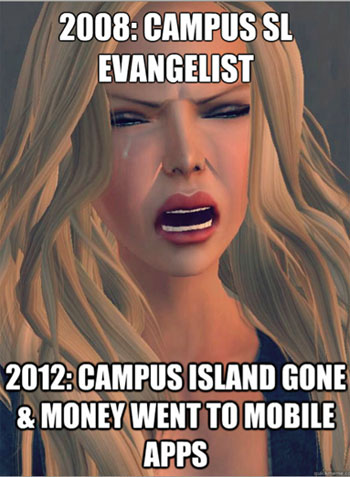
About the image: Got your own SL meme? Thanks to Hamlet Au for alerting us to this hilarious meme. Have a crack at adding your own caption here.

Location: Before My Crystal Ball

The other day at VWER, a colleague who should know better claimed that tablet-based computing is a fad on campus, the newest and shiniest object for technologists and administrators. I disagree, even though I have long resisted using a tablet.

This summer, my work will focus increasingly on mobile. I'm not going completely back to Flatland. I'll be finishing some work on Usher, both at SL and Jokaydia Grid, given that I might run the simulation again in the Spring of 2013. Yet I'd be nuts to devote much time to these platforms, given the energy generated by the technology that students and colleagues are actually using already.

It's something of an apples-to-watermelon comparison, when looking at virtual worlds and mobile computing. That said, I remain convinced that SL in particular is a "legacy app" because of its limited return on investment. Readers of this blog may have to get used to a few new directions here, but I'll continue to cover my and colleagues work in virtual worlds.

As for this post? I don't think the SL evangelist is teaching on an actual campus today. Here's why.

Reason 1: Students have mobile hardware on them 24/7

When Second Life was being hyped in mainstream media, students were not carrying technology, by and large, that ran it well. As I noted as early as my first class with SL in the Spring of 2007, if an application did not run well on wireless and on a laptop free of an AC adapter, it might as well not exist for students.

In the five years since, that gap has widened as SL and the promise of public virtual worlds remain down in the Trough of Disillusionment. Gartner analysts predict 5-10 years for mainstream adoption.

Meanwhile, after diving in to the Trough in the 90s, e-readers began climbing out. Media tablets are past the Peak of Inflated Expectations, but they remain two to five years from mainstream adoption. Part of that involves standards. No one knows who will dominate the tablet wars that are surely erupt as Windows 8 devices roll out. I don't really care, as I'm still a novice even with my iPad 2. Microsoft has deep pockets and, despite my disdain for their OS before Windows 7, they can build great hardware; my MS two-button mouse is King Mouse, even when I compare it to the sleek Apple cordless I use at work.

Even as tablets begin to jockey for market share, the mobile experience has gone from students' ways of contacting each other socially to the default device for using the Internet. These devices are already "always on and always on you," to quote from Sherry Turkle's Alone Together, a text I'm devouring on my iPad. One after another student tells me, in brief e-mails sent from iPhones, that their laptops are being reserved for times when they have to "type a paper." That means Word, and that means print.

I'll blog more about the reading experience on a tablet later.

Whoever gains (or in Apple's case, maintains) dominance and establishes the standard matters less to me than the fact that SL and OpenSim do not run well, if at all, on tablets.  Unity 3D does for iOS and Android. I cannot make content for that platform yet, and may never do so, but I'd like to try my hand at exploring others' work.

Concurrent to all this churn, we are  moving to tablets on our campuses for consuming media. If Moore's Law holds true, these devices will become better and better at creating content.

One does not wish to be on the wrong side of history, and I think SL evangelists are clearly on the wrong side, unless they are early in their careers and have a Plan B for research and teaching.

Reason 2: Mobile apps directly relate to classroom work

Save for simulations, as I've noted at length here, there are few compelling reasons to use a virtual world of any sort in the classroom. Many of us don't even need a "world" for a class: we need one or two sims and good content.

The bigger world of SL helps this teacher only insofar as it gets me together with colleagues to share ideas. For some social-sciences or writing courses, I could see the advantage of studying a lively online culture, though IRB reviews could be a nightmare for publication. For language classes, live contact with speakers of other languages would be good.

Otherwise, why DO we send students in-world?

For mobile technology, especially e-texts and note-taking apps, the advantage in a classroom setting, traditional, online, or hybrid, are immediate. Students need not lug heavy books to class, work, or bed. The devices link them directly to research sources. Virtual worlds, in comparison, are clumsy add-on apps that do not play with other applications well. Hence the notecards, LSL minefields, database failures, and other peculiarities that keep VWs from becoming mainstream in the near-term future.

Meanwhile, students working with a colleague in Physics are walking around campus at night and pointing their iPads at the heavens. On their screens, Sky Safari. It is intuitive and easy and can be done on the prowl with our campus wireless. Don't try that with a virtual world.

Reason 3: "Fast, Easy Fun"...We got it wrong before

We will all have characters in MOOs. We will all study literary hypertext. We will all have avatars in immersive 3D virtual worlds.


We'll all pilot flying cars on our commutes, too.

None of these technologies were easy for mainstream users. Some were fast, and to me all of them could be fun.

Remember Linden Lab's marketing push a while back, given Philip Rosedale's pitch that SL should be "Fast, Easy, Fun"? Hamlet Au nailed the challenges Linden Lab faced then. I would claim, based on my experience in OpenSim, that the challenges are even higher for mainstream faculty.

Not so for tablets and smart phones. They are fast and easy. Changing apps is a lot easier for a noob like me than was changing my outfit in SL.

And used judiciously, they are fun.  Too many users are addicted to them, but that's beyond a faculty member's control.

Mobile devices as "Flavor of the Month"? Hardly. More like "future main course."