Showing posts with label Apple Computer. Show all posts

Tuesday, May 7, 2013

Deformed: Virtual Worlds & 1970s Computing History

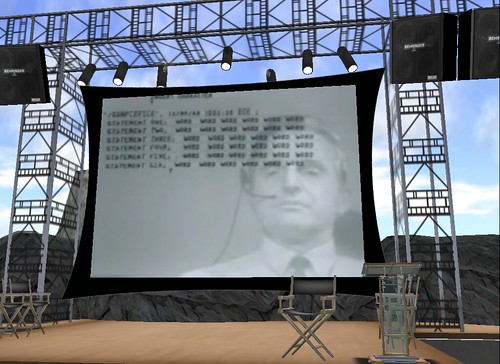
Mother of All Demos
Location: Watching Douglas Engelbart's "The Mother of all Demos"

image credit: New Media Consortium at Flickr

Many of us who have dabbled with virtual worlds have wondered how they could form a constellation of networked systems, in much the same way as the Internet's servers do today. Whatever the fate of this niche technology called virtual worlds, from the failure to run on mobile devices to the inherent boom-bust cycle of Second Life's particular brand, the road not taken always beckons.

There is an historical precedent here, and it's one that has a happy ending. Could the same be true for virtual worlds?

Today's Internet: Clarke's Law in Action

For a moment, consider the complex and delicate magic that occurs whenever we use the Internet. My university server talks fine to Google, for work such as the just-completed Usher project. Whenever the Outlook mail client randomly eats student file attachments sent to me, I smile. Ah, Microsoft's wonderfully Byzantine and wonderfully doomed, technology, eating even its own Word files. Cue Apple and Google, as the Ottomans on the horizon, slowly gobbling up a once mighty empire.  Good riddance.

Then, because of the lack of monopoly that Microsoft coveted and almost got, I have the students try, try again with Gmail. Excede's servers send me the results and, once I type, transmit my thoughts--profound or inane--from home travel via satellite to Google.  When I send notice of this post to interested folks at Twitter or Facebook, the servers hosting that data all "talk" to one another.

Types of Gardens and a World-Wide Web, 1975?

Compare that to virtual worlds technology, ostensibly part of the Internet since that is how we access it. Second Life, InWorldz, and many others that share core technologies could, in theory, speak to each other. Had development not branched off as it has done, Linden Lab and a few other grids might have pioneered a system for avatars and inventory to travel from world to world.  That happens with OpenSim Hypergridding, a technology that John Lester promoted, before his work for Reaction Grid turned to Jibe-based 3D worlds.  But "interoperability" died years ago at Linden Lab, and it seems unlikely to return.

It's curious, this set of walled gardens. If today the Internet resembles Borges Garden of Forking Paths, Virtual Worlds resemble something else: the road taken in the 1970s toward personal computing.

I realized that while reading John Markoff's What the Dormouse Said, a history of early computing got influenced by the American Counterculture:
When personal computing finally blossomed in Silicon Valley in the mid-seventies, it did so largely without the history and research that had gone before it. As a consequence, the personal-computer industry would be deformed for years, creating a world of isolated desktop boxes, in contrast to the communities of shared information that had been pioneered in the sixties and early seventies. (179)
The Internet did not begin with Al Gore, whatever he may have claimed. It did not begin in Jobs' family garage and with Steve Wozniak's brilliant hardware hacks. It did not begin at Xerox PARC with the Alto. The personal computer with a GUI and mouse? Yes, we can credit or blame Xerox and Apple for that.

But years before, nearly every element of the modern Internet would have been possible with the Augment system, developed under the leadership of Douglas Engelbart. Yet that development stalled and ended, a revolution stillborn.  I think we can see an analogue for what is going on, at this cultural moment, with user-generated virtual worlds.


Engelbart's Mouse

Want to see what might have been for the Internet? I am convinced that had something like Augment  been made less opaque for casual users, we'd have had an academic, and perhaps consumer Internet in 1975. Engelbart gave a show-stopper of a demo in 1968, with mouse, text-editing with clipboard and copy/paste, multiple files, graphics on screen, electronic mail, hyperlinks tagged to graphics, and remote visitors via a network.  You can see what he was doing with Augment at these videos from Stanford.

The reasons for Augment's failure are complex; Markoff's book does justice both to the creator's vision and his ultimate failure to produce a widely adapted product.  What happened, however, for consumers was the emergence of walled gardens and proprietary systems from Apple, Microsoft, Digital, Tandy, and other competitors forgotten except by historians of technology.

When the Internet emerged, it came late to a culture of desktop boxes that could not, generally, talk to one another.

What if the personal computer revolution had begun with networking? And similarly...

What if Virtual Worlds Had Begun with Interoperability?

I'm writing an article about one group of USENET hobbyists who have made the jump to Facebook, because the old .alt group proved too chaotic and full of spammers, trolls, and other bottom feeders. They also made the leap because, frankly, .jpgs and text import and export well between applications. Text did in Engelbart's day.

Little aside from these, plus Collada files and some other graphic formats, can move between different virtual worlds.  Standards for inventories, for avatar meshes, and for "land" templates are different. In this technology landscape, OpenSim grids serve as today's Augment. Managing a bunch of avatars and a region in OS is hard to master, not stable in my experience except in the hands of a pro, but interoperable. Running an entire campus-hosted grid would be lovely, but it's beyond my time or expertise to learn.

Other products with potential beyond SL's technology, such Unity 3D and Jibe, produce elegant worlds, but they don't talk to other worlds and expert designers need to craft objects. They do offer vast potential, according to OpenSim pioneer Adam Frisby, for scaling, running on mobile devices, and improved grahics.

That sounds great until one considers faculty skills-sets and what it takes to build with Unity or Jibe. As noted  before in this blog, developing for these platforms may be within reach for architecture and engineering students, but at my university, it's challenge enough to get students to juggle multiple e-mail accounts and embed files from YouTube into their blog posts. We faculty lack time and incentives to do more with them, let alone learn 3D applications such as Maya or Blender.  Yet nearly all of us at my school have created content, mostly with text and images and sometimes digital video, and shared it on the Internet.

For all its limitations and toxicity as a brand, Second Life and, lets amateurs with a copy of Photoshop build easily. I'm told that Cloud Party does too, and I will soon try again with Cloud Party's latest build tools. Scripting remains something for those not faint of heart and projects to make visual scripting tools, such as MIT's Scratch for SL, remain as stillborn as Augment.

What it will Take to be Disruptive

Here comes a sweeping generalization, and I'm ready to fall on this sword if some wise person can prove me wrong. Virtual worlds will never be a disruptive technology, in Tim Wu's sense of the term, until they become an interoperable and popular tool for everyday life, as the Web and e-mail have become.

Had virtual worlds begun with a series of collaborative academic ventures rooted in common standards, rather than a group of for-profit start-ups from The Valley, we might have that disruption and a 3D Web today.  Then the profits would follow, because in 1968, who could have foreseen eBay or Amazon or Facebook?

Right now, however, it's still 1968 and we've all seen the potential of a disruptive technology, as those who watched Engelbart's presentation did.

So today, who will build the 3D Web?


Saturday, February 2, 2013

The Phone Book's Here! The Phone Book's Here!

Location: Front Porch

Verizon's phone book landed on the porch a day or two ago, and only this morning did I get around to unwrapping the skinny little thing. It's like the Ghost of Phone Books Past, to this techno-Scrooge.

In another era, the arrival of the new edition would cause quite a flutter. Misplacing the phone book was also unthinkable. They were not easily or cheaply replaced, and my father guarded it like the Dead Sea Scrolls. In an otherwise chaotic Lebanese-American household, the phone book held court on the telephone table. Nowhere else.

Now phone books are incomplete and small. Verizon banishes residential listing entirely to a Web page, a crowning irony since most of the land-line stalwarts I know are so old that a broom provides the interface for web access in their homes.

Once, however, the phone book provided all sorts of diversions. I've three degrees of separation from musician Frank Zappa, but only one from his phone book. A grad-school friend named Rick, when living in Los Angeles, once had the job of delivering the huge directories to the homes of the famous and crazy in that star-studded town.

At one address, he was ringing the bell when a hippie "who looked like a madman" stuck his fuzzy head out of an upstairs window. "What the hell you want?" he challenged Rick.

"Phone books!" Rick replied, and the hippie's face brightened and he came running, shouting "Oh man! The phone book's here! The phone book's here!" Rick quickly found out he'd delivered Frank Zappa's phone book.  Lord knows what chemically enhanced games were played with the directory.  I know that my friends and I played geeky games of generating random names for role-playing games by picking, in the I-Ching manner, examples from the phone book and mixing examples from white and yellow pages. Names such as "Lorenzo Plumber" or "Scrap Metal O'Malley" resulted, to our geeky delight.

Now the I Ching is online, so I asked of it "What is the fate of the phone book?" With six casts of the stones, I received this answer:
"Waters difficult to keep within the Lake's banks: The Superior Person examines the nature of virtue and makes himself a standard that can be followed. Self-discipline brings success; but restraints too binding bring self-defeat."
History of technology there? Tim Wu's The Master Switch, the text just completed in my course on The History, Culture and Future of Cyberspace, is all about those who establish standards for an entire industry, like Bill Gates, though not just for themselves. Some geniuses such as Steve Jobs foresee needs we don't yet have, and they push others to and past the breaking point to make the vision real and the consumer's need materialize.

In the era of mobile technology, where most of my students carry area codes from faraway lands, there's no sense in a phone book. Discipline is needed, however; my students get so lost in a web of constant texts and other inputs that they do not give sufficient priority to e-mail about classes, and they suffer as a result.
 
So as be blunder forward, without much direction or a good directory, into this connected era I will miss the nigh-sacred tome on the "telephone table" in my, and perhaps Frank Zappa's, dining room. 


Or, perhaps, another room in his hippie mansion.

Wednesday, August 29, 2012

A Killer App That Killed iPhone for Me

Location: Verizon Store

image credit: screen capture from Google Streetview, on my campus near Westhampton Lake.


I'm not a gadget boy, but soon I'll make the shift from a flip-phone to a smart one.

And it won't be an Apple product. Why? Google Street View.

When Apple, for perfectly logical reasons, dropped Google Maps from their iOS 6 plans, they dropped me. I tend to by loyal--fanatically--to the Mac OS, and I'm a long-time hater of stodgy, backward Microsoft (Kinect and their fabulous two-button USB mice excepted).

As a tech user, there are some features that I refuse to abandon, and Street View is one of them. I have used it when traveling abroad to find a car-rental place or hotel that I'd never have found in the maze of York, England's medieval streets. Before Street View, I once walked to the wrong town looking for my car, just outside Bath. After Street View, I led a bunch of friends directly to the right restaurant in Istanbul, London, New York City, and San Francisco. My e-mail to Apple reads:
I am about to get my first-ever smart phone. My wife loves her iPhone 4, but without Street View being integrated into the OS tightly, Apple has lost me as a customer. I'm a 20+ year loyalist to the Mac OS, but I'm drifting away with iOS.

Just a word of advice to the geniuses at the Genius Bar: give me back Street View...now.
So yeah, it matters, Apple. I don't want to have to leap through three hoops to get Street View. I want it instantly, when I click on an address. The Phone app on the iPhone does that so well, with a "call" button in Google searches on Safari.

Instead of working with a competitor or launching a bunch of Apple vans to canvas and photograph the planet (how DID Google manage that?), Apple gives us a "flyover" view that won't help me find a restaurant or business from a human's-eye perspective.

Make my new phone an Android, please, Mr. Verizon Man. And if you show me a Windows Phone, my next post here will be written from jail after a headline reads "Professor arrested after stomping on crappy phone from stodgy company late to party where they never innovated anyway."

But Google? Bring  it on.


Friday, January 20, 2012

Kodak, iBooks, and a Day We Should Recall

Location: Crux of history

Yesterday's technology news featured two events worthy of an annual commemoration: the Eastman-Kodak bankruptcy filing and Apple's announcement of its iBook initiative.

Both show how corporations can prepare for changing times...or not. Kodak, inventor of the first digital camera, did not market it because the impact would be disastrous to their film-based model. It provides yet more evidence why Tim Wu's model of "disruptive technologies" often get suppressed in the name of profits. Fuji and other companies adapted to changing times and Kodak proved late to the game.

Apple, the champion of technological comebacks, took a different route ever since Steve Jobs' return to the firm. Every iOS device released was lambasted, at first, by mainstream reporters. Jokes about the iPad in particular were sharp and pretty darned funny, to this observer.

Unlike Kodak, however, Apple took a long view of how the devices might disrupt their sales of traditional computers, always far behind those running Microsoft's OS. Yet with less to lose, perhaps, Apple could gamble big on the future of digital content. I got angry at Apple, not long ago, over the iPad. It seemed to be Jobs' "up yours" moment to Mac loyalists.  Now, the post-Jobs Apple plays the two computers as one system: create content on the Mac, show it on the iPad. Apple still won't put Flash on the iPad, but so far I'm happy with their device.

And with the textbook announcement, they realized something I had said for years: the printed textbook is obsolete. Publishers rush to release new and expensive editions that students must lug about and then resell at a loss. These paper texts lack multimedia. My analogy for this is a botany text I own and love: the printed and $100 version can have color plates from a cloud-forest in Costa Rica or the Great Barrier Reef. The online version would have live video-streams from Webcams and embedded video demos.  It would cost $20 and not be able to be resold.


Kodak wanted to sell you a roll of film. Apple wants to sell school systems an ecosystem: cheap iPad with publisher-vetted content that cannot be resold. Brilliant.

Why did publishers wait so long? Apple took the systemic and long view, while Eastman Kodak sat on innovation.

And thus empires rise and fall.

Personal PS: we disconnected our land-line phone yesterday, for good. Of all days! I do have a dumb phone, while my more social wife got the iPhone. Call, and I may get back to you. Eventually.

Wednesday, October 5, 2011

Goodbye Steve


Location: Mac keyboard

You were my favorite megalomaniac.

Robert X. Cringely said it best: If Bill Gates were George H.W. Bush, Steve was Saddam Hussein. He didn't want to be a rich country-club boy: he wanted to rule the f'ing world.

That I can respect.

They'll pull my Mac out of my cold, dead fingers. I'd give up my Springfield M1911A1 .45 caliber first. The Mac is far more dangerous.

God had better watch out. Or Satan. Either way, inside of six months, Steve, you will be running the place.

Don't forget all the PeeCee weenies I converted to use a superior OS, Steve, after your Second Coming. Be it heaven or hell, I want a job in the hereafter.

You were insanely great--love you or hate you, or both--you changed the world.

Friday, August 12, 2011

Grandpa's Box: My Thoughts on the Future of Our Computers

Location: Using Obsolescent Computing Tool

I don't know how many of my friends among Second Life's digerati are in contact with young people on a daily basis. I am, and I am stunned by how fast they are abandoning the personal computer.

The other day, I got a briefing from a Writing Consultant who works for me. She reviewed our Writing Center Web site and, while polite and praising the content, noted that the organization is all wrong for a student audience. "I no longer use my laptop," she admitted. "The iPad is my primary computer."

Much of our content, developed over many years and going through a vetting process with several bureaucratic levels, is all wrong.

It has happened with hyperdrive speed, this shift.  We are not an engineering or arts school: our students reflect typical affluent users.

Should I cheer at this funeral?

Iggy in the Confessional Booth, Before St. Steve


As a Mac-OS fanatic, I take no comfort in Apple's victory with portable devices. Windows-users, we are in the same boat, because the iPad is no Mac. Or Windows PC.

It's the anti-Mac, or better still, the final realization of Steve Jobs' dream of 1984: a sleek and closed-down platform with an elegant interface, but where one pays a price: Apple controls every damned thing. The iPhones and iPads are also hip examples of industrial design, just as the Mac of 1984 was no bulky (and sturdy) IBM PC of the sort I then owned. The IBM was for office-clones who had reluctantly given up their Selectric typewriters. The Mac was for artists and freaks.

It was a machine with a personality. Over time, it acquired a soul after Jobs' hammer-lock on hardware design was yanked away. Except for Extensions conflicts before OS X. But we won't go there...Jobs' "second coming" swept away the Old Order.

Jobs is a man with Olympian ambition and an insanely great idea or two: his ideal factory would take trucks of sand in one end and ship out computers at the other end. He wants to own the whole system. Henry Ford was smiling from plutocrat-heaven when he looked down at St. Steve.  Tim Wu understands this well in his book The Master Switch. Wu takes some well aimed swipes at Jobs.

Sorry, Steve. I really adore your OS, but I'm thinking of backing Google with an Android purchase. And--horrors--I think I'll be playing Mass Effect on an Xbox 360.

Confession #2: I'm going to buy that in several months, mostly to play the latest Mass Effect.  Let's give the Devil his due; Microsoft kept their corporate wet-blanket culture off the gaming division, and out of that we got the Kinect.

Trouble for Granda's Box

My "Nerd-Night" tabletop RPG group consists of one Mac-guy (me) and a bunch of Windows-based gamers who get away from their MMOs to go "old school" and roll some d20s. Some of them own console games, but not a one uses a smart phone or tablet.

They are dinosaurs as surely as I am. They don't get why the next generation of computer users are eschewing desktop systems for portable devices. I, on the other hand, get it.

Millennials want to always be in touch with their hive. They need self assurance and confirmation of their choices, and they do their social planning on the fly. That's impossible from a tethered desktop or even a laptop. I've yet to see more than a scattering of students use a laptop outside, as university promotional photos often show. Instead, they compute as they walk across campus. Give them data glasses that look just like sunglasses, and they'd use them too. Just don't make them stop, even for a nanosecond.

I recently had an epiphany that the wider culture is also getting it when I saw this Scott Adams' cartoon.

Dilbert.comMy buddies and I are Dilbert. My students, the young fella.

I don't know how Apple's closed system will fare against the Android OS from Google. Poorly, I secretly hope. But as a Microsoft-hater, I am also pleased that Windows will be the biggest loser of all. The company, except for its Kinect, has been no innovator in recent years. Was it ever? Steve Balmer has the cool-factor of Dilbert.

Whatever our desktop OS, I think we old timers with our grandpa boxes will look back at the System Wars of the 1980s and 90s with nostalgia. Like many other hobbies I embrace, from model-building to boardgames about World War II, the rest of society has moved on and I'm in this eddy of forgotten time.

I see a future in which content creators will use powerful computers in some form. The rest of the public--the consumers--will want to be close to the Machine. Machines as easy to use that they are ubiquitous, a part of our bodies.

It's what Sherry Turkle of MIT has called "always on, always on you" technology. Get ready for it.

But I still don't own a cell phone...my "dumb phone," a pay-as-you-go model, expired in April.  It won't be missed.


Monday, January 17, 2011

Apple Without Steve?

Location: Reading Tea Leaves

Apple's die-hard faithful probably let out a collective moan today. Steve Jobs' decision to take medical leave sent shivers through not only computer users but also the entire stock market.

I wish Mr. Jobs a speedy recovery and a long life. While the man has been accused of draconian management practices, he did help usher in the personal computing revolution. Even if Steve Wozniak was the engineering genius behind the early Apple computers, Jobs' marketing brilliance made graphical user interfaces and the Cult of Apple happen.

It was a different sort of company from the upstart PC makers of the early 80s or the stumbling and arrogant behemoth that was IBM in that decade; if the competition consisted of geeks, Apple seemed run by artists and madmen of the sort I enjoy meeting for drinks.  I could imagine Apple's people chatting up the fire-breather and magician in San Francisco's Vesuvio, one of planet Earth's best bars, after shopping for poetry books at City Lights. IBM's folks would be (massive yawn) golfing with senators. Microsoft's people would show up at the bar and try to look hip, all the while looking like khaki-and-polo-shirted  tourists.

But I digress: my preference for bohemians over boring business and I.T. types is not news, but perhaps this is exactly how Apple fooled chumps like me into thinking the firm hip and not merely a very clever marketing idea wrapped around some elegant and useful technology. It sure snared cultural creatives as fanboys, to market the company's products to friends. I'm sure I convinced a dozen folks to try the Mac OS over the years. Not a one screamed at me later, a testimony to how well our Macs did, and do, work.


More Than Macs: How Apple Did "Think Different"

The history of the firm relates quite well to ideas from my class on the history of Cyberspace. Jobs will be remembered, when he leaves this planet to compare notes with John D. Rockefeller and Howard Hughes, in one of two ways.

First, Apple's CEO might be what what Tim Wu in The Master Switch calls a Defining Mogul.  That will be the case if Apple's closed system for handheld computing comes to dominate the future of Internet use.  You will get what Verizon, AT&T, and Apple decide you get to see or do. And I agree with Wu's well supported "central contention....in the United States, it is industrial structure that determines the limits of free speech" (121). I suspect this revelation about the first amendment applying to Congress, as in "Congress shall make no law..." and not to employers or ISPs, surprised my students as much as it did me.

On the other hand, if an open system dominates, Jobs might be recalled as a would-be monopolist who failed, despite a miraculous comeback in the late 1990s. I'm not sure which future I want. I used to fear Microsoft. I was hoping Macs would remain boutique systems for picky people like me. I also prefer German cars or pre-1973 Detroit Muscle. They are fancy fun, but they both run on our roads with boring cars. If my Mac could work with the sea of boring Windows boxes, what harm that?

Now, however, I am beginning to fear Apple.

My ownership of a handful of Mac systems since the dark years of the mid 90s shows how well they hold up. Our household iMac G5, now six years young, will soon enjoy a long retirement as our DVD player / media box for downloading films. Some child in Alaska is probably still using the G3 iMac I shipped up there, years ago, after an eBay auction.

Inside the latest iMac, however, there's a story that goes to the heart of Jobs' vision for Apple.  Unlike its predecessors, the new iMac's CPU has no user-serviceable parts aside from upgrading the RAM. This has long been Jobs' favored tactic. If the Apple II of Wozniak's day invited tinkering, the first Mac in 1984 became its antithesis: to open the case was the void the warranty!

Apple has played this push-pull game with its hardware since that time. As a tinkerer, I found this exasperating as my friends using Windows or Linux would build computers out of spare parts and make them do cool things.  Nowadays, however, we old geezers with desktop boxes are giving way to the iEverthing generation, who carry their devices around incessantly and don't tinker. It's about the app, not the device, to these kids. And Jobs--who not only could recognize but also create markets--knew this best of all.  The Mac's established niche among school teachers and artists and graphics designers and video professionals and crazy professors is, after all, somewhat limited. Apple did not even try to top Dell's game in Henrico County, where the middle schools will give up their Macs soon for PCs, just as the high schools have done. Though the Macs last longer and are more robust when dropped by little kids, Dell offered a better price on service. Apple declined, I suppose, betting that kids with iPhones and iPads will eventually want Macs, anyhow. Or that iPads might replace laptops in schools, and with the right Verizon contract Apple would best anything Dell could offer.

The educational discount, I just noticed, for the iMac I am considering comes to all of 100 bucks. It was once twice that. Second Life folks...does this sound at all familiar?

This reality suits Steve Jobs fine: his portable devices, selling in volumes we Mac zealots could only dream of in the late 1990s, are closed in ways Job could never manage with the Macintosh in any form.  We'd pry them open.

Try that with an iPhone. Maybe you have better eyesight than I do. Besides, even if  you do that, Apple's revenue-stream will switch from selling you a $2000 iMac (high end: I like my computers pimped) to selling you a $200 phone with a long-term contract that includes a cut for Apple with each App you buy and, I'm guessing, a bit of the monthly take that goes to the ISP carrying your data.

That's a sweet deal for all the corporations involved.

Consumers might not care, as long as the service is reliable, but as with AT&T before the 1984 breakup, with the iOS Steve's firm can dictate which apps appear, or do not, on the system. The Mac OS lets you write software; its relative openness, based on its UNIX underpinnings, compared to Windows has been great for those who had the skill to develop applications.

But What if Steve Loses (Again)?

Jobs lost the desktop market to Microsoft because he could not see what Bill Gates saw: that the software was the key to market saturation, even good-enough software. Most Windows users wanted the apps, and they could care little about the OS as long as it worked. I know that described me when I used Windows 3.1, 95, and 98 before making the Mac OS my primary system.

Could Jobs make a similar mistake today? As Google becomes more and more a competitor for the iPhone's and iPad's apps market, Apple could repeat its 1980s blunders. At the same time, it has some advantages it never had then.  Moreover, might Google  be forced into a more closed system? As I explained to my class today, Google must use the same broadband "tubes" (thanks, Sen. Stevens) to move data to one's computer or phone.

I'd feel better if I could get an Android OS tablet (what I'm waiting for) with service from any of dozen ISPs. Perhaps if some new and distruptive wireless service emerges, offering FIOS-level speeds without a cable, we could have 100 Verizons or Comcasts vying for our telecom dollar.

But in my region, it will be AT&T and Verizon carrying the data. As long as principles of Net Neutrality continue to hold for these big telecoms, in theory iPad / Phone competitors could run most anything and undermine Apple's closed-but-reliable model for access to content online.

If that happens, someone will have stolen Apple's message from the famous "1984" advertisement. I offer it here in case my students have never seen it:


I'm hoping for this outcome, even if it means that in a few years, I'll lose my Macs as Apple fades away (again). Maybe for my main computer I'll be running an admittedly sleek Sony Vaio with a Google OS on board and I'll have lots of options, including synching data with a tablet or smart phone. Maybe I'd even make peace with the old bogeyman, Microsoft. Windows 7 and clunky compared to the current version of the Mac OS, but it is the first version of Windows in a long time that I find compelling and rather intuitive.  Perhaps on a really tricked out machine...

Either way, if I can open the computer's case and change the hard drive out or upgrade the processor, better still.

Wednesday, June 2, 2010

Why an iPad is Not in My Future (For Now)

Location: Valley of Uncertainty

Okay, it's not about the price. This is one thing that Apple did get right with their new toy. I will always pay a bit more for Apple hardware because, in my experience, it holds up longer.

My dozen Macs, with one exception since 1998, have been bullet proof. I have encouraged at least a dozen others to purchase Macintoshes since 1998, when we got our “gumdrop” second-generation iMac. It ran for six long years, after a processor upgrade, and a student in an Alaska middle school is still using it.

The iPad hype should make a Mac zealot like me happy. To quote from a Bloomberg story, Apple, “the computer maker turned mobile gadgeteer,” has reached a plateau I never thought I would see, in the mid 90s when I defiantly stopped using Windows. The company “overtook Microsoft Corp. to become the most valuable technology company on optimism the company will keep adding customers for its iPhone, Macintosh computer and iPad.”

Maybe not for this Applehead. I have to admit that while the iPad is a seductive gadget, it’s not yet what I want: a device that lets me collaborate with others, live, using “the cloud,” which to me means Google Docs and Flash support.

At that very moment, I read Steve Jobs’ Tweet that “The future of computing isn't Apple versus Microsoft. It's Apple versus Google.”

In my house, the future of computing is collaborating with others. And Apple’s antipathy to Google, the venue for my collaboration, makes it seem a lot more like the Microsoft I have so long ridiculed as arrogant and single-minded, even when doing so hurt it.

The failure to support Flash on the iPad encouraged NBC and several other content providers to state that they will not be converting their content for Apple’s tablet. From a story at the New York Times:

“With support for Flash in both the upcoming Google TV platform, as well as in Google's Android mobile operating system (an OS that's now outselling Apple's iPhone), Google is making it clear that for the time being, the Web still needs Flash.”

Find the rest here.

These decisions will be a terrible mistake for Jobs, akin to his botches with the Macintosh lineup in the mid 80s, just before John Sculley replaced him as CEO and became the fall guy during Apple's long twilight. Now it just might happen all over again.

If Google can produce an e-reader the size of the iPad with Flash support, I’ll be buying it, not Apple’s offering. Given the success of the Android phone on the market as well as Google Books presence, such a device would be a small step for Google to take. There’s a twist to this story. On Twitter, a parody page claims the following as Jobs’ bio:

“I don't care what you think of me. You care what I think of you."

How true. This is the world of Steve Jobs. For now, however, the iPad aura seems just another radiation from the famous "reality-distortion field" that he projects. He disdains the very customers who have kept Apple afloat, introduces products that he considers insanely great, then moves ahead.

So far, he's mostly been correct. I keep buying Mac hardware even though I think that some offerings, like the latest version of iMovie, are poor when compared to its predecessor. Apple selectively removed features, apparently to encourage content creators to pony up for Final Cut Pro. So far, I've not done so. I also canceled my mac.com account and switched to Bluehost.com as my site-host because Bluehost offered better Web hosting, lower prices, and the ability to edit content with my own software, not Apple's extremely limited templates.

Even considering such gaffs, Jobs’ company has long been an innovator, unlike Microsoft. Bill Gates’ and Paul Allen’s brainchild was superb at making their OS “good enough,” then leveraging their products and establishing a standard for desktop computing, especially in the business world. Microsoft could afford to be arrogant for many years. Apple cannot, because now they have another competitor that is as innovative as they have been: Google.

In education Apple hung on to market share, as it did with creative professionals. That second category seems secure, for now, but education has not exactly gotten the red-carpet treatment from the House of Jobs. My wife’s school system, Henrico County, is gradually switching to a Dell contract, because Dell was flexible with prices for laptops and service. Apple was not. Ten years ago, Jobs flew to Richmond to give a speech to the teachers to trumpet the county-wide laptop initiative with the original and second-gen iBooks.

Aside from Google’s threat to Apple, Microsoft is far from out of the game. Windows 7 is really strong, jettisoning the bloatware of Vista. Some of Henrico's older Dells limping along with Vista will work far better when they are re-purposed to run 7.

Jobs does not listen to customers like me, but here's my take. Sometimes having a better product, as I believe Apple does for hardware, the OS, and for media applications, is not enough. Thus the lightweight tablet in my future may run Windows 7 or Google’s Android OS. I’ll need such a device for a big trip in 2012 that will feature a running set of posts , and by then the iPad may have evolved into something I’d buy. Or maybe not.

Like you’d care, dude, if I dared to “think different.”