Showing posts with label virtual worlds. Show all posts

Sunday, December 29, 2024

AI: Sorry, You May Not Always Sit at My Table

No Robots Sign

Ethan Mollick's book Co-Intelligence is a dangerous document. There, I said it. We read the text for our campus digital pedagogy cohort for Fall, 2024, and at first I was quite excited. The book promises to provide guidelines for wisely adopting AI, yet from the get-go I had issues with the author's less-than-critical acceptance of generative AI.

Let's start with Mollick's four, and seemingly absolute, rules for working with AI:

  1. Always Invite AI to the Table.
  2. Be the Human in the Loop.
  3. Treat AI Like a Person (But Tell It What Kind of Person It Is).
  4. Assume This Is the Worst AI You Will Ever Use.

I'm not much trouble with these save for number 1. I've been reading Wendell Berry, a techno-selective if ever there were one, and I am pretty certain how he'd react to generative AI: Hell no.

Why? Mollick's rule number one flatly violates Berrys notion about adopting new tools.

It also flies in the face of what Howard Rheingold, reporting for Wired eight long years before the iPhone 1 debuted, found out about the Amish. In "Look Who's Talking," he describes how the Amish approach any technology. They experiment to see if it violates:

a body of unwritten but detailed rules known as the "Ordnung." Individuals and communities maintain a separation from the world (by not connecting their houses to telephones or electricity), a closeness to one another (through regular meetings), and an attitude of humility so specific they have a name for it ("Gelassenheit"). Decisions about technology hinge on these collective criteria. If a telephone in the home interferes with face-to-face visiting, or an electrical hookup fosters unthinking dependence on the outside world, or a new pickup truck in the driveway elevates one person above his neighbors, then people start to talk about it. The talk reaches the bishops' ears.

Thus the Amish man who recently had a long chat with me about the virtues of PEX-based plumbing systems. He, like other Amish (and me) are techno-selectives, not utter Luddites.

Rheingold's piece had an enormous intellectual influence on me. It made me wary of new tools, though I admit falling without reservation for virtual worlds. I've come to regret that uncritical acceptance of a technology that not only fails the test above but also fails with a clumsy UI and poor use-case in education.

Maybe in consequence, I grew wiser about smart phones, doubting the corporate narrative from the start; today, mine is nearly always off. I don't use it much for one social media platform, less so for texting, have silenced all notifications, and never at all watch time-killer videos. Pop culture generally seems too ephemeral for my remaining years on the planet, and I don't want to discuss TV shows with friends. If something looks non-violent and well written, I still wait years before watching a series, methodically. 

Influencers? I find them in books. Berry is one. I bought heavily into the concept with which Rheingold closes his piece, "If we decided that community came first, how would we use our tools differently?"

I don't consider online community, including virtual worlds, much of a substitute for the real thing. Even gaming with old friends on our Monday Nerd Nites seems a pale shadow of a good in-person meeting. Only recently I began to read Berry, and he corroborates much of what Rheingold discovered.

So for Mollick's rule one, I plan to say "no" a lot. What do we gain by always using AI for any intellectual task? In Berry's 1987 article "Why I Am Not Going to Buy a Computer," he lays out nine rules for adopting a new tool:

1. The new tool should be cheaper than the one it replaces.

2. It should be at least as small in scale as the one it replaces.

3. It should do work that is clearly and demonstrably better than the one it replaces.

4. It should use less energy than the one it replaces.

5. If possible, it should use some form of solar energy, such as that of the body.

6. It should be repairable by a person of ordinary intelligence, provided that he or she has the necessary tools.

7. It should be purchasable and repairable as near to home as possible. 

8. It should come from a small, privately owned shop or store that will take it back for maintenance and repair.

9. It should not replace or disrupt anything good that already exists, and this includes family and community relationships.

Generative AI fails most of these, in particular anything to do with localism and energy use, but number nine reminds me of the unforeseen outcomes of ubiquitous mobile telephony: families in restaurants, not looking at each other, all intent on their screens and being somewhere else. That would seem perverse to anyone of my parents' generation or earlier.

So how do we NOT give into Mollick's notion that we must always bring AI to the table, dinner or otherwise, even without a good use case? I plan to be writing about that in the new year as I continue researching AI's role in the writing process, where I do cautiously let it have a seat.

Image by Duncan Cumming on Flickr

Saturday, January 25, 2014

Cloud Party, We Barely Knew You


Location: Prognosticator's Chair

I never spent much time in Cloud Party, though Cyn Skyberg did reach out for a phone interview about the potential of the virtual world for education.

I was my usual glum self about the future of user-generated virtual worlds: I told Cyn that if CP didn't run on mobile devices well, my students would roll their eyes and say "oh please. More busy work." If they could, however, explore the richness of a virtual world between texts and status updates (he says with a smirk) they might not savage me in class evaluations.

Despite my glumness, I still think the technology has a future, and Cloud Party impressed me. Now Yahoo has bought the company and will shut it down.

My glumness about virtual worlds also has a note of regret: I liked Cloud Party's browser-based world and freedom, as in Second Life, for normal humans without skills with Maya or Blender to make content.

What Yahoo does with the Cloud Party team remains to be seen. Yahoo is trying to survive in a hostile environment dominated by Facebook, Google, and Twitter as places where users spend lots of time finding or sharing content.  Perhaps Yahoo will launch games through its portal as Facebook has done well (including Cloud Party).

What an interesting week in the otherwise moribund world of user-generated virtual worlds. With Rod Humble leaving Linden Lab as CEO and Cloud Party running down the curtain, we'll see what comes next. Philip Rosedale has not, apparently, given up on the technology. His High Fidelity project looks like a reboot of SL's utopian promise.

So accuse me of wanting to believe. I don't need virtual worlds to socialize, but they rock for building simulations and DIY roleplaying. Here's to someone getting it right and making it a popular way to spend time!

Sunday, May 12, 2013

Commencement 2013: The Avatars Walk!

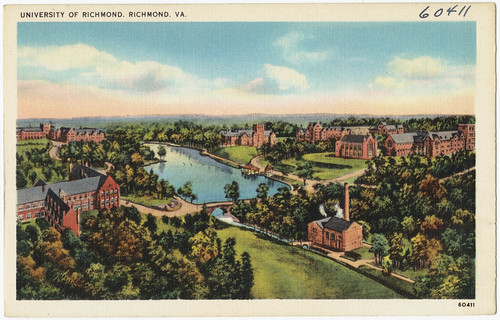
University of Richmond, Richmond, VA.
Location: Robins Center, University of Richmond

image credit: Boston Public Library at Flickr


I have reflected here before on the temporary and invented community that a college campus provides.

Today, my last group to use Second Life for an entire semester graduated. As a commencement marshal, I got to be up near the stage to help seat, direct, and congratulate our newest alumni. It's bittersweet to see them leave, as they were curious and interested students.

When I took my favorite walk of the year, from the ceremony back to my office to hang up my cap and gown, I thought about how time passes.  Today was wistful and perfect day, with light cloud, cool breezes, but warm-enough sun to remind us it is Spring in Virginia, the best time of all here. One colleague nearing retirement said to me "the years pass at first like telephone poles from a car window, then the pickets of a fence, then railroad ties."

As is always the case, the campus is boisterous near the basketball gym where the thousands of parents, staff, and students gather after the last diploma has been conferred. My walk in my academic robes takes me, in stages, further and further from those happy sounds and into the clear light of a quiet May afternoon. Soon the brick buildings--our campus looks like Hogwarts--loom in the clear daylight as if they'd been there for centuries.  Eventually all sounds, save those of Nature, are muted.

It's a ritual I never miss each year.

Next month, I'm going to return to my own alma mater's 30th reunion, partly because of the mark the education there left on me.

Thirty years!

Yes, in time in all becomes a blur. I suspect we'll all look back on the early days of virtual worlds that way, too, and say "that only seems like yesterday!" Moreover, I hope my students recall the strange experience of exploring SL as a possible future for communications, as they struggled to master the art of writing in academic settings.

Tuesday, May 7, 2013

Deformed: Virtual Worlds & 1970s Computing History

Mother of All Demos
Location: Watching Douglas Engelbart's "The Mother of all Demos"

image credit: New Media Consortium at Flickr

Many of us who have dabbled with virtual worlds have wondered how they could form a constellation of networked systems, in much the same way as the Internet's servers do today. Whatever the fate of this niche technology called virtual worlds, from the failure to run on mobile devices to the inherent boom-bust cycle of Second Life's particular brand, the road not taken always beckons.

There is an historical precedent here, and it's one that has a happy ending. Could the same be true for virtual worlds?

Today's Internet: Clarke's Law in Action

For a moment, consider the complex and delicate magic that occurs whenever we use the Internet. My university server talks fine to Google, for work such as the just-completed Usher project. Whenever the Outlook mail client randomly eats student file attachments sent to me, I smile. Ah, Microsoft's wonderfully Byzantine and wonderfully doomed, technology, eating even its own Word files. Cue Apple and Google, as the Ottomans on the horizon, slowly gobbling up a once mighty empire.  Good riddance.

Then, because of the lack of monopoly that Microsoft coveted and almost got, I have the students try, try again with Gmail. Excede's servers send me the results and, once I type, transmit my thoughts--profound or inane--from home travel via satellite to Google.  When I send notice of this post to interested folks at Twitter or Facebook, the servers hosting that data all "talk" to one another.

Types of Gardens and a World-Wide Web, 1975?

Compare that to virtual worlds technology, ostensibly part of the Internet since that is how we access it. Second Life, InWorldz, and many others that share core technologies could, in theory, speak to each other. Had development not branched off as it has done, Linden Lab and a few other grids might have pioneered a system for avatars and inventory to travel from world to world.  That happens with OpenSim Hypergridding, a technology that John Lester promoted, before his work for Reaction Grid turned to Jibe-based 3D worlds.  But "interoperability" died years ago at Linden Lab, and it seems unlikely to return.

It's curious, this set of walled gardens. If today the Internet resembles Borges Garden of Forking Paths, Virtual Worlds resemble something else: the road taken in the 1970s toward personal computing.

I realized that while reading John Markoff's What the Dormouse Said, a history of early computing got influenced by the American Counterculture:
When personal computing finally blossomed in Silicon Valley in the mid-seventies, it did so largely without the history and research that had gone before it. As a consequence, the personal-computer industry would be deformed for years, creating a world of isolated desktop boxes, in contrast to the communities of shared information that had been pioneered in the sixties and early seventies. (179)
The Internet did not begin with Al Gore, whatever he may have claimed. It did not begin in Jobs' family garage and with Steve Wozniak's brilliant hardware hacks. It did not begin at Xerox PARC with the Alto. The personal computer with a GUI and mouse? Yes, we can credit or blame Xerox and Apple for that.

But years before, nearly every element of the modern Internet would have been possible with the Augment system, developed under the leadership of Douglas Engelbart. Yet that development stalled and ended, a revolution stillborn.  I think we can see an analogue for what is going on, at this cultural moment, with user-generated virtual worlds.


Engelbart's Mouse

Want to see what might have been for the Internet? I am convinced that had something like Augment  been made less opaque for casual users, we'd have had an academic, and perhaps consumer Internet in 1975. Engelbart gave a show-stopper of a demo in 1968, with mouse, text-editing with clipboard and copy/paste, multiple files, graphics on screen, electronic mail, hyperlinks tagged to graphics, and remote visitors via a network.  You can see what he was doing with Augment at these videos from Stanford.

The reasons for Augment's failure are complex; Markoff's book does justice both to the creator's vision and his ultimate failure to produce a widely adapted product.  What happened, however, for consumers was the emergence of walled gardens and proprietary systems from Apple, Microsoft, Digital, Tandy, and other competitors forgotten except by historians of technology.

When the Internet emerged, it came late to a culture of desktop boxes that could not, generally, talk to one another.

What if the personal computer revolution had begun with networking? And similarly...

What if Virtual Worlds Had Begun with Interoperability?

I'm writing an article about one group of USENET hobbyists who have made the jump to Facebook, because the old .alt group proved too chaotic and full of spammers, trolls, and other bottom feeders. They also made the leap because, frankly, .jpgs and text import and export well between applications. Text did in Engelbart's day.

Little aside from these, plus Collada files and some other graphic formats, can move between different virtual worlds.  Standards for inventories, for avatar meshes, and for "land" templates are different. In this technology landscape, OpenSim grids serve as today's Augment. Managing a bunch of avatars and a region in OS is hard to master, not stable in my experience except in the hands of a pro, but interoperable. Running an entire campus-hosted grid would be lovely, but it's beyond my time or expertise to learn.

Other products with potential beyond SL's technology, such Unity 3D and Jibe, produce elegant worlds, but they don't talk to other worlds and expert designers need to craft objects. They do offer vast potential, according to OpenSim pioneer Adam Frisby, for scaling, running on mobile devices, and improved grahics.

That sounds great until one considers faculty skills-sets and what it takes to build with Unity or Jibe. As noted  before in this blog, developing for these platforms may be within reach for architecture and engineering students, but at my university, it's challenge enough to get students to juggle multiple e-mail accounts and embed files from YouTube into their blog posts. We faculty lack time and incentives to do more with them, let alone learn 3D applications such as Maya or Blender.  Yet nearly all of us at my school have created content, mostly with text and images and sometimes digital video, and shared it on the Internet.

For all its limitations and toxicity as a brand, Second Life and, lets amateurs with a copy of Photoshop build easily. I'm told that Cloud Party does too, and I will soon try again with Cloud Party's latest build tools. Scripting remains something for those not faint of heart and projects to make visual scripting tools, such as MIT's Scratch for SL, remain as stillborn as Augment.

What it will Take to be Disruptive

Here comes a sweeping generalization, and I'm ready to fall on this sword if some wise person can prove me wrong. Virtual worlds will never be a disruptive technology, in Tim Wu's sense of the term, until they become an interoperable and popular tool for everyday life, as the Web and e-mail have become.

Had virtual worlds begun with a series of collaborative academic ventures rooted in common standards, rather than a group of for-profit start-ups from The Valley, we might have that disruption and a 3D Web today.  Then the profits would follow, because in 1968, who could have foreseen eBay or Amazon or Facebook?

Right now, however, it's still 1968 and we've all seen the potential of a disruptive technology, as those who watched Engelbart's presentation did.

So today, who will build the 3D Web?


Friday, May 3, 2013

The Silence of the Blogs

Location: Blogroll

It's not just this blog that has become quieter. I've noted that Lalo Telling, Tateru Nino, and several other writers who focused primarily on virtual worlds have dropped off my radar. Tateru tweets, and some others post far less frequently than even a year ago.

Is that merely the drift of writers' interest away from virtual worlds? Or has blogging about this topic, generally, ebbed as interest and land-mass in Second Life have ebbed?

Did some in education who were grad students stop blogging as their career needs became a necessary priority?

There are clearly more blogs I should follow. After posting a first draft of this post, I did a quick Google Search and found that Daniel Voyager noted, in December last year, that Lalo's real-life typist passed away. Pity. He was a gifted writer.

One thing for certain: it's gotten a lot quieter around here.
 

Wednesday, May 1, 2013

Leaving Las Vegas: 6 Years in Virtual Worlds, Farewell

VWER 25 April 2013
Location: Grading Finals

During the Spring Semester of 2007, this fool rushed into Second Life, something he felt would not only change education but the world beyond. Virtual worlds looked like a utopian technology with lots of zealous folks ready to evangelize the masses.

Six years later, grading what may be my last-ever student projects about virtual worlds and somewhat wiser, this educated fool wonders why SL did not change the world or even higher ed. I've written elsewhere about why SL failed to become that "3D Web" of yore.  Meanwhile, the bandwagon has moved on, the cheerleaders yelling "hurrah!"and "higher education will never be the same!" for MOOCs.

I'll sum up what I've learned about utopian narratives and would-be transformative technologies here, based on not only the last 6 but the last 25 years of studying and writing professionally about technological change, especially that which generates legions of enthusiasts.
  1. Look past the message to the messenger
  2. Wait for results unless you are an entrepreneur or venture capitalist
  3. Be a trailing-edger
  4. Find community locally, not just online
  5. Consider what students have in their hands
Lesson one: Look past the message to the messenger

I first head about Second Life in a story from Wired. That is not a sedate or juried publication; it's the Popular Mechanics of the digital era. Ever the sucker for flying cars and moon bases, I decided "I need to get in early with this technology," not considering that one company, with a closed platform not built for education, held the cards. I trusted the vision of Magic Koolaid provider, Philip Rosedale. Linden Lab's corporate culture and Rosedale's wandering vision both disappointed this educator, along with many colleagues.

Who is pushing MOOCs today? College faculty members? Technologists who embrace the new without considering pedagogy of large classes with little or no contact with faculty? Right-wing lawmakers eager to dilute the power of those "tenured radicals" supposedly in charge of Higher Ed? Boards of Visitors eager to promote a school "brand" without a clear sense of what it will do to curriculum, staffing, or the long-term value of that "brand"?

Ask yourself, and take a deep breath before jumping on the band wagon.

I do wish I'd looked past the euphoria about virtual worlds in 2007 to see who was cheering most loudly.

Lesson Two: Wait for results, unless you are an entrepreneur or venture capitalist

I was not in virtual worlds for the money. As noted just now, I wanted to be in on "the next Web," as many were then pitching SL. In 1993, when I first saw a moving weather-pattern on the Mosaic browser in Dickie and Cindy Selfe's lab at Michigan Tech, I knew I was seeing something historic. In 2007 I thought so again, without applying the very critical-thinking skills I teach my students.

From 2003-06 or so, it made sense for venture capitalists to take a bet on this new technology. It might have become the next Web. Educators, however, need to always place sound pedagogy ahead of tech, which is a suspicious I have about the euphoria over MOOCs at the moment. I saw that same brand of enthusiasm for MOOs in the late 80s and early 90s, literary hypertext a bit later, glove-and-goggle VR from the 80s to the present, and of course, virtual worlds.

While one might reasonably claim that virtual worlds are going to become significant culturally, I'd suspect lots of Magic-Koolaid drinking by an educator who claimed SL will ever again be more than a niche-product in years to come. AJ Kelton of VWER rightly called SL "The AOL of virtual worlds" to the disdain of several Linden Lab staff. AJ was correct, and the Lab staff in question now work elsewhere, after being fired during the first stages of Second Life's ongoing and palpable decline.

Bottom line for me: waiting to see if SL lived up to its hype would have cost me nothing in 2007, and would have saved me time. Had I first taken a class in-world in 2009, I'd have been ready for the myriad frustrations and technical issues that bedeviled a product that seemed very much in Beta up to that point.

Lesson Three: Be a trailing-edger

During the summer I spent with the Selfes and their grad students at Michigan Tech, Richard "Dickie" Selfe, co-founder of that school's CCLI humanities lab, along with wife and fellow scholar Cynthia Selfe, once told me only to adopt trailing-edge tech for teaching and learning. The Selfes were among a group of 1980s pioneers with personal computing in the classroom, and Dickie's lab at MTU was a playful space, with stuffed animals, a coffee machine, snacks, and weekend gaming sessions with Doom and similar titles.  I'm sure that at Ohio State they continue this practice, so influential to young scholars of writing pedagogy in writing-intensive curricula.

At every step, while the Selfes liberally experimented with leading-and-bleeding-edge applications, in the classroom they proceeded more carefully with undergraduates. The older technologies were stable, easier to support, and grounded in best practices for teaching.

My experiences in 2007-8 in SL, and then in 2011 with OpenSim's Jokaydia Grid, taught me the dangers of being on the bleeding edge. My students and I bled. Only Jokay's personal help saved the final exam in 2011, but it left a bitter taste in my mouth for teaching with OpenSim. As for SL, only by 2009 was it stable enough for a class to appreciate. That class was, ironically, my last one to focus on the technology, rather than using it for a single project.

Today, SL as a product is fairly stable, and critical and scholarly work about virtual worlds has emerged to guide our pedagogy. One would be far better off starting today as a SLer with students, given these two changes. Those on the bleeding edge, however, get cut by it.

Lesson Four: Find community locally, not just online

My years with the Virtual Worlds Education Roundtable have been good ones, and I cherish the faculty contacts I have made there. That said, the weekly meetings and constant advice did not compensate for a lack of interest in virtual worlds on my campus. With other innovations, from our Writing Consultants program to First-Year Seminars, we meet in person and I have lunch with folks in the flesh. There is no substitute.

Our technologists all had avatars before I did, but they never convinced more than a handful of faculty to try SL. The learning curve, the oddness of avatar-based education on a residential campus, and the lack of incentives for faculty all worked against us.

In the end, SL was an experiment that failed at Richmond. When Linden Lab renewed the 50% discount for education (if you ask the right person!) we declined. Why spend even $150 monthly for a product that might be used once every few years by one faculty member? Meanwhile, our technologists have other more tasks, from supporting Blackboard and other meat-and-drink software to  new initiatives with mobile apps.

Mobile may turn out to be the "new shiny object" for education, but it's not a niche application for students. As for MOOCs? I will wait to see comparative studies of students' learning outcomes in them and outside them. That should have been done for virtual worlds.

Lesson Five: Consider what students have in their hands

The transition to smart phones as students' primary communications tools has changed everything for us. While laptops abound, students use them like big phones: never plugging in the AC adapters, perching them in nooks where Millennnials gather to collaborate, plastering them with stickers to personalize them. I suspect that with a better keyboard, students would do their content creation on fast tablets, since we have ubiquitous and fast wireless everywhere on campus.

None of that I could have foreseen in 2007, since I did not even slow down enough to consider how poorly SL would run on many laptops, especially those not hard-wired to an Ethernet port or plugged into a AC outlet.

Even with desktop connections, students loathe SL's lag. I saw that last week in the finals. Perhaps server-side baking from Linden Lab will make SL run better on what my students still use for content creation--laptops--though not on phones, where virtual worlds simply cannot display with any sort of grandeur.

But by then, Iggy will have left the virtual building.

Coda:

I'm thankful for an experiment of six years, even if the experiment failed. At least virtual worlds generated two publications for me, as well as a forthcoming anthology I'm co-editing with some chapters about virtual worlds. I don't write the rules, but publications and teaching evaluations are the currency of academia, despite the best wishes of utopians that it be otherwise.

It is always possible that my teaching load will shift again, and my Chair and Department will call on me to teach my course about the history, culture, and future of Cyberspace. In such an event, Iggy and his students will be back. Look out.

Thursday, March 28, 2013

Historical Precedent: Mobile Computing & Our Unease?

Location: In front of a large screen

image credit: U Penn Library Exhibit, "John W. Mauchly and the Development of the ENIAC Computer"

It's a common complaint that any mention of virtual worlds has ebbed in the popular media, and one reason given has often been the shift to mobile devices and tiny screens. Certainly that describes my students' preferences for online devices: about 90% of the e-mail I get from students comes from their phones.

I have met stiff resistance from colleagues wedded to desktop and laptop computers when suggesting that we need to make mobile computing the focus for our efforts with virtual worlds and more. For some historical precedent about this, consider an argument put forward by John Markoff in What the Dormouse Said: How the Sixties Counterculture Shaped the Personal Computer Industry.  In this, Markoff clearly realizes, as Tim Wu did a few years later in The Master Switch, that some technologies overturn entire industries and ways of communicating:
Indeed, the hallmark of each generation of computing has been that its practitioners have resisted each subsequent shift in technology. Mainframes, minicomputers, PCs, PDAs--at the outset of each innovation, the old guard has fought a pitched battle against the upstarts, only to give in to the brutal realities of cost and performance.
As Moore's Law makes our hand-held devices more powerful, I suspect this will happen again. For the latest shift, it will mean that something the size of a smart phone will be our primary computing device on the go or, when attached to  virtual keyboards and easily accessed monitors, nearly everywhere else. Here's a picture from the year 2023:

You enter your office and look at something like a large-screen television hung on the wall above the desk. You speak a login keyword. The phone, linked to the global data-cloud, remains in your pocket as you begin to work, using gestures in the air while in range of the television's scanner.  Windows for e-mail, a spreadsheet, and a calendar appear and you move them around with your hands while you issue voice commands. To input text you simply speak, and the voice-recognition software in the phone translates this to text. You finish just before a face-to-face meeting with colleagues, and walk down the hall. In the conference room, there's another big television, and with voice alone, you begin to talk. The notes taken in your office appear on the wall.

I will be a very late-comer to mobile computing, when I get a smart phone this fall. I don't fancy my iPad all that much, finding it must useful for quick browsing to, say, check the weather or read an e-book.  That may well change. For the longest time, Markoff notes, printing was one of the biggest hurdles for personal computing. When these puzzles get solved, such as providing big screens and input devices for mobile computing carried in a pocket, progress happens rapidly.

In a world with haptic and voice interfaces, as well as a robust data-cloud, we should get ready to say farewell to both desktop and laptop in fewer years than we might imagine. Then, imagine the students' gesture of neurotically clutching their smart phones to see as antique as clutching a magical talisman.

Tuesday, February 12, 2013

Sherry Turkle and Virtual Worlds


Location: Prognosticator's Chair

My students are in the midst of Alone Together, Sherry Turkle's jeremiad about the dangers of technology that throughout her book she calls "always on" and "always on you."

Though few Second Life or World of Warcraft users carry these imagined worlds around in their palm, given the beefy nature of the client software, many do spend lots of time in-world. Turkle's subjects mostly find escape there, and she freely admits that one can use these imagined spaces for "embarking on a potentially 'therapeutic' exercise" (212).  Mostly, however, she focuses on gamers like Adam, on the verge of losing his job, or Pete, who cheats on his wife with in SL, having a relationship with an avatar named Jade.  My students had their worst stereotypes of these immersive environments supported by Turkle's book, which otherwise does such a fine job of critiquing the other from of addiction to online activities, the augmented self of texts, apps, and phones glued to the users' palms.

It would be been interesting to see what she'd make of Fran, the 85-year-old Parkinson's patient, who with her daughter created SL avatars. As Wagner James Au reports, Fran was able to visualize herself standing again unaided, while watching her avatar Fran Seranade do Tai Chi or dance. Soon enough, Fran recovered some mobility.

Tom Boellstorff, author of Growing Up in Second Life, has met Fran and her daughter. He and other researchers are studying what has occurred. It's a heart-warming story of the sort rare in Turkle's book.

I will speculate a bit here, something I warn my students against since for them, the art of extrapolation from solid data may be safer for their grades.  I'll let you readers grade me.

Alone Together began as Turkle's "letter" to her daughter Rebecca. In Paris, Rebecca had spent her time texting and on Facebook, instead of taking in the city's many delights. Turkle was disappointed and has crafted one of the best critiques I've encountered of our relationship with our machines and the loss of such things as "the rewards of solitude" (3).

I hope that my class will remember Joel, Turkle's research subject who is an SL builder, both of content and community. Yet I fear Pete or Adam will stay in their minds instead. I do not possess the professional expertise to question how Turkle's bias might have influenced her writing about virtual worlds, but as a reader, I would have liked more Joels, and maybe a Fran, to balance the negative and all-too-common stereotypes of gamers as addicted, soon-to-be-unemployed, social castoffs.

In fact, I'd go so far, an an educator who has used Second Life and OpenSim grids and SimCity 2000 in class settings, to make another claim. Whatever the validity of Turkle's data, her method of presentation about gamers weakens for this reader her critique of social media, texting, and other potentially addictive behaviors.

That may be my bias, given the ease with which users of those apps can get a regular fix.

Work Cited:

Turkle, Sherry. Alone Together: Why We Expect More From Technology and Less From Each Other. New York, Basic: 2011.

Thursday, January 3, 2013

2013 Prediction: Sticking Around

VWER 11-29-2012  
Location: VWER meeting

Photo credit: Wrenaria

Today, the VWER meets to discuss its future under our new leader, SL's Kali Pizzaro. I hope that the group branches out to discuss more than virtual worlds, since there is a lot of action in education regarding technologies, both established and emerging. There is also a lot of progress to be made because many faculty are still struggling with technologies that seem second nature to me, such as Google Drive and similar cloud-based applications.

I hope to make a plea for appropriate technology. Too much of the educational community is still driven first by technology. No where was this more apparent to me than in educators trying to bolt educational uses onto World of Warcraft and Second Life, instead of starting with pedagogy. On campus, with more traditional technologies, I am seeing that healthy change.

And as for this blog, despite Tenchi's wise advice on focus, I will broaden "In a Strange Land" to talk more about other aspects of educational technology. I think readers will find less about the social and economic aspects of virtual worlds here, though coverage of the technology will continue as events merit it. I doubt this will become a prognostication-free zone.

So before I stop, here are some 2013 predictions about virtual worlds:
  • Continued evolution, albeit slow evolution, of non-SL alternatives. Focus will be on Unity 3D and Cloud Party. Most of the growth will be non-educational.
  • Continued slide, perhaps plateau, for Second Life's loss of private regions.
  • More attention to violence in gaming and, perhaps, SL. The latter will be held up in the US Congress for a place where immorality, even sexual slavery, is present. A right-wing ignoramus will wave around a battered copy of Slave Girl of Gor and show a Powerpoint with slides from SL in 2008 to make his belabored point.
So see you all around in this space, once in a while. My new blog Tractorpunk, on rural life and sustainability, with my usual punkish edge, will launch soon. That and my forthcoming anthology about online communities will keep me more than busy in 2013.

Tuesday, December 18, 2012

Shift of Emphasis at Blog...or the End?

Location: Looking at shockingly bad 2007 avatar photos

Now it can be told: little is happening that interests me professionally in virtual worlds. So what to do?

The exodus of educators seems ongoing and inevitable. I no longer recognize the promising world online that, in the picture above, had me thinking that we were on the cusp of a revolution. While our VWER meetings used to pull in 30 or more in a week, we now log about 13, that luckiest of numbers.

And the topics are recycled too often. And so would mere whining on this blog.

Iggy is not in Second Life at all, save for a weekly meeting of our Virtual Worlds Education Roundtable and a single use of Usher in the Spring semester.

Choice One: this blog changes with the times. Tech on campus has raced past the era of CPU-intensive virtual worlds to what students hold in their palms.  I would hate to just write about mobile technology so I'd expand to technoculture with an academic focus. Virtual worlds would crop up from time to time, as the situation merits.

Choice Two: End this blog to focus on the campus ones that look at writing. I'm working on an anthology about online communities, too, and most of them are not related to virtual worlds.

So by January I'm going to face a tough call about "In a Strange Land," the blog I began in 2007, when our local daily paper tried to shift with the times and ride the brief and fleeting hyperbole about Second Life. They failed. So did Second Life, in terms of changing the culture of how we work online.

Stay tuned for that decision (if you are still reading this). If the current crop of Doomsday predictors are right, on Dec. 22 I won't have to make a decision.