Showing posts with label Cloud Party. Show all posts

Saturday, January 25, 2014

Cloud Party, We Barely Knew You


Location: Prognosticator's Chair

I never spent much time in Cloud Party, though Cyn Skyberg did reach out for a phone interview about the potential of the virtual world for education.

I was my usual glum self about the future of user-generated virtual worlds: I told Cyn that if CP didn't run on mobile devices well, my students would roll their eyes and say "oh please. More busy work." If they could, however, explore the richness of a virtual world between texts and status updates (he says with a smirk) they might not savage me in class evaluations.

Despite my glumness, I still think the technology has a future, and Cloud Party impressed me. Now Yahoo has bought the company and will shut it down.

My glumness about virtual worlds also has a note of regret: I liked Cloud Party's browser-based world and freedom, as in Second Life, for normal humans without skills with Maya or Blender to make content.

What Yahoo does with the Cloud Party team remains to be seen. Yahoo is trying to survive in a hostile environment dominated by Facebook, Google, and Twitter as places where users spend lots of time finding or sharing content.  Perhaps Yahoo will launch games through its portal as Facebook has done well (including Cloud Party).

What an interesting week in the otherwise moribund world of user-generated virtual worlds. With Rod Humble leaving Linden Lab as CEO and Cloud Party running down the curtain, we'll see what comes next. Philip Rosedale has not, apparently, given up on the technology. His High Fidelity project looks like a reboot of SL's utopian promise.

So accuse me of wanting to believe. I don't need virtual worlds to socialize, but they rock for building simulations and DIY roleplaying. Here's to someone getting it right and making it a popular way to spend time!

Tuesday, May 7, 2013

Deformed: Virtual Worlds & 1970s Computing History

Mother of All Demos
Location: Watching Douglas Engelbart's "The Mother of all Demos"

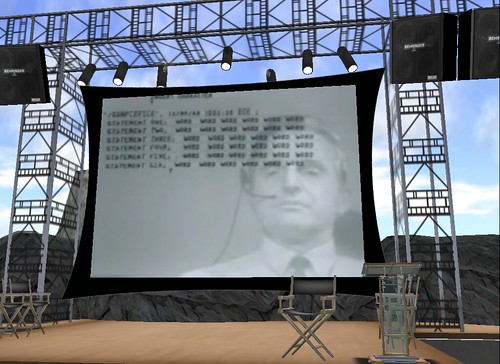
image credit: New Media Consortium at Flickr

Many of us who have dabbled with virtual worlds have wondered how they could form a constellation of networked systems, in much the same way as the Internet's servers do today. Whatever the fate of this niche technology called virtual worlds, from the failure to run on mobile devices to the inherent boom-bust cycle of Second Life's particular brand, the road not taken always beckons.

There is an historical precedent here, and it's one that has a happy ending. Could the same be true for virtual worlds?

Today's Internet: Clarke's Law in Action

For a moment, consider the complex and delicate magic that occurs whenever we use the Internet. My university server talks fine to Google, for work such as the just-completed Usher project. Whenever the Outlook mail client randomly eats student file attachments sent to me, I smile. Ah, Microsoft's wonderfully Byzantine and wonderfully doomed, technology, eating even its own Word files. Cue Apple and Google, as the Ottomans on the horizon, slowly gobbling up a once mighty empire.  Good riddance.

Then, because of the lack of monopoly that Microsoft coveted and almost got, I have the students try, try again with Gmail. Excede's servers send me the results and, once I type, transmit my thoughts--profound or inane--from home travel via satellite to Google.  When I send notice of this post to interested folks at Twitter or Facebook, the servers hosting that data all "talk" to one another.

Types of Gardens and a World-Wide Web, 1975?

Compare that to virtual worlds technology, ostensibly part of the Internet since that is how we access it. Second Life, InWorldz, and many others that share core technologies could, in theory, speak to each other. Had development not branched off as it has done, Linden Lab and a few other grids might have pioneered a system for avatars and inventory to travel from world to world.  That happens with OpenSim Hypergridding, a technology that John Lester promoted, before his work for Reaction Grid turned to Jibe-based 3D worlds.  But "interoperability" died years ago at Linden Lab, and it seems unlikely to return.

It's curious, this set of walled gardens. If today the Internet resembles Borges Garden of Forking Paths, Virtual Worlds resemble something else: the road taken in the 1970s toward personal computing.

I realized that while reading John Markoff's What the Dormouse Said, a history of early computing got influenced by the American Counterculture:
When personal computing finally blossomed in Silicon Valley in the mid-seventies, it did so largely without the history and research that had gone before it. As a consequence, the personal-computer industry would be deformed for years, creating a world of isolated desktop boxes, in contrast to the communities of shared information that had been pioneered in the sixties and early seventies. (179)
The Internet did not begin with Al Gore, whatever he may have claimed. It did not begin in Jobs' family garage and with Steve Wozniak's brilliant hardware hacks. It did not begin at Xerox PARC with the Alto. The personal computer with a GUI and mouse? Yes, we can credit or blame Xerox and Apple for that.

But years before, nearly every element of the modern Internet would have been possible with the Augment system, developed under the leadership of Douglas Engelbart. Yet that development stalled and ended, a revolution stillborn.  I think we can see an analogue for what is going on, at this cultural moment, with user-generated virtual worlds.


Engelbart's Mouse

Want to see what might have been for the Internet? I am convinced that had something like Augment  been made less opaque for casual users, we'd have had an academic, and perhaps consumer Internet in 1975. Engelbart gave a show-stopper of a demo in 1968, with mouse, text-editing with clipboard and copy/paste, multiple files, graphics on screen, electronic mail, hyperlinks tagged to graphics, and remote visitors via a network.  You can see what he was doing with Augment at these videos from Stanford.

The reasons for Augment's failure are complex; Markoff's book does justice both to the creator's vision and his ultimate failure to produce a widely adapted product.  What happened, however, for consumers was the emergence of walled gardens and proprietary systems from Apple, Microsoft, Digital, Tandy, and other competitors forgotten except by historians of technology.

When the Internet emerged, it came late to a culture of desktop boxes that could not, generally, talk to one another.

What if the personal computer revolution had begun with networking? And similarly...

What if Virtual Worlds Had Begun with Interoperability?

I'm writing an article about one group of USENET hobbyists who have made the jump to Facebook, because the old .alt group proved too chaotic and full of spammers, trolls, and other bottom feeders. They also made the leap because, frankly, .jpgs and text import and export well between applications. Text did in Engelbart's day.

Little aside from these, plus Collada files and some other graphic formats, can move between different virtual worlds.  Standards for inventories, for avatar meshes, and for "land" templates are different. In this technology landscape, OpenSim grids serve as today's Augment. Managing a bunch of avatars and a region in OS is hard to master, not stable in my experience except in the hands of a pro, but interoperable. Running an entire campus-hosted grid would be lovely, but it's beyond my time or expertise to learn.

Other products with potential beyond SL's technology, such Unity 3D and Jibe, produce elegant worlds, but they don't talk to other worlds and expert designers need to craft objects. They do offer vast potential, according to OpenSim pioneer Adam Frisby, for scaling, running on mobile devices, and improved grahics.

That sounds great until one considers faculty skills-sets and what it takes to build with Unity or Jibe. As noted  before in this blog, developing for these platforms may be within reach for architecture and engineering students, but at my university, it's challenge enough to get students to juggle multiple e-mail accounts and embed files from YouTube into their blog posts. We faculty lack time and incentives to do more with them, let alone learn 3D applications such as Maya or Blender.  Yet nearly all of us at my school have created content, mostly with text and images and sometimes digital video, and shared it on the Internet.

For all its limitations and toxicity as a brand, Second Life and, lets amateurs with a copy of Photoshop build easily. I'm told that Cloud Party does too, and I will soon try again with Cloud Party's latest build tools. Scripting remains something for those not faint of heart and projects to make visual scripting tools, such as MIT's Scratch for SL, remain as stillborn as Augment.

What it will Take to be Disruptive

Here comes a sweeping generalization, and I'm ready to fall on this sword if some wise person can prove me wrong. Virtual worlds will never be a disruptive technology, in Tim Wu's sense of the term, until they become an interoperable and popular tool for everyday life, as the Web and e-mail have become.

Had virtual worlds begun with a series of collaborative academic ventures rooted in common standards, rather than a group of for-profit start-ups from The Valley, we might have that disruption and a 3D Web today.  Then the profits would follow, because in 1968, who could have foreseen eBay or Amazon or Facebook?

Right now, however, it's still 1968 and we've all seen the potential of a disruptive technology, as those who watched Engelbart's presentation did.

So today, who will build the 3D Web?


Friday, February 1, 2013

Cloud Party Customization For Avatars

Location: Shiny Canyon

I'd been away from Cloud Party for a while, but a conversation during yesterday's VWER meeting spurred me to log in during the meeting.

I'd heard of but not tried the virtual world's new customization features. At login, I found myself in a welcome area, and wearing a new basic avatar greatly improved from the one I'd driven before.

Cloud Party's little smart-phone icon was drop-dead easy to recall after time away,  unlike many aspects of Second Life's bloated interface. I did not recall how to get home, but a navigation app on the phone, much like a maps tool for a physical phone, got me to Shiny Canyon in one smooth teleport.

Back in my stylin' pad there, I decided to try the customization features now in CP. First, I found it hilarious that unlike SL, where most male avatars are hulking body builders, my CP avatar was a skinny white guy. I'm no Hercules in real life, but farm work has made me rather burly and skinnier in the middle. So I buffed CP Joe Essid out to match the actual one.

The process greatly resembled SL's customization features, one aspect of SL that I found students mastered quickly. One can also save outfits and looks, as in SL. The lag was negligible as I did all this from within Firefox. Soon areas of outfit creation will merit a spin. I do not know what "movement" does, for instance. In the hair settings, I rather enjoyed the "stubble" feature for the beard. With hair removed, the avatar got the same swarthy look as this blogger.

Enter, Guido... rather like me but younger. There is no geezer-slider in CP's custom features.

At the VWER meeting, educators were too quick to dismiss Cloud Party for its name and lack of community. I'm not so sure. Despite a name I don't like all that much, anything that runs this well in a browser merits a close look. And without Facebook logins as mandatory (I still use mine) and  a working virtual currency plus marketplace, this world deserves more press from educators.

I'll have to have a try with the in-world building tools, rumored to be difficult. I'll also have to see if the ability to connect islands to make contiguous regions exists, also as rumored.

Shiny Canyon will never be the same.

Wednesday, November 28, 2012

A Novel Way to Market a New Virtual World

Glitch: Getting Started 
Location: Watching one door close as another creaks and threatens to open

I read Iris Ophelia's post that Tiny Speck's Glitch will close, joining the ranks of Google's Lively and Raph Koster's Metaplace in the bin of might-have-been sensations. Will Cloud Party be next?

I loved Glitch for a short while, but did not spend a great deal of time there after the funny concept grew a little tired. I never found community as we ran about squeezing chickens, planting seeds, and donating goodies to appease the giants and curry favor with them.

Iris noted that she too had tried it and stayed away until she heard the world was going under. She also noted the beautiful content she'd found. It was not enough, since not too many folks even knew that Glitch existed.

I'll quote at length from the company's closing announcement about why it failed to attract a user base large enough to sustain the world:
And, given the prevailing technological trends — the movement towards mobile and especially the continued decline of the Flash platform on which Glitch was built — it was unlikely to do so before its time was up. Glitch was very ambitious and pushed the limits of what could be done in a browser-based game ... and then those limits pushed back.
I have said, many times, to colleagues still vainly cheerleading for virtual worlds that I see the future daily: students using handheld devices, not heavy-duty desktops or even, increasingly, laptop computers. I feel sorry for virtual-world evangelists today, especially though naive enough to think that Linden Lab's bizarre corporate culture will pull off some miracle and make our media landscape that of 2006 again. Virtual-world evangelists remind me of me and my geeky Apollo-era friends, waiting for the Moon Base and our flying cars. Going on toward 50 years later, we are still waiting.

So does Glitch's closure mean that the virtual world concept is doomed to failure? Unlike SL, Glitch was fast and ran in a browser. So Flash or not, what could the next starry-eyed designer do to bolster the success of a virtual world with user-generated content?

How about market the world outside the echo-chamber of those who use and write about virtual worlds?

There's My Flying Car! A Vision For Marketing a Virtual World

No world with big aspirations is going to get enough users by cannibalizing SL's user base. Not Glitch or Cloud Party. None of these, including Google's Lively or Koster's Metaplace, advertised.

Compare that to the big games. I saw lots of adverts for Mass Effect III and now for the Assassin's Creed series, including ads on television. Would such expensive TV blitzes help a new virtual world? I don't know, but I have a notion that something different might.

I am about to read Ernest Cline's Ready Player One, a novel I'll teach next term in my first-year seminar Cyberspace: History, Culture, and Future. The novel's setting is largely a near-ubiquitous virtual world called Oasis, and today I began to think: what if an author worked with a game designer from the start to let readers of the book enter the book's world? And what if the book contained clues and puzzles that might be of use in the virtual world?

Cline beat me to the punch, partly. He announced that:
I’ve hidden an “Easter egg” in the text of both the hardcover and paperback editions of Ready Player One. If readers can find this hidden clue, it will lead them to the first of three increasingly difficult video game challenges. The first video game challenge is an Atari 2600 game that contains another Easter Egg that will lead you to the Second Challenge. Completing the Second Challenge will lead you to the Third and Final Challenge.
A winner, Craig Queen, won an actual DeLorean car. While Cline did not take the audacious step of trying to get someone to build Oasis, he's on the road to it.

His contest is pure marketing gold, the sort of thing that Linden Lab could have done but never did, in their assiduous attempts to avoid advertising their world. Imagine giving away a real automobile in 2007, at the height of the SL frenzy, for a Premium member who had solved an in-world riddle. It would have made national news, and Linden Lab would have easily parted with a Porsche or two.

The Lindens relied on free media buzz and insider hipness to pump up SL. We are more harried and tethered to our mobile devices now than five years ago, so cutting through the smog of information would be harder. And hip? That's no longer the case for virtual worlds, so it escapes me why Tiny Speck, with a platform both more obscure and more stable than Linden Lab's, did not promote their game.

If someone can figure out how to create an immersive space that can be accessed by the computers we carry in our hands, it will still need marketing, where Tiny Speck, Rezzable, Linden Lab, Raph Koster, and Google all failed. It will take a tie-in to the broader geek culture, and it will take something like what Cline is pioneering: cult book and world released together.

Friday, October 12, 2012

Cory Ondrejka's Vision, 8 Years On

Location: Reading Desk

I have had a great deal of academic fun reading Ondrejka's 2004 article "Escaping the Gilded Cage: User Created Content and Building the Metaverse" (get a copy here). I'll provide a few page references below, but not a works-cited list (this ain't no formal article, yet!).

Hamlet Au mentioned it over at New World Notes recently, and I decided to have a look at the creative fire from an era when the investor-utopians, and not the CEOs and bean-counters, planned to build something akin to Neal Stephenson's metaverse from Snow Crash:
This article will argue that creating a defensibly real, online world is now possible if its users are given the power to collaboratively create the content within it, if those users receive broad rights to their creations, and are able to convert those creations into real world capital and wealth.  This would be the Metaverse of Stephenson’s imagination. (Ondrejka 4).
Ondrejka, a supporter of Cloud Party, is still at it, and I like the way that new virtual world has seized the creative fire that Second Life, with its balky interface and legacy code, may never achieve. Cloud Party already has an avatar building kit, and while the results do not match what we have in 2012 SL, they are impressive for a world so young. As I get ready to play Patterns for the first time, however, I also wonder if it's too early to count Linden Lab out of the game.

What did Ondrejka want in 2004? Here are a few claims he makes that excite me still. I won't focus on the author's economic musings. They are fascinating, but I'm more concerned with his arguments about engagement and immersion.

User-Generated Content: Give Me Sandbox AND Arena

As Marcello DellaCarpini, my Vodacce character from the game 7th Sea, would say, "Two famous Vodacce sayings apply to such matters. First 'When in doubt, just make something up and say it with a straight face.' Second, 'It is never really fun until someone is caught on fire, run through with swords, made into an pincushion for archers, or eaten by monsters. Preferably someone you cannot stand.' "  Marcello made those both up, of course, on the spot for good RP. Creation, both verbal and physical, are essential:
People want to be perceived as creative by customizing their surroundings. People want to have their moments on the stage. In many cases, it seems that users are just waiting for access to the right tools (Ondrejka 9).
Due to the in-world tools and lack of a submission process, Second Life’s users have been able to create an amazing amount of content. At the end of May 2004, users had created more than one million objects, over 300,000 objects with scripted behaviors, and over 300,000 pieces of clothing (Ondrejka 10). 
I have long argued that UGC is the "special sauce" keeping me interested. I can destroy things in a thousand games, but in how many can I make them?

Eventually, both sorts of play will co-exist. What we call on my weekly Nerd Night "the minimum daily requirement of violence" in games will only take us so far.

If game designers want to attract my sort of relatively well-heeled customer and hobbyist, they need to consider two sorts of sandy spots where a type of "play" occurs: the sandbox and the arena.

Emergent and Predictable Behavior:

Ondrejka notes that when one drops and object, one expects it to fall. To fall back on a favorite expression of mine from Snow Crash, designers must not "break the metaphor" by, say, letting folks "beam in" to any location. Though many sims in Second Life support that type of movement, it's more predictable that one would walk or drive from a fixed point to the destination; this is what the original Linden Lab "telehubs" wanted to do.

Not breaking metaphors, whether gravitational or spatial, is predictable behavior.  Ondrejka contends that successful metaverse must support behavior that only emerges with creative play (15-16). In my OpenSim House of Usher simulation, for instance, I had no way to injure other characters when I was in the role of Roderick. I found that, however, I could rid myself of over-inquisitive guests by pushing them off the edge of the virtual region I rent at Jokaydia Grid. This was a software bug in OpenSim, but it served my purpose: through emergent behavior, I'd found a way to drown nosy and suspicious visitors to The House of Usher.

So When Do We Get our Metaverse?

Emily Short, working with Linden Lab on a new and non-SL narrative game, notes in a Gamasutra interview that the sort of game Ondrejka calls for would be lovely but it is not currently available:
Something that I tended to think was unfortunate about certain MMO storytelling... you get these narratives where the NPCs have lots of really emotive things to say to you, and they want to throw you into this narrative. Then on the other hand, your interaction with the characters played by humans -- even if they're inclined to play it in a very role-playing way and they're not running around shouting trollish remarks and that sort of thing, even if they've entered into playing that role, because of the way it's structured, none of the conversations you ever have with them are ever going to be acknowledged by the story as meaningful pieces of the story.
I have no time for childish players who type in text abbreviations or talk in voice like extras from The Jersey Shore. I am a snob. I would not even consider RPing in the local game shop; my preferred groups are guys I've known for 30+ years or a bunch of fellow PhDs who were with me during graduate study. Neither group is trollish but both can be a bit silly, to add humor to a gamemaster's crafting of a scenario. Neither group is childish.

So how can a game engine ever let players into the story as co-creators, as can happen in an SL roleplay sim or tabletop RP? One of Short's commenters noted that we'd need AI that could serve as a "dungeon master."  When will that occur?

Quantum computing, a gleam in the eye of many of us, recently got a public boost by the 2012 Nobel Prize in Physics. With processor speeds that fast, we may see something like the magic of Stephenson's vision realized.  Until I have that sort of power in my palm or my laptop, I will read the dreams of Ondrejka, Rosedale, Short, and Stephenson and keep hoping.

Top hat tip to Hamlet Au, for covering both Ondrejka's and Short's ideas.

Wednesday, July 18, 2012

From Scratch, Key Elements For an Educational Virtual World

Location: Thinking Cap in Place

After my few posts about Cloud Party and Glitch, I began pulling together a list of features that I'd want in a virtual world if I had unlimited funds and time to build one myself.

I plan to put this list of features to the vote with colleagues in VWER, before we hold a meeting about "What I learned from a silly game called Glitch" early in August.
  • User-Generated Content: The killer feature for virtual worlds used by educators. We can make and share our creations in a world that is, essentially, a big sandbox
  • Collaborative Permissions: Creators can transfer full ownership for shared builds so backups and exports are possible. Mixed-permissions builds in Second Life are a nightmare
  • In-World Building with Simple Tools: Again, for collaboration this seems very popular with educators
  • Offline Building with Professional 3D Tools: For advanced builders with 3D modeling skills
  • Local Hosting Options: Educational Institutions like to own their hardware and make backups frequently
  • The Illusion of a Contiguous World: World maps are available for Glitch, most OpenSim grids, and Second Life. In Cloud Party, to my knowledge no map is available
  • Several Means of Travel: All virtual worlds include point-to-point movement such as teleportation.  Those making simulations in a world, however, should be able to turn that feature off, so participants are forced to walk or ride to a destination. Second Life manages this well with settings for parcels and regions
  • Freedom of, and From, Adult Content: This will be contentious even among educators. I'd suggest that pornography is not needed in an educational world, but adult content, such as art-museum nudity or discussions of sexuality, is necessary for many educational purposes
  • Simulations Tools, Including a Physics Engine a Combat System: My students asked for this again and again in reviews of my House of Usher simulation. In realistic simulations, bad decisions have consequences.  Avatars in these settings should get tired, hungry, injured when appropriate. They might be able to "level up" for accomplishing goals in a course or assignment. This idea got suggested in Edward Castronova's Exodus to the Virtual World and I like it a lot
  • Simple Help Tools: Glitch wins on this. The designers' humorous approach to FAQs and the Pet Rock charm me every time I log on.
What did I forget? Sound off!

Thursday, July 5, 2012

Shadows, Privacy, Restarts in Cloud Party

Location: Shiny Canyon

I had a comparative experience with server restarts in Cloud Party and Second Life today.

But first, some details about the new virtual world that caught my eye.

Mobile access, More than Facebook: 

Usually we skip such reading, but in the CP privacy policy, I ran across references to Google+ and Tablet access. Clearly, the CP folks intend to branch out from their Facebook-centered approach to their world. How far--and the use of "nyms" instead of display names, remains to be seen.

Given the frequent mention of iOS devices in the policy, I assume I'll soon be able to log on with my iPad.

I'll quote the next bit verbatim:

Offer Walls:

Cloud Party games or their purchase pages may display an "offer wall" that is hosted by an offer wall provider. The offer wall allows third party advertisers to provide virtual currency to users in exchange for interacting with an advertisement or for completing a marketing offer that may include signing up for an account with one of those advertisers. These are not offers made by Cloud Party. These offers may be displayed to you based on certain technical information, such as your geographic area or anonymous demographic information.

Does this mean billboards in the game or sidebars beside it? I can live with them, as I do with Google Ads, but I see one revenue model, beyond CP's modest tier, for the firm.

Others with more experience with privacy policies can comb through the rest of the document, but at my first-glance exegesis, it seems standard stuff.

Dynamic Shadows:

They are blocky in my limited experience, but considering how difficult they are to render in Second Life, I'm already impressed.

Fast Restarts:

I could not log onto SL today for our meeting of the VWER. When I did get in, about half-way into our meeting, I got rerouted to an adult welcome area full of furries, virtual prostitutes, a woman cradling a prim baby, and Gorean slave girls. Luckily, they were gray and stayed that way because of the load on my client and the sheer number of logon refugees present.

This sort of collision of worlds often happens when an avatar is age-verified and server issues force a "last location" login to redirect to a welcome area.

Thanks to a VWER member, after I escaped this den of vice I learned how to prevent this from happening again. Let me compare that to Cloud Party, where today the CEO announced a server restart not long after I logged on. I waited to see what would happen.

The app quit and restarted automatically, and I was back in Shiny Canyon, inside my fake home.

I realize that as Cloud Party grows, Sam Thompson won't be available to chat with gamers in Cloud Party. But so far, that hands-on attitude is refreshing. I IMed Sam to tell him of how pleasantly different his restart was from Linden Lab's. Reply? Sam sent back a smiley face :)

Maybe we'll see prim babies and Gorean roleplay in Cloud Party. I hope not, but we'll see.

The Antisocial Network: Facebook Takes a Holiday

Location: Facebook...no. Not Facebook

Well, for me, Facebook is an experiment that has...failed.

I had to create an account to moderate our Writing Center's FB presence, but inexorably my little site drew family members, friends, and status-updates from me.

And I don't like it one bit. So while I can't leave Facebook, I'm not going to update my status for a while, at least until after the November election. I find that at log-in, I'm assaulted with political spam from said "friends" and family, and often it's of the Right-Wing variety that makes my eyes cross.

Or perhaps it's the revelation--hold the friggin' presses--that some dunce who friended me "likes" Wal-Mart, a place I'd as soon crush with Cat D-9 bulldozers as enter for shopping.

Facebook can be useful to maintain distance contacts with old friends, but this year I've made the vow to see friends in person more and even mend a few old fences. In person. Not with pixels or cat videos or posts about some ill-conceived article that I simply must read.

Luckily, I can log in through our Writing Center portal to FB and not even see the wall of status updates. With a click, if I so choose, I can visit my own wall. I can post updates to the Virtual Worlds Roundtable Group. I can certainly access content such as Cloud Party without directly logging in to FB .

And that way I can bloody well avoid all the spam normally seen at login.  What did Bilbo Baggins say at his final birthday party in the Shire? "I don't know half of you half as well as I should like, and I like less than half of you half as well as you deserve."

Meanwhile, I'm going to be doing more of what I've increasingly done all this curmudgeonly year: reading (and learning about e-book technology for my upcoming first-year seminar that will only use e-texts), smoking my pipe, sipping a cold beer in the cool of the evening, and, as has been the case with my explorations of Second Life, not going online as often as I once did.

I never spent a great deal of time at Facebook, no more than an hour each week. But somehow that hour felt like it had been through time dilation.  Having an hour back seems sweet, indeed.

Wednesday, June 27, 2012

Like Jilted Lovers?

VWER_120614_008  
Location: Virtual Worlds Education Roundtable

image credit: Grizzla Pixelmaid at Flickr


I forget who at one of our VWER meetings told AJ Kelton, aka AJ Brooks, that he acted like a jilted lover when Linden Lab fired its education team and hiked our tier prices. But the simile is apt for me too; it explains some of our community's enthusiasm for Cloud Party, noted in my last post. There's not much at Cloud Party yet. When you cannot sit on your new couch, that shows we have a ways to go. But the will to "go" is there.

Slowly but surely, my own wonder and love for Second Life drained away. For students it was too hard to learn, too slow to use on wireless and their laptops. For me, it meant 200 hours of development for The Virtual House of Usher, a project that we ran a few classes through before my co-developer lost his job, our island closed in SL, and I needed to move on to other pursuits.

I get as much credit, and probably more, in my annual review for a published article. I could have written a few in those 200 hours.

Some of the reaction by SLers trying Cloud Party's new virtual world is predictable: soured on Linden Lab's mismanagement of a once-revolutionary online space, we either wish to punish the Lab or simply try some competition that is easier to master than the largely DIY spaces of OpenSim grids.

At our most recent Roundtable, I found myself spouting these words:

"I have come to hate Linden Lab and don't want them taking my money any more." You can read the rest of our exchange here in the transcript.

I did not get crucified by the assembled educators for saying this. Few SLevangelists were present, so the remarks were civil as we discussed what "special sauce" SL still has. The answers? Good content and community.

Linden Lab is repsonsible for neither of these. Stability, a third common answer, is their doing, but Cloud Party offers that one already with only a few weeks since they opened their world in open beta. The other two will follow.

So how can a firm such as Linden Lab win back our trust? To continue the romantic simile, they cannot or cannot in any span of time worth noting. If we look for exceptions in the history of technology, there is one.

It took decades for Detroit car makers to woo back those jilted by their crappy 1970s cars.

Linden Lab did not sell us a Chevy Vega or similar lemon. It sold us a lovely but doomed Corvair Monza and refused to listen to customers who bought into that dream or decided that they really wanted a Mustang instead. Recent efforts, such as Linden Realms or Wilderness, brought only yawns from our group of educators.

Clearly, Linden Lab lacks Detroit's time and government support. If Cloud Party flops, it's just a start-up firm, but Linden Lab's failure would make big news, even in media outlets that have at best sniggered, and mostly ignored it, since 2008.

Wednesday, June 20, 2012

Why Cloud Party Matters To Educators

Location: Shiny Canyon, in Facebook!

A great number of pixels have been used to praise or critique Cloud Party over at Hamlet Au's New World Notes. True, one needs a Facebook account, and sacrifices anonymity, to use the service fully. Anonymous logins are possible at the link I gave above, but they only permit limited interactions and the avatar's experience and content--as far as I understand--do not persist.

Here are some reasons I think Cloud Party represents the next generation of virtual worlds:
  • No client: this is key to mass adoption. For educators, it means that a student only needs a FB account. That means about 100% uptake for my students.
  • Real life ID: for Millennials, that too is key. They find virtual worlds "creepy" because, to paraphrase most of my 100+ users, "you don't know who is on the other end of the wire."  Their faith in authenticity may be naive, but it's strong and consistent in this demographic. Blame it on 12 years of "Internet Safety" classes rammed into their heads by schools.
  • Users such as "Pussycat Catnip" argued, with me and others in a long string of commentary at Au's blog, that one key aspect of enjoying SL is being able to assume a new identity. For her, Cloud Party's link to Facebook "makes it useless for anyone wishing to explore concepts like identity or self expression." Frankly, that matters little in how I've used virtual worlds, save for the House of Usher simulation, which is a one-off assignment with roleplay.

    Fretful administrators at colleges and universities will like the seeming transparency of Cloud Party as currently configured, though I suspect that "Cloud Party" to be only a marginally better name than the tainted "Second Life" moniker.
    I'd have preferred "New World" or similar, but Cloud Party goes not purport to be an educational tool. Nor did SL; we just took to it, and so did many others with some very different interests and intentions.
  • Easy UI that looks bound for mobile devices: Desktop rigs are the choice for serious games for serious gamers. They are not my students or colleagues, however; gamers here are a very small, and disrespected, part of the student body. When mainstream students do play games, they are more likely to pick up a console or play a casual game on their mobile devices and laptops.

    Cloud Party exploits the metaphors of mobile computing nicely.
    The Control Panel, shown here, looks like a smart phone and, when opened, provides small icons straight out of the world of mobile computing.
  • Perfect Timing. Educators screwed over by Linden Lab's mid-year doubling of tier have been looking for something easier to use than OpenSim. I think something like this new virtual world could do the trick. My Avatar looks like a newbie refugee from The Sims Online, but I can live with that. Building is very much like SL, from what I see. Linden Lab needs to be worried...very worried.
  • Storm Clouds? Right now, unless a browser supports WebGL, it won't run this virtual world. Nor will iOS devices. I am searching for a app to try it on my iPad.  Android users may have more luck. But for now, the majority of computing on my campus is done with laptops on wireless. About 70%, at last report, of new students bring Mac OS laptops.  On my MacBook Pro, Cloud Party runs very well and the fan never comes on, as it does constantly with SL running the Firestorm viewer.

    I hope that Cloud Party pursues access to all tablet OSes, though one wonders if Apple and Microsoft will open their mobile OSes to WebGL; on a phone Cloud Party would not be useful for more than texting. A tablet might be too constrained for building, but given my limited experience, my iPad's screen is plenty big for moving and chatting.  Much of Cloud Party depends on right clicks, so that would need to be fixed for mobile users.
Now for the experience: In two visits, I completed the basic and build tutorials and got a free house in a region called "Shiny Valley." Easy enough for veteran SLers. What about those new to virtual worlds? The tutorials were excellent, better than what I found in Second Life and more akin to my unalloyed joys of the first hour in Glitch. My interest in Glitch waned, I admit, because of the lack of realistic avatars and its side-scroll interface.

Here I am being greeted by Gwenette Sinclair, one of the new neighbors.  I know, it's The Sims kinda-sorta. But shiny!

We immediately went to YouTube to watch this R.E.M. video:


It's nice to feel happy about this shiny new virtual world. I hope the happy dance continues. Come by Shiny Canyon for a visit.