Showing posts with label mainstream media. Show all posts

Friday, February 3, 2012

Notes from the Trough of Disillusionment

Location: Down in the Valley So Low

Next Friday, I agreed to give a short presentation to faculty colleagues in a learning community focusing on new technologies.

My topic: "3d Virtual Worlds: Down in Gartner's Trough of Disillusionment"

Here are a few notes from a Blackboard page I created to guide our discussion. I do plan to log into Second Life and OpenSim during our meeting, as well. At least two of the group tried SL and were not impressed with the platform, for one or more reasons I'll list as detrimental to the spread of virtual worlds.

Readers, what am I missing? I'd love to hear your perspectives on this. My notes follow, except for links to content in SL and other grids worth seeing (from Virtual Ability and Genome Islands to the WW I Poetry Sim and my Usher Project).

All links below will open in new tabs/windows.

The sector for public 3D virtual worlds has fallen into the Gartner "trough of disillusionment" since Fall 2008, just as the global economy teetered on the brink of total collapse. In what follows, I offer some reasons and resources, based on my five years of work in Second Life and OpenSimulator virtual worlds.

Here is their 2009 "Hype Cycle" snapshot:

http://www.gartner.com/it/page.jsp?id=1124212

In 2011, while other technologies advanced, the Gartner authors concluded that "virtual worlds remain entrenched in the trough after peaking in 2007."

For Second Life in particular, several factors hurt:

  • High pricing for content-hosting without offline backups. Linden Lab, SL's maker, ended 50% discounts for education and non-profit customers in October 2010, at which point Richmond left SL.
  • A competing open-source alternative, OpenSimulator (or OpenSim), often hosted locally on campus servers and capable of URL-type linking to other campuses or corporate projects through a technology called Hypergrid.
  • The difficulty of the SL user interface and the steep hardware requirements of the client.
  • The stability of the virtual world and the need for frequent client upgrades (both largely resolved today).
  • The relatively slow pace of empirical evidence for teaching effectiveness in immersive 3D environments. Ironically, this has emerged in 2010 and 2011, but by them many campuses had decided to focus more on mobile technologies and social networking for teaching. Many with an investment in virtual worlds moved to OpenSim instead.
  • A perception that the environment was too "gamelike" for serious learning. SL is more of a "sandbox" that permits user-generated content, including games. One can more easily make the case for using SL in education than, say, World of Warcraft. Ironically, "gamification" is a buzzword for emerging educational technologies in 2012. Was SL too early?
The SL brand's reputation for social and adult-rated usage did hurt, but this proved the least of the problems for my classes. My students encountered SL's X-rated culture and giggled. I made them sign waivers to avoid adult content unless 1) it was after class and 2) they were not representing themselves as members of the UR community. One or two students did research on "relationships" in SL, but they age-verified to be able to go to adult-zoned parts of the virtual world.

What Virtual Worlds still offer, despite their learning curve:
  • A way to build simulations at low cost. I could not make a ruined Victorian mansion appear on campus for my House of Usher simulation (see below).
  • A way to interact for virtual conferences in an embodied way. I do not find teleconferencing and 2D applications such as Elluminate as engaging for participants. SL encourages all participants to become active, in my experience from the weekly Virtual Worlds Roundtable and the annual conference, Virtual Worlds: Best Practices in Education.

Tuesday, April 12, 2011

This is NOT the Future

Location: Holding Sides, Laughing

Hamlet Au ran a reference to a New York Times piece about virtual meetings.  We've been talking a little about the concept in my current class, as we read Exodus to the Virtual World, by Edward Castronova.

Other than making me sing "The Time Warp" from The Rocky Horror Picture Show, I saw little use in the graphic that accompanied a story about a groundbreaking (to the Times staff, anyhow) development.  We are a long way from selling that particular technology to any serious business.

There's also a drop-dead hilarious video of a "business meeting" with this clumsy technology.  I'm no graphics maven but I could not get through the demo without breaking down in gales of laughter. The avatars make Second Life's look wonderful.

Granted, as I noted over at New World Notes, using an avatar seems to spur more participation in a meeting than I have seen in teleconferences or Elluminate meetings. This merits formal study by academic psychologists: I have no idea why the avatar is more empowering than a teleconferencing window.

That said, I do prefer those technologies or Skype for small-group conferences, but they fail to enable really good work for large groups. In some cases, one may as well watch a television seminar with one or two active participants.

Second Life does pretty well for large-group meetings, but it suffers in professional circles from its rep for cybersex and nonhuman avatars. My colleagues not in virtual worlds, like many business folks and even many of my Millennial students, are wary--very wary--of identity shifting online.

For that crowd--and it's one I suspect to be the majority of potential conference users--to make the Castronova "exodus" they'll need something like the virtual meetings shown in the Times story.

But with necks.

Wednesday, March 23, 2011

A World That Dares Not Speak Its Name?


Location: New York Times Web Site

image courtesy of the Language Lab site


My departmental chair sent me this story about the use of the Virtual Globe Theater in a class at Bryn Mawr. I read it with great interest, seeing in it the sort of nuanced story about virtual worlds that too rarely appears in mainstream media outlets.

Not once, despite the clear image of the Second Life client on the screen of a laptop, was the Linden Lab product mentioned by the reporter.

I have an idea that, as noted in an earlier post here, that the name "Second Life" is so tainted by sensational stories from a few years ago, or tainted by the "once was big" reputation among technologists, that the brand name simply got dropped. As Hamlet Au noted for the Language Lab project, its site does not mention Second Life on its first pages. The video they provide flashes the name "Second Life" on screen for a brief instant, when the woman demonstrating how to get started downloads the client. The product name also appears on the Language Lab FAQ page about job opportunities. It is refreshing to see that SL knowledge is a prerequisite for a job.

There's no mystery here for me: the Second Life brand-name is toxic enough, but the product good enough, to create this discomfort. How can Rod Humble rebrand his product?  If Linden Lab had taken a different route with the enterprise version and licensed it under a different name and with a lower price than they did, they might have achieved more uptake.

Language Lab students do not need a larger world than English City and the cluster of other restricted-access sims, the Language Lab sim, to attend classes. The other "LL" in this story might have taken a different route to offering its product to just such potential customers.  Doing so under a different name ("NewWorld," "Metaverse," "MatrixLand," even the old standard "Linden World") would have helped make many projects like Language Lab's viable.  We might be talking about hundreds of thousands more regular users in various SL shards.

Part of me is proud to see increasing evidence that the use of virtual worlds can go "mainstream," as we all hoped in the glory-days of hyperbole and utopianism before 2009. Part of me is sad, however, that when I do say "Second Life," in any group of colleagues, the grins come out still, because every negative (and usually exaggerated) stereotype about slave-girls of Gor, virtual sex, and more from 2007-8 rushes to mind.  Now that CNN plans to close its bureau there, the last of the big-media holdouts is gone.


What next? That is Linden Lab's decision.

Friday, February 4, 2011

Linden Lab Embraces SL Romance

Location: Averting My Eyes

Second Life's rep as a place for online hanky-panky was the butt (ahem) of many jokes during the media-hype era of 2006-7. At that time, the Lab often played it down, then moved overtly adult content to its own continent.

I thought that the move to Zindra was wise at the time, and it's essential now that minors are in-world, but I always wondered why the Lab dodged the "hook up" scene that is so much a part of their world.

It was with some satisfaction that while logging on to the Lab's web site, I spotted an advert for "When Strangers Click," an HBO documentary.

You can visit the site and watch Clip # 4, where a fellow chats about the romance that blossomed in SL. It all looks rather innocent, two avatars dancing and kissing under a perfect night sky in a garden where no one need stoop to pull any weeds.

Perhaps Linden Lab wanted to promote this as a counterargument to all of the stories of more visceral encounters in their world? The sappy romantic music had me laughing, and I can imagine my chuckles swelling to howls of merriment when my students stumble upon the clip.

At the same time, and for the first time in a long time, I see the Lab making a savvy marketing move. They know their core audience is not educators like me or the hard-core gamers of my weekly "Nerd Night" crew. It's not even my fellow-travelers, SL's wonderfully creative artistic community.

Increasingly LL's bread-and-butter customers are roleplayers and fashionistas and those seeking romance.  These folks want toys and experiences. And to thrive, the world needs new blood. So why not sell your platform's core strength?

Get out the Barry White.

Could we expect more of same from the Lindens' new CEO?

Friday, October 15, 2010

Bald-Headed Freak to Talk about Second Life & Edu with Paisley Beebe


Location: Ready for my close up, Mr. DeMille

Just a quick note that on Sunday I'll be on "Tonight Live with Paisley Beebe," talking about the impact of the price increase on educators. Paisley did well to invite me this week and not last. I'll even wear a polite shirt!

Thanks to Bliss (pictured) teaching me how not to act the fool on live TV. I did not sit on Paisley's cat during my voice-check, so she slept peacefully as I droned on and on and on.

I'd have done a lot of yelling a week ago. Now, I can at least try to be urbane about the difficulties my colleagues face.

The potential exodus from SL has caught the eye of the mainstream, with Jeff Young interviewing AJ Brooks of VWER for the Chronicle of Higher Education. Nice work, AJ.

I'll try not to be too much of the "bad cop" to AJ's "good cop" while on Paisley's show. Damn.

Monday, October 11, 2010

Gor & The Educators: Our Best Reason To Leave Second Life

image courtesy of Nightflower's New World Notes Post

Location: Letting Door Slam Behind Me, Washing Hands, Burning Bridges, Etc.


Nightflower wrote an interesting post on why real-life women chose to roleplay Gorean Kajirae (slave girls). Her blog contains a full interview with three Gorean women.

Disclaimer: I've long felt that adults can do what they please online as long as the acts are consensual and others do not have to watch. I've long been ambivlaent to Gor; John Norman's prose is terrible and clearly a reaction to the rise of Feminism in the 1960s. He's certainly never made full professor because of his Gorean fiction, though I suppose it made him a lot of money in the 70s, when the lurid covers attracted an army of teenage boys. I stumbled through Tarnsman and Slave Girl back then. That was enough. Even for a horny teen, the prose was dreadful when Burroughs, Howard, and Lovecraft awaited.

That said, no academic administrator who barely knows SL would fail to be outraged that this content is on the same grid as a campus. One counterargument deployed holds that campuses rarely censor internet use (totalitarian schools like Regents and Liberty don't count for me).

Yet the argument ignores a basic fact: SL's adult content is different from educational sites being on the Inernet alongside sites with X-rated content (or that promote Gorean lifestyles). Unlike other vendors we use, LL hosts both. If Blackboard hosted both RP slavery and campuses, we'd leave that software provider fast.

Here's another chat about Second World...I mean Life, with an administrator:

Department Chair: Joe, come on in. I was reading "Iggy's" blog for your annual review. Sorry to hear our campus is leaving Second Life so suddenly, because you'd planned to use it next term, true?

Iggy: Yes.

Chair: That's bad, but part of me is glad.

Iggy: Why's that?

Chair: You know I've spent my entire career writing about women's issues in literature, and so much of modern feminist theory is about the backlash to what we painfully accomplished, especially since the start of the women's movement in the 1960s.

Iggy: Oh no. You found the Goreans.

Chair: Yes! I learned about Norman's books when I first was in grad school in the 70s. We laughed because it was such a pitiful attempt to subvert our progress. Norman was such a cheap hack, too, that he didn't pose much of a threat.

Iggy: Yes, his writing is horrible.

Chair: His academic writing must not have been much better. He never rose above Associate Professor. But then you have people roleplaying these relationships in a virtual world. It's disgusting that real women would do that.

Iggy: Some are fake women.

Chair (laughing): I hope their "Masters" don't find out. Well, this new virtual world we are going to use...does it have Goreans?

Iggy: No adult content at all.

Chair: Great. If the right-wing morons at our local paper got wind that we share space online with such content, the editorial pages would be a nightmare. Let me know when you have The House of Usher moved to this new provider. And I want to see that article you've drafted on immersive literature.

A few years ago, as advisor to out campus literary magazine, I and the student editor got "called on the carpet" by the folks who fund it. The current issue opened at the midpoint to a poem with X-rated language. I defended the work, but the campus official said "this was on tables at parents' weekend. If the students want to print and distribute it, okay. But if they continue to print this sort of content, they should not expect any funding from us next year. Maybe they can sell cookies to cover their costs."

Thus, readers, I bid the Goreans, their home stones, their slaves, and their "natural order of things" a fond farewell.

Friday, July 2, 2010

Businessweek Goes Back to SL

Location: Reflective State of Mind

All in all, it's not a bad treatment of what has happened since their famous 2006 cover story. That earlier piece (cover image shown) greatly contributed to the hype-and-bust cycle that we are still experiencing.

I might quibble with a few points, but some standout observations include:
  • How the broken in-world search contributes to problems in growing SL
  • How the clunky UI and orientation experiences deter new members.
  • The mainland prices have tanked.
  • That a cloud-based SL would prove better for most mainstream users; I agree.
  • That the Lab seems to have bought into the inevitability of virtual worlds as "The Next Internet."
Much of Matt Robinson's story (click for full story) is devoted to interviewing the four individuals featured in 2006. It' s worth a look to show where we've come since then. For a change, mainstream media covered a virtual world with some care and attention to details.

Friday, May 7, 2010

Kunslterlism of the Week: Raccoons with Breasts?

Location: Kunstlercast site

Kunstler riffed on Second Life last week, in his weekly podcast, recalling SL as a place "where you adopt the persona of a raccoon with big tits and go around trying to make dates with people. It's funny how it all resolves itself into a lot of social maneuvering, basically for sex. It's so dumb. We're such monkeys when everything is said and done."

I laughed with recognition. We've all run into such SLers. Kunstler's vitriol also reminds us of what mainstream media and students of the generation I teach find so bizarre and, often, repellent, about virtual worlds and MMORPGs.

At the same time, Kunstler makes a more cogent point when he says:

"We've got to stop kidding ourselves that virtual life is as good as real life."

Here, I tend to agree. Virtual worlds enhance and extend, and they enable contacts that would be nigh impossible in the tangible world. They don't replace...as much as the transhumanists would wish. One trip into my garden this morning, to set out some basil seedlings and draw water from my rain-barrels, reminded me of what I miss, sitting in a chair and typing.

Surf to the Kunstlercast at http://www.kunstlercast.com/ and point to podcast #108: The Virtual Realm vs. The Authentic. Decide for yourself how much time we should be spending in irreal spaces, be they online paradises or the doomed consumerist landscapes of our hellish suburban strips.

Wednesday, February 24, 2010

CNN Provides Heritage Key with Good Press


Location: CNN Web Site

I'm really pleased, after the lackluster article in The Chronicle, to see CNN cover, from a "noob perspective," the promises of virtual-world technology. You can see a nicely done video, aimed at the general viewer.

Funny how the announcer notes that Second Life is a "game" but implies Heritage Key is not. That's some of the best backhanded marketing I've seen. Administrators resisting the perceived sex and griefing of SL--a view The Chronicle piece encourages--might say "well, maybe there is a use for this technology on campus."

Soon I plan to look at more strong developments in Heritage Key's Valley of the Kings.

Jeff Young in the Lion's Den

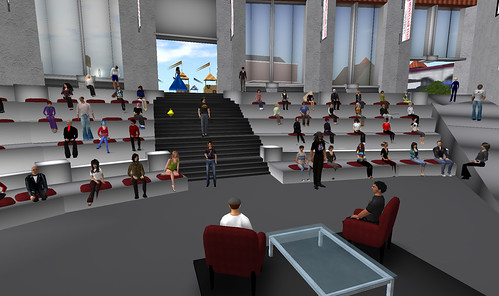
Audience view, Dav Phobos session

Location: Virtual Worlds Roundtable


Photo by Sheila Webber

Mr. Young is a brave man. His recent story in The Chronicle of Higher Education caused such a ruckus among educators that we expected griefing when he appeared at our weekly event. I was on security with several others for meeting Moderator AJ Brooks.

The only grief was verbal, and it was hot and heavy. Primarily, educators objected to these aspects of Young's coverage:
  • He did not have enough in-world experience to adequately cover Second Life and OpenSim worlds
  • He failed to visit some of the richest educational content
  • He wrote a piece that seemed slanted to editorializing about SL, rather than probing some of the strongest problems--and promises--for early adopters
  • He over-emphasized sex and griefing, aspects of SL that have not posed large problems for most of the VWER members.
I've probably missed a few of Young's and our group's main points, but I will post a link in a future post here to the entire conversation. Readers take note that the flames are plentiful in our talk. Kudos to Mr. Young; he says he'll return to SL again to visit classes and attend an upcoming conference. I'm glad he will do so.