Showing posts with label VWER. Show all posts

Thursday, November 19, 2015

Dutch Boy Running Out of Fingers at Linden Lab

Location: Back at VWER Roundtable

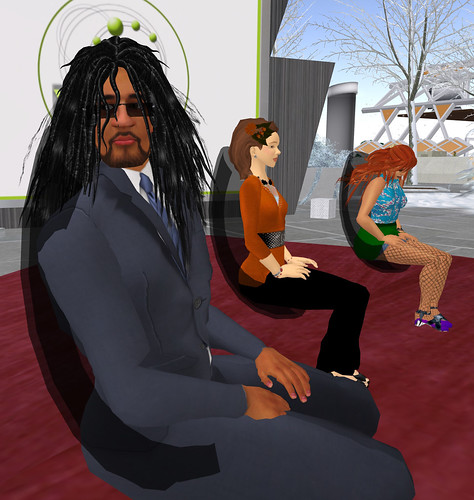
How odd it feels to be blogging again, ever so briefly, about Second Life. I have returned to the virtual world for a couple of VWER meetings and am even considering updating Iggy's avatar shape and skin. His relatively new dreadlocks demand it!

Yet following a post I spotted in New World Notes, about Linden Lab's deciding to lower set-up fees for sims, I thought my two cents might contribute to the debate.

Second Life continues to lose sims at a stately pace. I wonder, as many SLers do, if the entire world is no more than a cash-cow for the Lab to milk until Project Sansar launches. Purportedly, it will:
"democratize virtual reality as a creative medium. It will empower people to easily create, share, and monetize their own multi-user, interactive virtual experiences, without requiring engineering resources. The platform will enable professional-level quality and performance with exceptional visual fidelity, 3D audio, and physics simulation."
These promises are at odds. If Sansar lets us "easily" create such 3D content using our Occulus Rift headsets, it would require tools far simpler than Blender or Maya.  Those high-end tools then put Sansar out of reach of many educators I know.  Motion-sickness issues for the Rift may be easier to resolve than those about the tools needed for content creation. I reserve judgement on the "native building options" the Lab mentions. Perhaps in-world creation for ordinary mortals and student teams will endure, freed from the cumbersome permissions system that hamstrings SL team-builds.

Meanwhile, the Lab's original virtual world chugs along shedding 20-30 sims per week of landmass, rather like an iceberg drifting with the Gulf Stream. The Lindens do no, and probably can not, do the one thing that would democratize Second Life again: cut monthly tiers deeply for ordinary users.
Image of trends for private estates, from Gridsurvey.com

At $25 per month for a homestead and $50 for a full sim, I'd rent server space to make a roleplaying game from my twisted imagination. I could then take advantage of SL's rich marketplace, finely designed mesh avatars and other content. Linden Lab launched its Experience Keys program precisely for content like what I envision. Unlike 3D creations at Turbosquid, the SL marketplace offers content for pennies or just a few dollars. I could build the rest.

I've no faith that the Lindens would do what it takes to get tiers lower, such as moving to a low-rent neighborhood far from San Francisco's posh restaurants and boutiques. I've no faith they'd focus more staff time on finding out what ordinary SLers, and not just their land-barons, need.

It will be interesting to see what happens as Sansar launches. I fear that some SLers are so immersed in the world that they do not see the dyke cracking and the Dutch Boy trying every finger and toe he has to plug the leaks. Then, one day, comes the deluge.

Thursday, March 5, 2015

VWBPE 2015: Staying the Course!


Location: VWER Meeting

I don't get Iggy into SL much any more, but I decided to pop in to hear about this year's VWBPE Conference, one I attended when I was more active in my use of virtual worlds.

This year's conference sessions look really interesting. Sadly, I'll miss it, since I'm going to be participating virtually, via Skype, in the CCCC 2015 Conference for writing teachers that week.

There's some irony there: me presenting via my RL self about work done a few years back in a virtual world. I would love to attend the SL conference, too, but I'd need a clone.

The resilience of VWBPE is timely. Just this week, I was at an academic meeting where an article was mentioned by a colleague. The source? Journal of Virtual Worlds Research.

It's an indication that these worlds are getting closer to that academic mainstream, for scholarship if not for widespread use.  Perhaps that will follow.

Wednesday, August 28, 2013

VWER Educators Discuss the Linden Discount

Location: Back in Second Life, Briefly

On August 15, I guest moderated the VWER meeting and decided it was time to chat about the new tier discount in SL, to see what others think or are doing.

The complete transcript of our meeting can be found here. Meanwhile, it's safe to say that a few "wants" emerged from our meeting, even as Linden Lab reinstates its discount:
  • An educational continent: this was on the Linden radar in 2010, before the company suddenly fired its staff who supported education.  We'd get a lot of synergy from proximity, and we'd also be able to rent parcels smaller than an entire sim, in a setting with others like us.
  • Linden staff tasked to support education: As in "full-time and on-call." The software vendors I deal with, as I pay them far less annually than what we'd pay in discounted Linden tier, have these helpers by the phone during US business hours. Many at the VWER meeting felt that Linden Lab could afford concierge service for education, too.
  • An educational portal online: It's just an embarrassment to show educators and administrators the socially focused SL Web site, let alone the racy content of Marketplace. We need something that looks like education, not reality TV.
  • Fixing permissions for group builds: We need a new level of permissions so that student builders (who graduate) can not only transfer content to a team but cede "Creator" setting so the content can be exported, backed up, and linked for builds.  While we are at it, how about some off-world backups of the IP we create?
Great ideas, all. I am not holding my breath.

Though I personally think it's too late to bring education back to SL, or even reversing the continuing loss of land-mass in the once popular virtual world, if the Lindens are serious about it, these steps would help.  There are other choices out there beyond OpenSim; Educators now can export virtual-worlds content to worlds employing Unity 3D content.

Wednesday, May 1, 2013

Leaving Las Vegas: 6 Years in Virtual Worlds, Farewell

VWER 25 April 2013
Location: Grading Finals

During the Spring Semester of 2007, this fool rushed into Second Life, something he felt would not only change education but the world beyond. Virtual worlds looked like a utopian technology with lots of zealous folks ready to evangelize the masses.

Six years later, grading what may be my last-ever student projects about virtual worlds and somewhat wiser, this educated fool wonders why SL did not change the world or even higher ed. I've written elsewhere about why SL failed to become that "3D Web" of yore.  Meanwhile, the bandwagon has moved on, the cheerleaders yelling "hurrah!"and "higher education will never be the same!" for MOOCs.

I'll sum up what I've learned about utopian narratives and would-be transformative technologies here, based on not only the last 6 but the last 25 years of studying and writing professionally about technological change, especially that which generates legions of enthusiasts.
  1. Look past the message to the messenger
  2. Wait for results unless you are an entrepreneur or venture capitalist
  3. Be a trailing-edger
  4. Find community locally, not just online
  5. Consider what students have in their hands
Lesson one: Look past the message to the messenger

I first head about Second Life in a story from Wired. That is not a sedate or juried publication; it's the Popular Mechanics of the digital era. Ever the sucker for flying cars and moon bases, I decided "I need to get in early with this technology," not considering that one company, with a closed platform not built for education, held the cards. I trusted the vision of Magic Koolaid provider, Philip Rosedale. Linden Lab's corporate culture and Rosedale's wandering vision both disappointed this educator, along with many colleagues.

Who is pushing MOOCs today? College faculty members? Technologists who embrace the new without considering pedagogy of large classes with little or no contact with faculty? Right-wing lawmakers eager to dilute the power of those "tenured radicals" supposedly in charge of Higher Ed? Boards of Visitors eager to promote a school "brand" without a clear sense of what it will do to curriculum, staffing, or the long-term value of that "brand"?

Ask yourself, and take a deep breath before jumping on the band wagon.

I do wish I'd looked past the euphoria about virtual worlds in 2007 to see who was cheering most loudly.

Lesson Two: Wait for results, unless you are an entrepreneur or venture capitalist

I was not in virtual worlds for the money. As noted just now, I wanted to be in on "the next Web," as many were then pitching SL. In 1993, when I first saw a moving weather-pattern on the Mosaic browser in Dickie and Cindy Selfe's lab at Michigan Tech, I knew I was seeing something historic. In 2007 I thought so again, without applying the very critical-thinking skills I teach my students.

From 2003-06 or so, it made sense for venture capitalists to take a bet on this new technology. It might have become the next Web. Educators, however, need to always place sound pedagogy ahead of tech, which is a suspicious I have about the euphoria over MOOCs at the moment. I saw that same brand of enthusiasm for MOOs in the late 80s and early 90s, literary hypertext a bit later, glove-and-goggle VR from the 80s to the present, and of course, virtual worlds.

While one might reasonably claim that virtual worlds are going to become significant culturally, I'd suspect lots of Magic-Koolaid drinking by an educator who claimed SL will ever again be more than a niche-product in years to come. AJ Kelton of VWER rightly called SL "The AOL of virtual worlds" to the disdain of several Linden Lab staff. AJ was correct, and the Lab staff in question now work elsewhere, after being fired during the first stages of Second Life's ongoing and palpable decline.

Bottom line for me: waiting to see if SL lived up to its hype would have cost me nothing in 2007, and would have saved me time. Had I first taken a class in-world in 2009, I'd have been ready for the myriad frustrations and technical issues that bedeviled a product that seemed very much in Beta up to that point.

Lesson Three: Be a trailing-edger

During the summer I spent with the Selfes and their grad students at Michigan Tech, Richard "Dickie" Selfe, co-founder of that school's CCLI humanities lab, along with wife and fellow scholar Cynthia Selfe, once told me only to adopt trailing-edge tech for teaching and learning. The Selfes were among a group of 1980s pioneers with personal computing in the classroom, and Dickie's lab at MTU was a playful space, with stuffed animals, a coffee machine, snacks, and weekend gaming sessions with Doom and similar titles.  I'm sure that at Ohio State they continue this practice, so influential to young scholars of writing pedagogy in writing-intensive curricula.

At every step, while the Selfes liberally experimented with leading-and-bleeding-edge applications, in the classroom they proceeded more carefully with undergraduates. The older technologies were stable, easier to support, and grounded in best practices for teaching.

My experiences in 2007-8 in SL, and then in 2011 with OpenSim's Jokaydia Grid, taught me the dangers of being on the bleeding edge. My students and I bled. Only Jokay's personal help saved the final exam in 2011, but it left a bitter taste in my mouth for teaching with OpenSim. As for SL, only by 2009 was it stable enough for a class to appreciate. That class was, ironically, my last one to focus on the technology, rather than using it for a single project.

Today, SL as a product is fairly stable, and critical and scholarly work about virtual worlds has emerged to guide our pedagogy. One would be far better off starting today as a SLer with students, given these two changes. Those on the bleeding edge, however, get cut by it.

Lesson Four: Find community locally, not just online

My years with the Virtual Worlds Education Roundtable have been good ones, and I cherish the faculty contacts I have made there. That said, the weekly meetings and constant advice did not compensate for a lack of interest in virtual worlds on my campus. With other innovations, from our Writing Consultants program to First-Year Seminars, we meet in person and I have lunch with folks in the flesh. There is no substitute.

Our technologists all had avatars before I did, but they never convinced more than a handful of faculty to try SL. The learning curve, the oddness of avatar-based education on a residential campus, and the lack of incentives for faculty all worked against us.

In the end, SL was an experiment that failed at Richmond. When Linden Lab renewed the 50% discount for education (if you ask the right person!) we declined. Why spend even $150 monthly for a product that might be used once every few years by one faculty member? Meanwhile, our technologists have other more tasks, from supporting Blackboard and other meat-and-drink software to  new initiatives with mobile apps.

Mobile may turn out to be the "new shiny object" for education, but it's not a niche application for students. As for MOOCs? I will wait to see comparative studies of students' learning outcomes in them and outside them. That should have been done for virtual worlds.

Lesson Five: Consider what students have in their hands

The transition to smart phones as students' primary communications tools has changed everything for us. While laptops abound, students use them like big phones: never plugging in the AC adapters, perching them in nooks where Millennnials gather to collaborate, plastering them with stickers to personalize them. I suspect that with a better keyboard, students would do their content creation on fast tablets, since we have ubiquitous and fast wireless everywhere on campus.

None of that I could have foreseen in 2007, since I did not even slow down enough to consider how poorly SL would run on many laptops, especially those not hard-wired to an Ethernet port or plugged into a AC outlet.

Even with desktop connections, students loathe SL's lag. I saw that last week in the finals. Perhaps server-side baking from Linden Lab will make SL run better on what my students still use for content creation--laptops--though not on phones, where virtual worlds simply cannot display with any sort of grandeur.

But by then, Iggy will have left the virtual building.

Coda:

I'm thankful for an experiment of six years, even if the experiment failed. At least virtual worlds generated two publications for me, as well as a forthcoming anthology I'm co-editing with some chapters about virtual worlds. I don't write the rules, but publications and teaching evaluations are the currency of academia, despite the best wishes of utopians that it be otherwise.

It is always possible that my teaching load will shift again, and my Chair and Department will call on me to teach my course about the history, culture, and future of Cyberspace. In such an event, Iggy and his students will be back. Look out.

Tuesday, March 26, 2013

The Linden Discount: 7 Desires by Educators

Location: VWER meeting

Last Thursday, VWER covered the contentious topic. On Friday, I reached out to the Linden, Zeeshan Linden, whose name appeared on the invitation letters received by several at the meeting. To date I've not gotten a reply.

So here is the list we generated:
  1. Make an official statement.
  2. Define what an “educational or nonprofit sim” means.
  3. State who is covered: Existing owners or those like my school who left?
  4. Clarify length of required contract.
  5. Permit those returning from an OpenSim grid a one-time OAR import to SL.
  6. Designate an official LL contact for educators and non-profits.
  7. Waive set-up fee for those educational and non-profits who have left SL and return.
The full transcript of our meeting discussion, running many pages, can be found here.

My campus did not receive the offer, and our former island manager is not planning to ask. He notes that we are unlikely to have any budget or support available, even at the old rate.  Faculty are simply not using virtual worlds at my school, and my own work with classes will probably end this semester. I'm on tap to teach a different range of classes for the next few years, with topics that do not lend themselves to using SL or OpenSim grids.

That is not the case at other schools with active programs, so Linden Lab should say something officially, and soon. Their delay and arbitrary offers only deepen the suspicion of those who continue to pay tier for educational and nonprofit sims in SL.

Sunday, March 24, 2013

Jessica Lyon of Firestorm Discusses Changes to Viewer Software


Location: VWER Meeting

Just over 40 educators and guests at VWER listened to Jessica Lyon discuss upcoming changes that all third-party viewers must make to work with server-side baking and other innovations that Linden Lab will soon roll out.

How soon? No idea, but "soon," as Jessica herself does not know. I'd say "not a moment too soon," as we soon crashed the simulator where the meeting occurred. After a restart, ten of the group never returned.

Thus the current state of SL. If the coming changes mean less lag and more stability, so be it.

The complete transcript of Jessica's Q&A can be found here.

Thursday, March 7, 2013

Linden Lab's Project Shining and Educators

Location: Valley of Disillusionment

Of the many vexations with Linden Lab, no other exceeds my anger at their inability to understand how the US academic calendar works.

In October 2010, they threw us all for a loop when they decided to jack up tier for educators in the midst of our fiscal year. At the time, educators reacted with confusion, shock, and finally, justifiable anger. Since then, even SL stalwarts have noted the decline in educators using Second Life with their classes, as evidenced by the dwindling of college & university sims, posts to the SLED list, and lower participation in meetings such as our VWER group.

Now, with the mix of classes I teach, as well as research interests, shifting,  I prepare for what is likely my last-ever use of a virtual world in the classroom. I've planned a suitable finale at the Virtual House of Usher, but then I read the Firestorm Viewer blog, noting an easily overlooked Linden Lab announcement from June 2012 about "Project Shining."

On the surface, the switch to "server-side baking" will reduce one of SL's vexing problems of avatars not rendering properly. That's of interest to every category of user. For the technical details well explained, I point readers to Inara Pey's post on this topic.

Yet once again, the Lab prepares a massive change to its viewer software without considering what educational institutions might do mid-term in a semester. Project Shining will apparently roll out this month, just in time for my students' final examinations involving Usher.  For some schools, it will mean more and finding a Plan B viewer that works on a few computers: lab software often gets changed over summer and winter breaks. This is one reason my school, even during SL's honeymoon era when our IT staff had avatars, never installed any viewer on our lab images.

Now these folks, like many IT staff nationally, have forgotten their SL flirtations and have focused on the new (and more promising) shiny object, mobile devices.  No way I could get an SL-based project on their radar.

Yet thanks to the good will of Evelyn McElhinney of Glasgow Caledonian University, Usher returned to Second Life, with the structure of the House built at Jokaydia Grid and many props added from SL builders such as Morris Mertel and Trident. I've been shopping for a combat system too, all of which would support the hard-working, long-suffering content creators of the virtual world. They are probably the only group to suffer more than educators from Linden changes. Every time a server-code update breaks a script, it means more work for them.

The last time Usher ran for my class, I used my Jokaydia Grid's build, soon to be packed up as a final OAR as I end my work in OpenSim as well. Jokay's grid has moved to OSgrid and I've not yet logged on to check if my Plan B works. Expect an update here, and soon.

Thus I'm not sure we'll use Second Life for the exam. Expect an update on my decision after Jessica Lyon of Firestorm meets with VWER members later today, to talk about what her team is doing to be ready for the big update.

Friday, February 1, 2013

Cloud Party Customization For Avatars

Location: Shiny Canyon

I'd been away from Cloud Party for a while, but a conversation during yesterday's VWER meeting spurred me to log in during the meeting.

I'd heard of but not tried the virtual world's new customization features. At login, I found myself in a welcome area, and wearing a new basic avatar greatly improved from the one I'd driven before.

Cloud Party's little smart-phone icon was drop-dead easy to recall after time away,  unlike many aspects of Second Life's bloated interface. I did not recall how to get home, but a navigation app on the phone, much like a maps tool for a physical phone, got me to Shiny Canyon in one smooth teleport.

Back in my stylin' pad there, I decided to try the customization features now in CP. First, I found it hilarious that unlike SL, where most male avatars are hulking body builders, my CP avatar was a skinny white guy. I'm no Hercules in real life, but farm work has made me rather burly and skinnier in the middle. So I buffed CP Joe Essid out to match the actual one.

The process greatly resembled SL's customization features, one aspect of SL that I found students mastered quickly. One can also save outfits and looks, as in SL. The lag was negligible as I did all this from within Firefox. Soon areas of outfit creation will merit a spin. I do not know what "movement" does, for instance. In the hair settings, I rather enjoyed the "stubble" feature for the beard. With hair removed, the avatar got the same swarthy look as this blogger.

Enter, Guido... rather like me but younger. There is no geezer-slider in CP's custom features.

At the VWER meeting, educators were too quick to dismiss Cloud Party for its name and lack of community. I'm not so sure. Despite a name I don't like all that much, anything that runs this well in a browser merits a close look. And without Facebook logins as mandatory (I still use mine) and  a working virtual currency plus marketplace, this world deserves more press from educators.

I'll have to have a try with the in-world building tools, rumored to be difficult. I'll also have to see if the ability to connect islands to make contiguous regions exists, also as rumored.

Shiny Canyon will never be the same.

Thursday, January 3, 2013

2013 Prediction: Sticking Around

VWER 11-29-2012  
Location: VWER meeting

Photo credit: Wrenaria

Today, the VWER meets to discuss its future under our new leader, SL's Kali Pizzaro. I hope that the group branches out to discuss more than virtual worlds, since there is a lot of action in education regarding technologies, both established and emerging. There is also a lot of progress to be made because many faculty are still struggling with technologies that seem second nature to me, such as Google Drive and similar cloud-based applications.

I hope to make a plea for appropriate technology. Too much of the educational community is still driven first by technology. No where was this more apparent to me than in educators trying to bolt educational uses onto World of Warcraft and Second Life, instead of starting with pedagogy. On campus, with more traditional technologies, I am seeing that healthy change.

And as for this blog, despite Tenchi's wise advice on focus, I will broaden "In a Strange Land" to talk more about other aspects of educational technology. I think readers will find less about the social and economic aspects of virtual worlds here, though coverage of the technology will continue as events merit it. I doubt this will become a prognostication-free zone.

So before I stop, here are some 2013 predictions about virtual worlds:
  • Continued evolution, albeit slow evolution, of non-SL alternatives. Focus will be on Unity 3D and Cloud Party. Most of the growth will be non-educational.
  • Continued slide, perhaps plateau, for Second Life's loss of private regions.
  • More attention to violence in gaming and, perhaps, SL. The latter will be held up in the US Congress for a place where immorality, even sexual slavery, is present. A right-wing ignoramus will wave around a battered copy of Slave Girl of Gor and show a Powerpoint with slides from SL in 2008 to make his belabored point.
So see you all around in this space, once in a while. My new blog Tractorpunk, on rural life and sustainability, with my usual punkish edge, will launch soon. That and my forthcoming anthology about online communities will keep me more than busy in 2013.

Tuesday, December 18, 2012

Shift of Emphasis at Blog...or the End?

Location: Looking at shockingly bad 2007 avatar photos

Now it can be told: little is happening that interests me professionally in virtual worlds. So what to do?

The exodus of educators seems ongoing and inevitable. I no longer recognize the promising world online that, in the picture above, had me thinking that we were on the cusp of a revolution. While our VWER meetings used to pull in 30 or more in a week, we now log about 13, that luckiest of numbers.

And the topics are recycled too often. And so would mere whining on this blog.

Iggy is not in Second Life at all, save for a weekly meeting of our Virtual Worlds Education Roundtable and a single use of Usher in the Spring semester.

Choice One: this blog changes with the times. Tech on campus has raced past the era of CPU-intensive virtual worlds to what students hold in their palms.  I would hate to just write about mobile technology so I'd expand to technoculture with an academic focus. Virtual worlds would crop up from time to time, as the situation merits.

Choice Two: End this blog to focus on the campus ones that look at writing. I'm working on an anthology about online communities, too, and most of them are not related to virtual worlds.

So by January I'm going to face a tough call about "In a Strange Land," the blog I began in 2007, when our local daily paper tried to shift with the times and ride the brief and fleeting hyperbole about Second Life. They failed. So did Second Life, in terms of changing the culture of how we work online.

Stay tuned for that decision (if you are still reading this). If the current crop of Doomsday predictors are right, on Dec. 22 I won't have to make a decision.

Wednesday, December 5, 2012

What Simulations in Education Would Santa Bring YOU?

Location: VWER venue

It will be a fun meeting tomorrow, with the topic "Tell Santa: What Simulation Do YOU Want in STEM, the Arts, Humanities, or Social Sciences?"

Cue the ho-ho-ho music, cause I'm your Santa Claus as seen on TV.

I hope to publish a list of what we've never seen in any virtual world or have lost, such as the King Tut exhibit in SL's build of Heritage Key. That was a stunner.

Can't make the meeting and would like to suggest some simulations? Post 'em right here and naughty or nice, you may at least get your wish heard!

Tuesday, October 30, 2012

Hosting a Mixed-Reality Event the Right Way

Location: Conference Room at Work

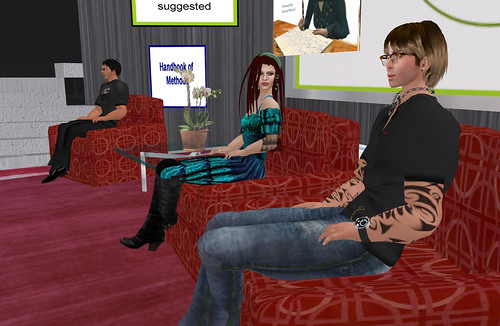
In late August, the Virtual Worlds Education Roundtable held a really interesting meeting in which we interviewed Tom Boellstroff and Celia Pearce, two of the authors of Ethnography and Virtual Worlds: A Handbook of Method.

I wanted to have a local audience attend, and most of them do not have avatars or did not see the need to sit in a virtual space to hear our speakers. With a laptop, a video adapter, and a big screen, I both hosted the local event and, as voice-to-text transcriber for the meeting, connected the virtual and physical audiences. I learned a few things:
  • Promote and arrive early. I always do for such events, using campus e-mail, plus direct appeals to interested faculty, staff, and students. Then I get to the room half an hour before the event in SL begins. This mitigates the usual problems of connecting to SL, teleporting to the venue, and doing sound-checks.
  • Second Life sound is lousy. To compensate, I had my camera location as my listening point, and I positioned the camera between our two speakers and moderator
  •  Focus is key. There was no need to show the crowd constantly. I focused the camera on the speakers, either from in front or just behind, and this avoided any raised eyebrows from avatars dressed like Hooters waitresses or body builders (such avatars were mostly non-academic visitors at the SL meeting)
  • Explain who, what, where. Some of my campus audience did not know the nature of the presenters' book or VWER. It took some quick task-shifting, but I was able to transcribe, provide side-notes orally, and share questions from our audience.
  • Provide interaction! Even with my system lagging, I was able to convey a few questions from campus and get responses from the virtual venue. We followed VWER with some real-life chat about the potentials of virtual worlds.
  • Be serious before, during, after. This is an academic audience. In my 2007 enthusiasm about SL, I wrecked a great chance to show good content to my audience of nearly 20 at a campus conference. What went wrong? Blathering about "the next Internet" and showing how easy it was to dance and change avatar appearance (to a Wynx Whiplash gorilla avatar, no less) was the stupidest thing I have done since my 21st birthday.
The audience on campus came away impressed by the professionalism of VWER, and they learned a great deal about the topic (read the transcript here). In other SL demos, the interface or world got in the way. Not that day, and I'll apply my tips to every "mixed reality" event I host from now on.

Wednesday, October 3, 2012

Patterns and Creatorverse: Speculations

Location: Linden Lab Web Site and New World Notes

At New World Notes, I have been eagerly watching, and contributing to, both the discussion about Patterns and the one about Creatorverse.

Now VWER will ponder what these mean for educators. Watch the videos first for Creatorverse, and then Patterns:


A few stabs at what all this may mean:
  • I am fond of the term "shared creative spaces" that CEO Rod Humble employs. But creative for whom? Shared by whom?
  • Creatorverse, as an iOS app, will give K-5 teachers (in particular) new tools for sharing content. My wife really likes what she sees there. Linden's signature product, Second Life, cannot be used in K-5 and even an "over the shoulder" use means getting the application approved by the censors and finding a rig hefty enough to run it well.
  • Creatorverse looks drop-dead easy. Ease will mean adoption, since both SL and OpenSim clients are too complex for my wife's  setting. Teachers don't have time.
  • Patterns may be easy, but it needs hardware similar to Second Life to run. My own MacBook Pro does not meet the specs. Not good.
  • Patterns also looks a lot like Minecraft. What will distinguish it and lead those in Minecraft to switch? Those  not using it to choose Patterns first?
More on what educators have to say, in light of the VWER discussion, soon.

Tuesday, September 25, 2012

The Ethics of Ethnography: A Transcript

VWER - August 30, 2012 
Location: VWER meeting

Image courtesy of Wrenaria

On August 30, authors Tom Boellstroff and Celia Pearce met to discuss their book, Ethnography & Virtual Worlds: A Handbook of MethodThe transcript of their voice interview with AJ Kelton is now available here.

Pearce, Boellstroff, and their coauthors have accomplished something important with this work. The ethics of working in virtual worlds should be paramount for anyone who calls him or herself an ethnographer. As I have opined here before, many folks in Second Life call themselves "educators," but what does that mean?

Whatever one's institutional affiliation or lack of it,  when doing research on human subjects, even those behind avatarian masks, two our VWER guests find essential the following points. The ideas were paraphrased by our transcribers, including me. Any faults are then our own, not Tom's and Celia's.

The Dangers Amateur "Ethnography"
  • "There is a danger…folks calling themselves researchers and publishing screen names of subjects" (Tom)
  • "one (person doing research) had sexual and romantic relationships (with subjects)" (Celia)
  • "One must have good research design and take care when generalizing. So there is no difference (between face-to-face and virtual research)" (Tom).
  • Both Tom and Celia use their real-life names in parts of their profiles to let subjects know who they really are. They do not use ALTs to conduct research.
  • "The popularity of people claiming to be ethnographers can undermine our work" (Tom)
One person at the meeting claimed that the point just made "sounds a bit elitist," and I'd prefer to say "no, it's merely professional." Anyone can turn a wrench or even replace parts on a car, but it takes a lot of professional training today to become a professional mechanic. The same is true for researchers.

Anonymity of Subjects:
  • In Indonesia, because gay men are ostracized, I often get pseudonyms from those I interview. This does not invalidate the research…and we cannot assume the same online " (Tom)
  • "My research ethics committee wanted paper signed copies and I could not do that, so this was new for the committee to get their head around" (Celia).
The book will provide benchmarks for all of us. I hope it starts a long and much-needed conversation as more and more virtual worlds emerge and researchers visit them. Even ones that be dressed as pirates, like Celia, and have that in their profiles! Avast!


Wednesday, September 5, 2012

What Educators Want in a Virtual World: All

Location: VWER meeting, Aug. 2


Late in July, I published my lists of wants for in-world features and technical features for a educational virtual world that I would build, had I time and money enough. Then I put the issue before 23 members of the Roundtable. Here is their list of wants:
  • Cross-platform & mobile friendly
  • Non-mesh build options
  • Cross-world travel and inventory control
  • Accessibility for users with visual and hearing impairments, such as easily visible icons, as well as text-to-speech and speech-to-text support
  • Media on a Prim (MOAP), including Flash support
  • Integration with Kinect & similar interfaces
  • Ability for students under 18 to access content (with my caveat of "freedom of, and from, adult content)
  • Better system for notecards
  • Working economy where content creators can be paid for their work but as JeanClaude Volmar warned us, "Just don’t make the economy so tightly coupled to the creator to render objects useless like it is in SL."
  • Avatar puppeteering and webcam support
  • Better permissions systems to allow more flexibility with collaborative builds
It seems we do "want it all," and many VWER members want a virtual world as a primary tool for teaching.

As readers know, I tend to agree with VWER participant Alan Sandalwood, who noted "I worry that we would try to do everything in VW; It’s a tool to be used judiciously."

My own students say a version of this: "what's the point? Our parents pay high tuition to be taught by a PhD in a classroom." For them, VWs are worthwhile for limited simulations or a field trip to see content otherwise unavailable. Other educators will use the technology differently and, in many cases, in transformative ways.

To read the Aug. 2 transcript, click here.

Monday, August 20, 2012

Who IS a Virtual Worlds Educator?


Location: SLED List

It may be easier to say who is most assuredly not.

A few weeks back, a colleague in VWER asked me "who is an educator" in a private IM.  I replied "well, if you teach at an accredited school..." but then I realized that some folks provide education to others in informal circumstances.

A story about Saj, one of my best students ever, came back to me. Saj is an Indian national who graduated to become a well known economist. He credited his considerable talent in mathematics to informal tutoring done, at a dining room table, by a retired professor who would work out equations by hand for a dozen Indian boys.  The teacher used recycled "green bar" computer paper for the teaching, and one by one he would write down equations and solve them for a horde of pupils who watched and memorized. They had a hunger to learn: Saj learned his "maths" by this method, and he had to watch the professor's work upside down, since Saj was the newest pupil and could not get close enough at the table to see the equations in their proper orientation.

So an accredited position does not an educator make, the material or virtual worlds.

But what makes  you NOT a educator? In the recent SLED-list discussion of Linden Lab's decision to offer SL through Steam, many participants fretted about rising graphics requirements for the virtual-world client. Then one soul chimed in:

"Game gfx have always been scalable. Just for the few that plop down a couple  hundred dollars on a new GeForce will gain the full experience.  Best $200 I ever spent!"

Easy for him to say! Imagine an educator telling students, "to take the course you must own a desktop PC and have this graphic card, or buy one, for something you will never, ever do again while enrolled here."

I have begun to reply to this SLED participant several times by e-mail, but I don't think I could do so politely.

Clearly, this person has not recently taught at a college, where nearly all students employ laptops of various, and usually middling, sorts. Nor has this person taught at any K-12 schools, where budgets are strained and computer replacement cycles run in the five-year range. While volunteering at one middle school in our city, I found that to order a replacement USB mouse from Central Office took six weeks.

Sure. Drop in a new graphics card, class! While a professional might spend that amount for a desktop upgrade...let's be serious. This is not the voice of any educator I know.

So let's try this an a definition: an educator is someone who not only works in an educational setting, be it a lecture hall or a dining-room table. An educator also understands the facts on the ground in these settings: what students need, what they can or cannot do, their level of motivation.

I am sure that a student like Saj would find the money to buy a new graphics card, if that were what he needed to excel in his studies. But most of my charges? It would mean dropping the class at best, grumpily slogging along and slamming me in my evaluations, at worst.

Now here, from the same discussion, in the voice of an educator:

"Interestingly the lowest res graphics game ...Minecraft...is incredibly popular...I don't think kids expect good graphics as much as they expect engaging learning, challenges that are relevant to their lives and acceptance that the world today (Google and the information repository it can search in your pocket) is different from the world 50 years ago (where you had to remember a lot of stuff). "

A new graphics card is a pain in the butt; engaged learning will pull the learner alone to all sorts of challenges, including those posed by rapid technological change.

Tuesday, August 14, 2012

Bringing SL Back to the Conference Room?

Location: Virtual Worlds Education Roundtable

Celia Pearce image from her Web site
Tom Boellstorff
image by Olivia Hotshot

I'm pleased that VWER will again host Tom Boellstorff, author of Coming of Age in Second Life, and Celia Pearce, author of Communities of Play, will be guests at a special meeting on August 30, 12:30 SLT. To teleport to the venue at Bowling Green State University in SL, click here.

Tom was an excellent guest before, and we'll all put questions to him in a voice-chat event hosted by AJ Kelton. I'm reading Pearce's Communities of Play now, and I'm looking forward to the two scholars next project, Ethnography and Virtual Worlds: A Handbook of Method.

This time, with two noted scholars and a venue that could be comprehensible to those without avatars, I have offered to show the meeting in one of our conference rooms on campus. Faculty and staff should then see the potential of virtual worlds for the sorts of meetings that would be hard to arrange and moderate on the fly in real life.

Given my experience with conferencing software, I also feel that virtual worlds offer a better venue that encourages less passivity. There is something powerful about embodiment, even as a cartoon character, that gets folks to talk back in a meeting.

Thursday, July 26, 2012

From Scratch, Key Elements for an Educational Virtual World, II

Location: VWER meeting

In my last post, I focused on the in-world features of an educator-built virtual world. Next week we'll debate that as well as this second big aspect of design: technical requirements. My suggestions for a virtual world that would please students and not hurt faculty evaluations:
  • Laptop + Wireless: Desktops are as dead in dorms here as are land-line phones. If an application cannot at least run on a laptop untethered from any cables (power cables too: students travel light) the application may as well not exist.  Students will seek out a desktop work station for projects requiring high-end apps, but the don't and won't own such. Try requiring students to visit a lab a few hours weekly, outside of class, to log into a virtual world many would find "creepy" anyhow. I'm glad I'm not you when evaluations are given.
  • Fast, Easy Start: the world must be drop-dead easy to install. No tweaking the viewer, no need to upgrade video cards. It must work right away to retain the attention of students and protect the course evaluations of their faculty.
  • Cross Platform: The Mac OS has jumped on my campus from 5% in the mid 90s to at least 40% two years ago. I now hear, but don't quite believe, it's at 70%. Clearly, any virtual world for students in higher education must work on a variety of operating systems and types of hardware, thus:
  • Browser Based: Cloud Party's use of WebGL as its basis trumps Second Life, which in its current form is nigh impossible to run in a browser. Making the world browser-friendly eases the leap to tablet computing, if this part of the market does replace the laptop for many users.
What have I forgotten?

Wednesday, July 18, 2012

From Scratch, Key Elements For an Educational Virtual World

Location: Thinking Cap in Place

After my few posts about Cloud Party and Glitch, I began pulling together a list of features that I'd want in a virtual world if I had unlimited funds and time to build one myself.

I plan to put this list of features to the vote with colleagues in VWER, before we hold a meeting about "What I learned from a silly game called Glitch" early in August.
  • User-Generated Content: The killer feature for virtual worlds used by educators. We can make and share our creations in a world that is, essentially, a big sandbox
  • Collaborative Permissions: Creators can transfer full ownership for shared builds so backups and exports are possible. Mixed-permissions builds in Second Life are a nightmare
  • In-World Building with Simple Tools: Again, for collaboration this seems very popular with educators
  • Offline Building with Professional 3D Tools: For advanced builders with 3D modeling skills
  • Local Hosting Options: Educational Institutions like to own their hardware and make backups frequently
  • The Illusion of a Contiguous World: World maps are available for Glitch, most OpenSim grids, and Second Life. In Cloud Party, to my knowledge no map is available
  • Several Means of Travel: All virtual worlds include point-to-point movement such as teleportation.  Those making simulations in a world, however, should be able to turn that feature off, so participants are forced to walk or ride to a destination. Second Life manages this well with settings for parcels and regions
  • Freedom of, and From, Adult Content: This will be contentious even among educators. I'd suggest that pornography is not needed in an educational world, but adult content, such as art-museum nudity or discussions of sexuality, is necessary for many educational purposes
  • Simulations Tools, Including a Physics Engine a Combat System: My students asked for this again and again in reviews of my House of Usher simulation. In realistic simulations, bad decisions have consequences.  Avatars in these settings should get tired, hungry, injured when appropriate. They might be able to "level up" for accomplishing goals in a course or assignment. This idea got suggested in Edward Castronova's Exodus to the Virtual World and I like it a lot
  • Simple Help Tools: Glitch wins on this. The designers' humorous approach to FAQs and the Pet Rock charm me every time I log on.
What did I forget? Sound off!

Friday, July 13, 2012

A Closer Look at Glitch, Reloaded

Location: Cebarkul and Far Afield

I will admit, in starting this post, that some of the material was probably in the pre-Beta Beta (or whatever the heck it was) that I played. But I'm liking the following aspects of Glitch. I'm assembling ideas for a future VWER meeting in which we actively plan beyond Second Life and OpenSim, to the features of the virtual worlds we educators would design.  My last two trips to Glitch have been far better than what I experienced last year and earlier this year. I noted, in my entry about Cloud Party, that the side-scrolling interface and lack of realistic avatars were detrimental to my fun.

But Tiny Speck, who makes Glitch, have added depth to the game by giving players more information in an as-needed and funny way. And a little house to call home. So here goes with the features I like so far:

References at One's Fingertips: An Encyclopedia is available even before the player enters the world. Glitch's cute backstory has some surprising complexity. Thus the entry on the Giants helps a great deal, given the game's location: in their giant heads.

I was able to find out a bit quickly about the paths open to players, because a Glitch (the name of our little peopleoids) must chose a series of linked skills at some point. With the reset I'm back to level 2, but I'm thinking that as before, I'm going agrarian with skills related to animals and plants. Note that one's Pet Rock gives hints. Mine suggested that I become a "Porcine Pleaser" when I clicked the "show me" button below, even as it gave other advice about how to become a more effective Glitch:


There are oodles of skills in Glitch. but from the Web profile for each player, a refresher of what the Glitched learned and can do is as easy as clicking the timeline, as I did for one of the first skills I acquired, Animal Kinship I. Each accomplishment can then be Tweeted. I did that for my Hen Hugger badge. I know the world stopped on its axis when that Tweet appeared.

Simple and Clever Menus: Compared to Second Life clients, with their dizzzying array of choices, Glitch's are straight forward: a "player" menu with a character's stats and links to content, and an "imagination" menu (shown at the start of this post), with choices for learning skills and going on quests.

In comparison, it would take a Type A Cyborg to love the menus in Firestorm, let alone its "Advanced" menu.

Everyone Gets a Home Base and Collaboration Reaps Rewards: For now at least, all Beta accounts in Glitch include a home street. My Pet Rock told me that if I can get other Glitches to collaborate on projects on my home street, I get more benefits and bonuses.

For educators, collaboration is a key to Constructivist pedagogy. So any online environment that fosters it would be preferable to one fostering competition.

Humor that is not Cloying:  Way back when, the Lindens had snowball fights with residents in Second Life and have a shared account called "Pony Linden." Once at VWER John Lester (then Pathfinder Linden) showed up as Pony and explained that Linden employees took turns as Pony to greet and entertain newcomers, even offering rides.

Those days are long over and Pony Linden's account was sent to the glue factory.

Conversely, in Glitch my Pet Rock and every darned menu pokes fun at me and itself.

And, yes, there is a Shrine to a giant named "Pot." I thought I had imagined that last time:

Round of belly and capacious of stomach Pot is the Giant of Prosperity, with dominion over anything edible, cookable, munchable or nibbleworthy. Pot himself is not munchable. Do not attempt to munch any giants.

Every time I log out of Glitch, I'm warned "Wait! You were just about to win the game!"  I think that in terms of learning what a good virtual world should offer, I have already won. I'm far from an overarching theory about why I so like Glitch, in much the same way I liked Metaplace. At this point I only have a suspicion. Glitch lacks the gravity and gore of "serious" gaming, the festering drama that is today's Second Life, and the frenetic chase-the-monkey of most side-scrolling games.

There's some stoner magic at work in Glitch, some parody of Philip Rosedale's dream of a perfect online world. By not taking itself so seriously while fostering collaboration and non-violence without earnestness, Glitch charms. That may be utopia enough.