Showing posts with label Edward Castronova. Show all posts

Wednesday, July 18, 2012

From Scratch, Key Elements For an Educational Virtual World

Location: Thinking Cap in Place

After my few posts about Cloud Party and Glitch, I began pulling together a list of features that I'd want in a virtual world if I had unlimited funds and time to build one myself.

I plan to put this list of features to the vote with colleagues in VWER, before we hold a meeting about "What I learned from a silly game called Glitch" early in August.
  • User-Generated Content: The killer feature for virtual worlds used by educators. We can make and share our creations in a world that is, essentially, a big sandbox
  • Collaborative Permissions: Creators can transfer full ownership for shared builds so backups and exports are possible. Mixed-permissions builds in Second Life are a nightmare
  • In-World Building with Simple Tools: Again, for collaboration this seems very popular with educators
  • Offline Building with Professional 3D Tools: For advanced builders with 3D modeling skills
  • Local Hosting Options: Educational Institutions like to own their hardware and make backups frequently
  • The Illusion of a Contiguous World: World maps are available for Glitch, most OpenSim grids, and Second Life. In Cloud Party, to my knowledge no map is available
  • Several Means of Travel: All virtual worlds include point-to-point movement such as teleportation.  Those making simulations in a world, however, should be able to turn that feature off, so participants are forced to walk or ride to a destination. Second Life manages this well with settings for parcels and regions
  • Freedom of, and From, Adult Content: This will be contentious even among educators. I'd suggest that pornography is not needed in an educational world, but adult content, such as art-museum nudity or discussions of sexuality, is necessary for many educational purposes
  • Simulations Tools, Including a Physics Engine a Combat System: My students asked for this again and again in reviews of my House of Usher simulation. In realistic simulations, bad decisions have consequences.  Avatars in these settings should get tired, hungry, injured when appropriate. They might be able to "level up" for accomplishing goals in a course or assignment. This idea got suggested in Edward Castronova's Exodus to the Virtual World and I like it a lot
  • Simple Help Tools: Glitch wins on this. The designers' humorous approach to FAQs and the Pet Rock charm me every time I log on.
What did I forget? Sound off!

Sunday, April 17, 2011

No Exodus to Virtual Worlds for These Millennials

Location: Glued to Keyboard, Working (not Gaming!) on a Fine Spring Day

On reading Edward Castronova’s Exodus to the Virtual World, once again the types of Millennial I teach are nearly uniform in their disdain for a cultural migration to use avatars in our lives and work. I think my students represent a majority view of career-driven and affluent US college students. I’m told that our campus is not that unique.

Dare I claim a surprising Neo-Luddite response in this rejection of virtual worlds?  Irony of ironies: as a decided Neo-Luddite, I see occasional use of virtual worlds as an environmentally sustainable alternative to academic conferences, expensive brick-and-mortar training, and even some forms of cultural tourism. Our driving is wrecking our planet's ecosystem. The less we do, the better, and I welcome all forms of telepresence as alternatives to "commuting to the office." We're more likely to power our grid with alternative technology, or at least clean the point sources at power plants than we are to tidy up billions of tail-pipes emitting poisons.

But enough of my fears; there are plenty from the students for one post. The finest negative response came from this writer; it is nuanced in a way many others are not and I think it shows what I’ve intuited among the Facebook: Yes, Games: No mainstream of Richmond students.
I don’t ever see myself using a virtual world, but that could just be because of my current situation. In college, I am constantly surrounded by my friends and love talking to them and spending time with them face to face. I don’t picture myself wanting to spend ten hours a day online in a virtual world, instead of laughing out loud and talking to my real life friends. In addition, my opportunity cost of spending more than two hours a day online is too great. I would be failing all my classes because I would be giving up time to study to be in a virtual world. I cannot afford to essentially waste my time not being productive. I also do not like the idea of anonymity online. People can create avatars that don’t look anything like them and pretend to be someone completely different. While people can be misleading on Facebook, I know I only communicate with my friends, people that I know in the real world. Virtual worlds can be very private and people do not meet the people in real life with whom they are making alliances and friends with.
Here are a few other voices from their class blogs, almost all negative:
“I do understand that there are many people today who are already deeply involved in virtual worlds. I am not one of these people. Perhaps, because of this, I am biased against such worlds. I would much rather spend my time talking with my friends or furthering my education (getting my parents' money's worth).”

“In my experience, games (even MMOs) are something that is outgrown.  I know many of my friends (myself included) who played consistently throughout middle and some of high school and then left due to lack of extra time or lack of interest.”

“An overwhelming majority of college-aged kids view virtual worlds as time wasting, unproductive, and nerdy addictions reserved for the socially inept.”

“I’m sorry, but I will never spend hours interacting in cyberspace, nor will I allow my children or my children’s children to join the exodus to the virtual world.”    

“The current generation (The Millennials) is almost entirely preoccupied with social networking. ‘Facebookers’ as we are sometimes called, we would rather use virtual realities to connect with old friends from back home, not to escape the confines of daily life. So instead of being active users, we may participate maybe once or twice a week, giving us no reason to participate in the exodus.”

“What he describes is something so artificial and unnatural. There are many gamers out in cyberspace right now who want to escape their lives and transform into something they are not, however I am not one of them. The main issue is of avoidance and denial. When you assume these fake identities then you are essentially in denial of your own life. I don’t think its healthy not to deal with the issues present and escape to a virtual world.”
One contrarian voice notes “I think that our bias as successful college individuals also blinds us from other populations that use games to escape from their circumstance.”

This is my opinion as well. My students cannot imagine the modern version of Emerson’s “quiet desperation” of many individuals who seek escape, or those who see themselves empowered to do things not possible in real life. Those may be artists working in a new medium, explorers of simulations not possible here (to one blogger, I cited Ancient Egypt or the interior of the human heart as examples).

Another student was kinder to Castronova’s ideas:
We all want to be challenged and overcome obstacles in order to feel good about ourselves. Additionally, we want to have fun, to simply enjoy our existence and be happy. As Castronova puts it “helping people find happiness may involve something other than giving them the things they currently seek” (88). This is what these online games promise.
One student who feels good about virtual worlds stands apart from the rest and says a great deal about what they don’t see:
I could jump into a virtual world right now.
No, really. All I'd need is a secure income. I could be there 24/7, easy.

As I looked around the classroom when this question was asked, I had the feeling I was the only one who felt this way. Some of you are probably shaking you're heads right now, thinking "You're crazy," but I'll tell you why I can do it.

For one, I'm used to it. Sitting in front of a screen for hours is easy to me. When I'm not at class or with my friends, I'm plopped in front of the screen. Furthermore, I'm used to synthetic worlds. Being in a fake world with filled with real people who don't look like themselves is normal to me. I don't find it weird.

Secondly, just about everyone is already engaged in a digital world, whether they realize it or not. We've really already migrated over in Facebook. My best friend once told me, "The more friends you have on Facebook, the fewer you have in real life." And as someone who has over 400 Facebook friends, but less than 10 real friends she can actually trust, she would know. She's in her own world where she has lots of friends that are easily accessible no matter where they live, where she thinks other people care about what her status is, where all her photos are of her looking perfect, and where she only has to care about what she wants to.
Here’s how I answered a different student, and my response could have been to them all:
Your comments echo many in the class. I understand your disdain, but the number of generalizations is enormous here. I applaud you for admitting your bias.

Before we judge these individuals, we might try better to understand them. As noted in class, Richmond students are, in many cases, from sheltered and loving families who provide support and care.

It is very different beyond the campus gates, even for many in your age-group; in fifteen years, as a virtual worlds researcher, I will be most curious to see how the Millennial generation regards escapist entertainment online.

I disagree with Castronova's thesis; I think virtual-world use will increase among all age groups, but there will be no exodus. Usage will be as a casual and occasional escape or for limited professional purposes such as simulations for technical or military training and meetings.

Reality will instead become more and more difficult, under the strains of environmental damage, political gridlock, resource scarcity, and economic stress, and we'll learn to take better care of the real again as we strive to fix the things generations before yours broke.

My biggest hope for you Millennials is that the researchers who wrote Millennials Rising are correct: yours is the next "Great Generation" able to collaborate, remain cheerful, and solve problems without the slack and cynicism of my Gen-X peers or the narcissism and greed of the Baby Boomers.

Maybe if your peers stay in Reality instead of making the exodus, you can accomplish great things. Maybe you'll even use Facebook to organize your efforts!

Monday, February 14, 2011

Do My Students Need a 3D Web?

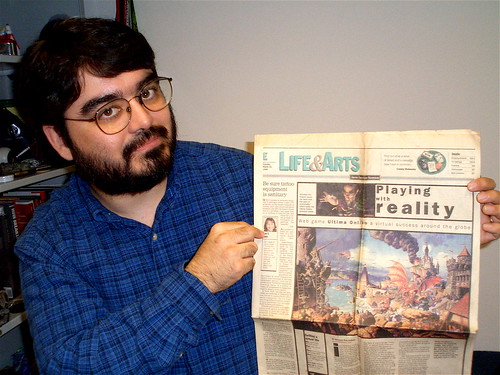
Raph Koster and old UO headline, Sony Online Entertainment, San Diego 
Location: Certainty

image credit: Raph Koster, of Ultima Online, Metaplace, and more, via Cory Doctorow's Flickr Photstream

"No," seems to be the uniform answer. The reasons say a great deal about the directions in which virtual worlds may not evolve. I put the question of "why haven't we gotten something like Gibson's immersive Matrix?" to my first-year seminar class.

I'll paraphrase the answers the came back:
  • Immersive engagement is best saved for when it is worth the extra work / software / time
  • Students prefer easy applications done "on the fly." In other words, they don't need an avatar to check the weather or send a short text to a friend or a relative
  • The less hardware needed, the better. Any rig like Case's would be tedious to use and hard to carry. An iPhone or similar fits into a pocket.
Would my students use a 3D experience? The answers here are complex. Yes, this group argued, for immersive gaming.  I don't know that current levels of virtual-world technology, with so much user-generated content, will ever enable that level of immersion. At best, they might make work for a class more fun.

We should look to other types of game-environments if we want something akin to Simstim or Case's rig. As I'll report soon, two technologists from a major defense contractor who spoke to VWER recently argued exactly that.

Will those emergent forms of 3D engagement replace our 2D Web? If my students are correct, no. It would, however, open worlds for gaming and for meetings, an ironic realization of Castronova's thesis that work and play will merge in the decades ahead. 

Monday, January 31, 2011

Four Years in Second Life. What Now?

Location: Montclair State University Virtual Campus

I've been setting out virtual furniture for a group of technologists from a major US aerospace & defense contractor who will be speaking at the next VWER meeting. Their firm is doing some amazing things with virtual worlds, mostly in OpenSim but also with technology that William Gibson would have predicted in Neuromancer : exoskeletons, VR rigs for antiterrorist training, and more.

Meanwhile, consumer-level VR interfaces make halting but continued progress. The Wii and Kinect are first steps to a future when such technology could meet  changing norms about being in virtual spaces. Even partial immersion "creeps out" too many of my peers and students. But what if, as Edward Castronova claims in Exodus to the Virtual World, norms slowly begin to change? Then we might experience something like Gibson's Matrix or Stephenson's Metaverse.

I don't plan to be in-world 24/7, but I'd like the option to be a tourist in such spaces, from time to time.

Linden Lab has been an early pioneer here, and though I've said intemperate things about them in the past couple of years, it's been more out of disappointment for what might have been. Perhaps we'd have all been better off without the media-storm in 2006 and 2007. It made us dream too big too soon. Now, however, that early optimism has changed to a balance of weariness and hard work. My colleagues are divided on the future of 3D immersive worlds. Some suspect they'll be a niche forever. Others, citing trends among younger Millennials, claim they will make the revolution to build a 3D Web happen.

I hope so. Though I like the older Millennials I teach, they are too serious and career-driven to start a revolution, and they lack enough experience with open-ended play to imagine one. They don't turn off their hive of social networking long enough to look deeply inside. They are always in a hurry. But they are nice kids. I worry about them when they get older and life throws them some curve-balls.

I hope their younger siblings show us all a few new tricks.

Whatever happens, as I look back over four years, my colleagues, friends, and I have been pioneers on the edge of what is possible with our computers. I don't feel like an SL newbie any more.

Are SL years like dog years? I blew through my rezzday without realizing it. I'm sorta over that.

Am I feeling charitable or could LL still be masters of this new reality? If not, they sure as hell gave us a good ride at times. I hope the new CEO can keep the torch lit and the ride will continue.