Showing posts with label legal issues. Show all posts

Monday, December 13, 2010

A Reply From the Frank Lloyd Wright Foundation

Mr. Wright & Mr. Wrong
Today this appeared in my university in-box. After the furor over the closing of the Virtual Frank Lloyd Wright Museum in the last 10 days, I was pleased to see the Foundation reply. My protest over the closing in my e-mail was civil, and I appreciate the civil and detailed reply given here.  If you want to editorialize, have a go in the comments.

The Frank Lloyd Wright Foundation (the Foundation) has received numerous inquiries regarding its decision to terminate the license relationship with Virtual Museums, Inc., the builder of the Frank Lloyd Wright Virtual Museum in Second Life. Misinformation directed towards the Foundation regarding the situation appears in press releases, blogs, and throughout the Second Life community and is perpetuating an incorrect and misleading perception of the Foundation’s position with respect to an educational presence in Second Life.

The Foundation and the owners’ of various Frank Lloyd Wright building sites own copyrights that give the Foundation and others the exclusive rights to copy and display Wright’s buildings and designs. The Foundation entered into a licensing agreement with Virtual Museums, Inc. (VMI) for installation of a virtual museum in Second Life that allowed VMI to reproduce the architectural designs of the homes and buildings created by Frank Lloyd Wright and protected by copyright and trademark law. It was the Foundation’s hope and intention that a virtual museum would be a positive and educational undertaking to allow architects, scholars, students, and a younger generation to be able to learn about the many aspects of Wright’s architecture.

The Foundation terminated the license agreement with VMI for numerous reasons, including the fact that several of the buildings as constructed in Second Life and displayed by VMI did not accurately reflect the buildings as actually designed by Frank Lloyd Wright. The Foundation further offered a new and revised license agreement to VMI’s new board and management but it was declined. The Foundation was disappointed that they could not obtain agreement with VMI as to the license agreement terms, but the Foundation and the real world Frank Lloyd Wright building site owners have a duty to protect the intellectual property and works of Wright.

The Foundation will continue to look for creative ways to work with academics, authors, scholars, reputable organizations and online and virtual communities to educate the public about the work and teachings of Frank Lloyd Wright.

Friday, December 3, 2010

Copyright Sniffing at Second Life Marketplace?

Falling Water in SL
Location: Frank Lloyd Wright Virtual Museum in Second Life

Cry, "Infringement!" and let slip the dogs of copyright!

This is quite the black Friday for those fearing over-zealous IP enforcement.  Tateru Nino and Hamlet Au have covered the snafu of the Frank Lloyd Wright Foundation's decision to not renew permission for The Frank Lloyd Wright Virtual Museum, an homage to the architect's work built in Second Life. I won't cover that, since both bloggers have done such a good job already.

Neither of them note, however, the red meat Linden Lab has thrown to prowling law-dogs, when LL pushed commerce to their online marketplace.

Hamlet notes that one reason for the reversal of an earlier decision to endorse the SL build was the Foundation's outrage over Wright-themed items on Second Life Marketplace. Never mind that the items were not made, sold by, or endorsed by the group in Second Life.

A concurrent event could make this situation far worse for, say, anyone in SL who makes a sneaker that resembles, not that I've ever seen such, a Converse All-Star. Tateru also reports, in another post, on a bill in the US Senate, "The Innovative Design Protection and Piracy Prevention Act," that would permit "prosecution of similar designs for clothing, which need not be limited to physical clothing, but also of virtual items. Formerly, only the trademark text, logos or other iconography on clothing was protected – but now the whole design" would be.

By making changes to search in SL that made many merchants close their in-world stores and migrate the online marketplace, Linden Lab began to reap revenue for each transaction in a way they could not from in-world locations. Of course, it lost tier payments for those merchants who closed their shops. What the Lab probably did not anticipate is how easy it can be to comb through a Marketplace search for "sneaker," even without a SL account, then flag copyright violations. Many interns and junior partners at law firms will be busy for years on this.

I suspect that the quarry will simply find a new home.  Such a waste of legal talent, when copyright holders, such as Wright's Foundation, might instead encourage homage in fan-created items.  After all, no one is making a replica of Falling Water in the world outside my window, then putting it up for sale as "just like Wright's masterpiece!"

It's ironic that Wright chose the term "Taliesin" for his studio.  In Welsh myth, the trickster/demigod/bard stole wisdom from the Goddess of the Underworld, Ceridwen. The goddess pursued Taliesin, who kept changing forms to evade her and her wrath. She finally got him, changing herself into a hen who ate the trickster, who had become a grain of wheat.  Ceridwen became pregnant and birthed a beautiful child, and she was unable to slay the reborn Taliesin.

Ultimately, Taliesin got away with his affront to a deity. I suspect that the sleek and greedy hounds of Copyright Law will make a lot of money chasing the protean figures who follow Taliesin's example. And yet, after a long chase, the hounds will lose their quarry in the wilds of the Internet.

Will Linden Lab lose business? No doubt. More commerce may come back in-world, but some will just shimmer and vanish, like Taliesin's becoming a salmon and swimming away.

Thursday, November 25, 2010

Here Come The Teens (Hide Your Pose Balls & Censor Your Profiles)

Public Orientation Island
Location: Linden Lab Blog

Terrence Linden seems to be assigned the tough jobs by his employer. He's an urbane man who visited the Virtual Worlds Roundtable a while back, just before the price-hike for education and nonprofits. We all liked what he said to us, then, though a week later I'm sure a few educators were saying entirely different things.

Now Terrence got the short straw and has to explain to residents how safeguards will work when 13-17 year old teens are permitted on Second Life's Main Grid next year. I waded through the comments to Terrence's post, I wondered what the changes might mean for those who teach, host sims, hold events, or develop educational content.

Our Profiles

First, we'll have to police not only our profiles but also those of visitors who come to our events on any sims zoned "General." Linden Lab is clearly not doing this, and though certain terms can be blocked automatically in classified listings, does the Lab have the ability to consider every photograph in a profile pic?

I just was at a VWER meeting with a woman whose name and profile noted her BDSM interests and even status as a teacher of these erotic arts. At a meeting with teens, I'd argue that she could not stay, nor could those with naughty group-titles or pictures in their profiles. Are we to AR such folks to prove due diligence? While I could care less what an adult does in private, once teens are legitimately "in the house," inaction will no longer be an option. Could a group who hosts events be sued in a US court? The sim owner? Linden Lab? All of above? We'll soon find out.

Naughty Cam, Naughty Click

For 13-15 year olds, to me it seems that Linden Lab's safeguards are sufficient. They will be locked down to estates where they have been sponsored.

But for 16 & 17 year-olds, who will be able to come to the Mainland, I agree with Ceera Murakami, who opined "Parcel bans to NOT prevent someone from camming into a parcel and buying content from vendors. They do NOT prevent anyone who is banned from interacting with content in the parcel they are banned from. The only "safe" thing to do with the arrival of the teens is to remove 100% of the content that is not G-rated from the mainland. Period. The vast majority of the Mature sims on the Mainland are within camming distance of one or more G-rated sims."

Linden Lab currently lacks the ability to police camming and clicking. One of my students, in Fall 2009, found many adult items in plain view on the Mainland just walking down the Linden-built roadways.

After the Teen Grid merges, no teen, in theory, will be allowed into a "Moderate" sim, the analog to the Mature sim. This, too, needs to be tested carefully before teachers bring their teens to the Mainland. My student later walked into a night club in a Mature sim to find a couple on a pool table, talking very dirty in public chat while warming up to have cybersex in front of the other patrons. Only my student and the loving couple can be seen here.

My student was not looking for this sort of content. He was part of my gender-or-race-change assignment, and he used in-world search to find popular social spaces to see how other residents would react to his female avatar. Not wanting a turn on the pool table, after an "Ewwwwww! Old folks doing it!" (and a snapshot!) he left. He was also 18 years old.

The Logical Fallacy of "It's No Different from the Internet"

How is our diddling among the pool balls different from what a minor might see on the 2D Web? A lot tamer, if it were only snaps. But I want to head off a rather facile complaint that "SL is no different from the Internet." In a PG-rated word, bullshit.

As an interactive environment, SL's content can "talk back" and educators make a great deal of how immersive it all is. We cannot argue that the environment is both more realistic than other online experiences and yet, when it comes to adult content, no different.

As meshes come to the grid, we'll make a big step closer to a photo-realistic metaverse.

My European colleagues will be scratching their heads over a lot of my concerns, but while the USA is not Iran, we have many thin-skinned moral conservatives who would not mind filing a law suit or two. We have conservative-activist Attorneys General in states like mine with ambitions for national office. A few appearances on some law-and-order TV show "protecting our children from online smut" would further such careers.

And we are a litigious nation.

It May All be Moot

While 16-17 year olds will be able to register from home, at school it may not be an issue. Even after the change, many schools will not touch SL with a 10-meter prim pole. My wife's county does not let any flavor of SL through its firewall, and having exceptions granted is a tedious business.

Personally, I'm not even bringing my of-age students to SL in 2011-12, since I'll be using Jokaydia Grid and my Usher simulation. Any who explore SL for class research will sign my usual waiver. By then, this mess may be sorted out. Or not. Linden Lab needs new customers, and getting teens in-world seems to promise that. I'd argue that they could have already signed up in droves for the soon-to-close Teen Grid, had Linden Lab spent money on marketing.

If Linden Lab wants more concurrency and dots on their map, they should have instead encouraged in-world shopping and fixed some of the extant problems with their grid. Merchants like Morris Mertel have closed their in-world (and teen-friendly) shops to go to the online marketplace.

I'm just glad my colleagues and university won't be dealing with this legal jungle.

Friday, August 20, 2010

Counterpoint: Why Educators Still Need Second Life (For Now)

Brain and Skull in jar
Location: House of Usher

It's all about content, content, content. Let's suppose one needed a human brain in a jar, for the hidden examination room of a twisted family doctor in, say, 1847 and, say, in an Edgar Allan Poe story.

To make such an item myself in Third Rock or Reaction Grids, I'd have to learn to make sculpties, scripted bubbles, and the jar. The jar part would be easy for me. But the rest would take me many hours for which, as an educator, I'm not rewarded one iota in my annual evaluation.

Let's see. Does "made brain in jar for immersive simulation of the examination room of Doctor Renfield Allan" come under "Professional Development," "Teaching and Scholarship," or "Service"?

You see my quandry: I would be stuck with making a lousy 2D brain in a jar. Now what self-respecting madman would own a flat brain? In Second Life, to add such an immersive prop, I went over to Xstreetsl and searched for "brain." Even "brain in jar" turned up several possibilities. Cost: 110L. Time required, 15 minutes. Back to essential work, such as finding illustrations from morbid Victorian medical texts.

For now, Second Life offers the sort of premade content, much of which can be modified to suit an educator's needs, free or virtually so. It's the best reason to build a simulation in SL, after one factors in the higher land costs, the per-upload fees, and the failure to provide off-world backups.

Eventually, the Linden Lab product will lose this crucial edge, but I'd hope that, if the Lindens wish to make money from other grids, that the Xstreeets site could alter licensing with creators to permit delivery to multiple grids. Technically that is possible and would lead buyers to purchase Linden Dollars or pull out a credit card.

It's a win-win for Linden Lab to leverage their residents' creations and their currency in multiple worlds. Why not do it?

If anyone at Linden Lab needs a spare brain, I've told you where to look.

Brain credit: Chrom Snook. Go buy one of Chrom's brains NOW. You know you need one. Act fast and get human skull in jar, gratis.

Friday, May 14, 2010

Legal Jungle for Virtual Worlds? An Expert Speaks

Roundtable May 3 , 2010
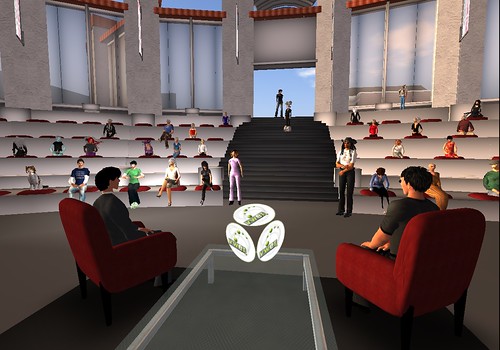
Location: Virtual Worlds Education Roundtable

VWER recently hosted Stephen Wu, known as Legal Writer in Second Life and a partner in the Silicon Valley law firm Cooke Kobrick & Wu LLP.

Wu explained that his "practice includes intellectual property and commercial litigation. My IP cases include trade secret, trademark, and copyright cases."

This meeting provided an excellent opportunity to quiz an attorney about some of the most vexing legal issues, and Wu told his that his opinions were "offered for informational purposes only and is not legal advice. Please consult an attorney if you have questions about your specific situation." That said, we were excited to glimpse the frontiers of jurisprudence that Wu and his colleagues confront in courtrooms.

Legal Problems in a New World

It's a difficult moment for them, since as Wu stated "I have seen the legal profession have trouble grappling with technology issues such as electronic discovery and digital evidence. Rapid and dramatic changes in technology may, in future decades, become overwhelming for the profession."

SL's international clientele makes legal matters even more complex. Wu noted that "Some countries may have laws making some contract terms written by U.S. companies unenforceable. In addition, businesses may need to comply with foreign privacy laws."

Among concerns for lawmakers, Wu pointed out that "For instance, governments are worried about money laundering in VWs."

I've often been curious about this issue. How on earth could a virtual currency be tracked across multiple transactions, then split between several avatars and then cashed out? In a time when we cannot keep track of stock derivatives for what happened with the Greek debt, I doubt that we'll ever track and control these new forms of income.

IP & Copyright

Several participants wished to know if greater content protection might be provided by Linden Lab. Wu felt it would be difficult, and if Linden [Lab] was unwilling to implement a system like that, you may need to find a different VW that is willing to offer that kind of protection. In other words, you may have to vote with your feet."

Regarding the Eros LLC case against Linden Lab (one of several, such as Evans et. al vs. Linden Lab and Fahy v. Linden Lab, that Tateru Nino has reported in her posts at Massively), Wu opined that Stroker Serpentine had previously brought suit against those copying his creations. In such cases "There is a section in the Copyright Act, which may be useful here." He continued "However, if there is not a contract it is difficult to prove." Finally, he qualified this statement as mere opinion and not legal advice, a good thing for an attorney to do in such a charged environment where legal precedent may not apply.

Terms of Service

As for complaints about Linden Terms of Service being excessively restrictive or altered post-facto for those who signed in under an earlier contract (what I and some wags and cynics might term a bait-and-switch tactic):

"One thing to be aware of is that Linden can restrict what you can do by contract, but there are limits to what Linden can do. If their terms of service place unreasonable conditions on use and the TOS terms are seen as unfair, it is more difficult for Linden to enforce restrictive terms.The restrictions may be challenged as unfair or deceptive trade practices."

Regarding the new third-party viewer policy, host AJ Brooks asked, "The user of the 3rd party viewer is not actually 'at fault' in any way in this policy then?"

Wu replied "Yes, that is what I am seeing at the moment. This policy could have been a lot stronger in terms of restricting non-creators from exporting objects." He added, regarding an export feature, "but if the Lindens' own software permitted non-creators to export objects, while third party viewers could not, then there might be an issue under competition (antitrust) law if that was a critical feature for users. It may also rise to the level of an unfair or deceptive trade practice."

This could make for some good television:

New Linden Lab Spokesman?

In other words, the Eros LLC case could be only the start of a much longer series of legal battles for Linden Lab. You can read the entire transcript of our meeting here.

PS to William Shatner: that is a derivative work and no infringement is intended. And if it ticks you off, come lay a beating on me. I have always wanted to get my butt kicked by Captain Kirk.