Showing posts with label academic culture. Show all posts

Thursday, July 31, 2025

A Bleak Future For Peer Tutoring in Writing?


Even before retirement from full-time teaching, I had concerns about how the concurrent emergence of AI and a neoliberal generation of senior administrators demanding "data-driven" programs and assistance might harm the autonomy of writing centers.

We are no longer lore-driven, but our work focuses first and always on human interaction rather than measurable results, work that proceeds from 50 years of scholarship and practice. What will ubiquitous AI mean for us?

We can see from the chart above, reflecting my Spring 2025 survey responses from students, that 3/4 admit to using AI for writing work. Though the survey was anonymous, I suspect the percentage to be far higher. To paraphrase what several students said in textual responses, "we are all using it, no matter what professors say." In Summer 2024, I attended sessions at the European Writing Center Association where directors reported declines in usage at their centers, as students turned more to AI for just-in-time assistance during hours when centers are closed.

I've called elsewhere for writing-center staff and administrators to be leaders as AI advances, so folks who do not teach but presume to lead universities do not tell us how to do our work. At stake? What I call a "Dark Warehouse" university on the Amazon model: much human labor replaced by technology, delivering a measurable product when and how consumers want. It's not a bad model for dog food or a cell-phone case, but it's terrible for the sort of human-to-human contact that has built the modern writing center.

I need more data from my and other schools to make any big claims, but I will focus on the AI's role in this possible and disturbing future, with some data from my student surveys of the past three years.

We had a smaller number of respondents this year than in the past (in 2023, n= 112, in 2024, n=74 , this year n= 47). Without a cohort of Writing Consultants and teaching fewer students myself, my reach was shorter, and I relied upon notices via our campus e-list. Faculty may not have sent out the survey either; many (too many) still ignore AI and others seem disinterested in knowing what students are doing. I have no empirical evidence for these claims, but my gut reaction and stories from other campuses lend support to my hunch.

Here is another chart from the current data from Spring, 2025, for the 3/4 of respondents who used AI in some manner for writing:

Some of the "create a draft" labels get cut off, but here are the options:
  • Create a draft I would submit for a grade: 1 respondent (3%)
  • Create a draft I would not submit but use to get ideas for structuring my draft: 11 respondents (33.3%)
  • Create a draft I would not submit but use to get ideas for vocabulary or style: 8 respondents (24.2%)
  • Create a draft I would not submit but use to incorporate sources better: 6 respondents (18.2%)
The range of uses from the chart maps well onto the tasks done by writing centers, except we don't write anything for clients, beyond modeling a sentence or two. We ask questions of writers, which some systems such as Anthropic Claude began to do as recently as Spring 2025.
 
Interactivity in natural language, with the first metacognitive questions from AI, raises a question or three, involving how AI might replace human tutors especially in the wee hours or at the busiest times of the semester. I've found assessment of drafts (with the right prompts!) can be as good as the feedback I give as a human.
 
Ironically on my campus, we've made seeing humans more onerous. As institutions like mine want to measure everything, there's an irony: students may simply seek commercial AI instead of campus services. My institution set up a rather onerous system for students to set up meetings. The intentions were good (track students' progress and needs) but undergrads are simply not organized enough, in my experience, to heed the details needed to book meetings. Many exist in a haze of anxiety, dopamine fixes from phones, and procrastination. ChatGPT asks for nothing except a login using their existing credentials.
 
The notion of walk-in appointments, which had been the rule when I directed the center, remains for us at Richmond, but students get pushed to the new system and need to register even during a walk-in. This added level of bureaucracy confused and daunted many who stopped by, during my final semester of full-time work, when I worked one shift weekly myself as a writing consultant.
 
I argued against adding more complexity to our system, in vain. The collected data on writers seemed sacred. We had to count them, to count everything. My counterpoint? You want students to come? Just let the kids walk in and help them; the human helper does the bean-counting later. AI, on the other hand, invisibly counts those beans for its corporate owners (and trains itself). It serves needs at 3am and in a heartbeat. One need not leave one's chair to get assistance that, as my students have found in my classes, steadily improves by the semester.
 
Instead of wrestling over social-justice concerns in our journals, we might focus our limited time on how to avoid becoming amateur statisticians for Administration. We might concentrate our energies on how we get students to come to us, not AI, when they are stuck or panicking. 
 
I have no clear advice here, except: make a tutorial with a human as seamless as with AI. That goal seems more important to me than all the arguing about students' rights to their own voices, since AI tends to reduce prose to a voiceless homogeneity. Getting students to see human tutors offsets some of the environmental and labor consequences of AI, too. If students see humans more, their carbon footprints are smaller and those tutors stay employed. 
 
Get them in our doors and, yes, employ AI ethically for refining work already done, to add voice and nuance, to remove falsehoods dreamed up by machines, and say something exciting. I'm pessimistic that our bean-counting, non-teaching leaders of many colleges will heed my advice. The Dark Warehouse seems more at hand than when I published my article early in 2023.


Wednesday, May 1, 2013

Leaving Las Vegas: 6 Years in Virtual Worlds, Farewell

VWER 25 April 2013
Location: Grading Finals

During the Spring Semester of 2007, this fool rushed into Second Life, something he felt would not only change education but the world beyond. Virtual worlds looked like a utopian technology with lots of zealous folks ready to evangelize the masses.

Six years later, grading what may be my last-ever student projects about virtual worlds and somewhat wiser, this educated fool wonders why SL did not change the world or even higher ed. I've written elsewhere about why SL failed to become that "3D Web" of yore.  Meanwhile, the bandwagon has moved on, the cheerleaders yelling "hurrah!"and "higher education will never be the same!" for MOOCs.

I'll sum up what I've learned about utopian narratives and would-be transformative technologies here, based on not only the last 6 but the last 25 years of studying and writing professionally about technological change, especially that which generates legions of enthusiasts.
  1. Look past the message to the messenger
  2. Wait for results unless you are an entrepreneur or venture capitalist
  3. Be a trailing-edger
  4. Find community locally, not just online
  5. Consider what students have in their hands
Lesson one: Look past the message to the messenger

I first head about Second Life in a story from Wired. That is not a sedate or juried publication; it's the Popular Mechanics of the digital era. Ever the sucker for flying cars and moon bases, I decided "I need to get in early with this technology," not considering that one company, with a closed platform not built for education, held the cards. I trusted the vision of Magic Koolaid provider, Philip Rosedale. Linden Lab's corporate culture and Rosedale's wandering vision both disappointed this educator, along with many colleagues.

Who is pushing MOOCs today? College faculty members? Technologists who embrace the new without considering pedagogy of large classes with little or no contact with faculty? Right-wing lawmakers eager to dilute the power of those "tenured radicals" supposedly in charge of Higher Ed? Boards of Visitors eager to promote a school "brand" without a clear sense of what it will do to curriculum, staffing, or the long-term value of that "brand"?

Ask yourself, and take a deep breath before jumping on the band wagon.

I do wish I'd looked past the euphoria about virtual worlds in 2007 to see who was cheering most loudly.

Lesson Two: Wait for results, unless you are an entrepreneur or venture capitalist

I was not in virtual worlds for the money. As noted just now, I wanted to be in on "the next Web," as many were then pitching SL. In 1993, when I first saw a moving weather-pattern on the Mosaic browser in Dickie and Cindy Selfe's lab at Michigan Tech, I knew I was seeing something historic. In 2007 I thought so again, without applying the very critical-thinking skills I teach my students.

From 2003-06 or so, it made sense for venture capitalists to take a bet on this new technology. It might have become the next Web. Educators, however, need to always place sound pedagogy ahead of tech, which is a suspicious I have about the euphoria over MOOCs at the moment. I saw that same brand of enthusiasm for MOOs in the late 80s and early 90s, literary hypertext a bit later, glove-and-goggle VR from the 80s to the present, and of course, virtual worlds.

While one might reasonably claim that virtual worlds are going to become significant culturally, I'd suspect lots of Magic-Koolaid drinking by an educator who claimed SL will ever again be more than a niche-product in years to come. AJ Kelton of VWER rightly called SL "The AOL of virtual worlds" to the disdain of several Linden Lab staff. AJ was correct, and the Lab staff in question now work elsewhere, after being fired during the first stages of Second Life's ongoing and palpable decline.

Bottom line for me: waiting to see if SL lived up to its hype would have cost me nothing in 2007, and would have saved me time. Had I first taken a class in-world in 2009, I'd have been ready for the myriad frustrations and technical issues that bedeviled a product that seemed very much in Beta up to that point.

Lesson Three: Be a trailing-edger

During the summer I spent with the Selfes and their grad students at Michigan Tech, Richard "Dickie" Selfe, co-founder of that school's CCLI humanities lab, along with wife and fellow scholar Cynthia Selfe, once told me only to adopt trailing-edge tech for teaching and learning. The Selfes were among a group of 1980s pioneers with personal computing in the classroom, and Dickie's lab at MTU was a playful space, with stuffed animals, a coffee machine, snacks, and weekend gaming sessions with Doom and similar titles.  I'm sure that at Ohio State they continue this practice, so influential to young scholars of writing pedagogy in writing-intensive curricula.

At every step, while the Selfes liberally experimented with leading-and-bleeding-edge applications, in the classroom they proceeded more carefully with undergraduates. The older technologies were stable, easier to support, and grounded in best practices for teaching.

My experiences in 2007-8 in SL, and then in 2011 with OpenSim's Jokaydia Grid, taught me the dangers of being on the bleeding edge. My students and I bled. Only Jokay's personal help saved the final exam in 2011, but it left a bitter taste in my mouth for teaching with OpenSim. As for SL, only by 2009 was it stable enough for a class to appreciate. That class was, ironically, my last one to focus on the technology, rather than using it for a single project.

Today, SL as a product is fairly stable, and critical and scholarly work about virtual worlds has emerged to guide our pedagogy. One would be far better off starting today as a SLer with students, given these two changes. Those on the bleeding edge, however, get cut by it.

Lesson Four: Find community locally, not just online

My years with the Virtual Worlds Education Roundtable have been good ones, and I cherish the faculty contacts I have made there. That said, the weekly meetings and constant advice did not compensate for a lack of interest in virtual worlds on my campus. With other innovations, from our Writing Consultants program to First-Year Seminars, we meet in person and I have lunch with folks in the flesh. There is no substitute.

Our technologists all had avatars before I did, but they never convinced more than a handful of faculty to try SL. The learning curve, the oddness of avatar-based education on a residential campus, and the lack of incentives for faculty all worked against us.

In the end, SL was an experiment that failed at Richmond. When Linden Lab renewed the 50% discount for education (if you ask the right person!) we declined. Why spend even $150 monthly for a product that might be used once every few years by one faculty member? Meanwhile, our technologists have other more tasks, from supporting Blackboard and other meat-and-drink software to  new initiatives with mobile apps.

Mobile may turn out to be the "new shiny object" for education, but it's not a niche application for students. As for MOOCs? I will wait to see comparative studies of students' learning outcomes in them and outside them. That should have been done for virtual worlds.

Lesson Five: Consider what students have in their hands

The transition to smart phones as students' primary communications tools has changed everything for us. While laptops abound, students use them like big phones: never plugging in the AC adapters, perching them in nooks where Millennnials gather to collaborate, plastering them with stickers to personalize them. I suspect that with a better keyboard, students would do their content creation on fast tablets, since we have ubiquitous and fast wireless everywhere on campus.

None of that I could have foreseen in 2007, since I did not even slow down enough to consider how poorly SL would run on many laptops, especially those not hard-wired to an Ethernet port or plugged into a AC outlet.

Even with desktop connections, students loathe SL's lag. I saw that last week in the finals. Perhaps server-side baking from Linden Lab will make SL run better on what my students still use for content creation--laptops--though not on phones, where virtual worlds simply cannot display with any sort of grandeur.

But by then, Iggy will have left the virtual building.

Coda:

I'm thankful for an experiment of six years, even if the experiment failed. At least virtual worlds generated two publications for me, as well as a forthcoming anthology I'm co-editing with some chapters about virtual worlds. I don't write the rules, but publications and teaching evaluations are the currency of academia, despite the best wishes of utopians that it be otherwise.

It is always possible that my teaching load will shift again, and my Chair and Department will call on me to teach my course about the history, culture, and future of Cyberspace. In such an event, Iggy and his students will be back. Look out.

Tuesday, October 30, 2012

Hosting a Mixed-Reality Event the Right Way

Location: Conference Room at Work

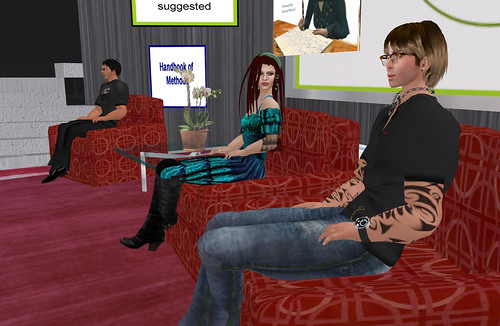
In late August, the Virtual Worlds Education Roundtable held a really interesting meeting in which we interviewed Tom Boellstroff and Celia Pearce, two of the authors of Ethnography and Virtual Worlds: A Handbook of Method.

I wanted to have a local audience attend, and most of them do not have avatars or did not see the need to sit in a virtual space to hear our speakers. With a laptop, a video adapter, and a big screen, I both hosted the local event and, as voice-to-text transcriber for the meeting, connected the virtual and physical audiences. I learned a few things:
  • Promote and arrive early. I always do for such events, using campus e-mail, plus direct appeals to interested faculty, staff, and students. Then I get to the room half an hour before the event in SL begins. This mitigates the usual problems of connecting to SL, teleporting to the venue, and doing sound-checks.
  • Second Life sound is lousy. To compensate, I had my camera location as my listening point, and I positioned the camera between our two speakers and moderator
  •  Focus is key. There was no need to show the crowd constantly. I focused the camera on the speakers, either from in front or just behind, and this avoided any raised eyebrows from avatars dressed like Hooters waitresses or body builders (such avatars were mostly non-academic visitors at the SL meeting)
  • Explain who, what, where. Some of my campus audience did not know the nature of the presenters' book or VWER. It took some quick task-shifting, but I was able to transcribe, provide side-notes orally, and share questions from our audience.
  • Provide interaction! Even with my system lagging, I was able to convey a few questions from campus and get responses from the virtual venue. We followed VWER with some real-life chat about the potentials of virtual worlds.
  • Be serious before, during, after. This is an academic audience. In my 2007 enthusiasm about SL, I wrecked a great chance to show good content to my audience of nearly 20 at a campus conference. What went wrong? Blathering about "the next Internet" and showing how easy it was to dance and change avatar appearance (to a Wynx Whiplash gorilla avatar, no less) was the stupidest thing I have done since my 21st birthday.
The audience on campus came away impressed by the professionalism of VWER, and they learned a great deal about the topic (read the transcript here). In other SL demos, the interface or world got in the way. Not that day, and I'll apply my tips to every "mixed reality" event I host from now on.

Friday, October 12, 2012

Cory Ondrejka's Vision, 8 Years On

Location: Reading Desk

I have had a great deal of academic fun reading Ondrejka's 2004 article "Escaping the Gilded Cage: User Created Content and Building the Metaverse" (get a copy here). I'll provide a few page references below, but not a works-cited list (this ain't no formal article, yet!).

Hamlet Au mentioned it over at New World Notes recently, and I decided to have a look at the creative fire from an era when the investor-utopians, and not the CEOs and bean-counters, planned to build something akin to Neal Stephenson's metaverse from Snow Crash:
This article will argue that creating a defensibly real, online world is now possible if its users are given the power to collaboratively create the content within it, if those users receive broad rights to their creations, and are able to convert those creations into real world capital and wealth.  This would be the Metaverse of Stephenson’s imagination. (Ondrejka 4).
Ondrejka, a supporter of Cloud Party, is still at it, and I like the way that new virtual world has seized the creative fire that Second Life, with its balky interface and legacy code, may never achieve. Cloud Party already has an avatar building kit, and while the results do not match what we have in 2012 SL, they are impressive for a world so young. As I get ready to play Patterns for the first time, however, I also wonder if it's too early to count Linden Lab out of the game.

What did Ondrejka want in 2004? Here are a few claims he makes that excite me still. I won't focus on the author's economic musings. They are fascinating, but I'm more concerned with his arguments about engagement and immersion.

User-Generated Content: Give Me Sandbox AND Arena

As Marcello DellaCarpini, my Vodacce character from the game 7th Sea, would say, "Two famous Vodacce sayings apply to such matters. First 'When in doubt, just make something up and say it with a straight face.' Second, 'It is never really fun until someone is caught on fire, run through with swords, made into an pincushion for archers, or eaten by monsters. Preferably someone you cannot stand.' "  Marcello made those both up, of course, on the spot for good RP. Creation, both verbal and physical, are essential:
People want to be perceived as creative by customizing their surroundings. People want to have their moments on the stage. In many cases, it seems that users are just waiting for access to the right tools (Ondrejka 9).
Due to the in-world tools and lack of a submission process, Second Life’s users have been able to create an amazing amount of content. At the end of May 2004, users had created more than one million objects, over 300,000 objects with scripted behaviors, and over 300,000 pieces of clothing (Ondrejka 10). 
I have long argued that UGC is the "special sauce" keeping me interested. I can destroy things in a thousand games, but in how many can I make them?

Eventually, both sorts of play will co-exist. What we call on my weekly Nerd Night "the minimum daily requirement of violence" in games will only take us so far.

If game designers want to attract my sort of relatively well-heeled customer and hobbyist, they need to consider two sorts of sandy spots where a type of "play" occurs: the sandbox and the arena.

Emergent and Predictable Behavior:

Ondrejka notes that when one drops and object, one expects it to fall. To fall back on a favorite expression of mine from Snow Crash, designers must not "break the metaphor" by, say, letting folks "beam in" to any location. Though many sims in Second Life support that type of movement, it's more predictable that one would walk or drive from a fixed point to the destination; this is what the original Linden Lab "telehubs" wanted to do.

Not breaking metaphors, whether gravitational or spatial, is predictable behavior.  Ondrejka contends that successful metaverse must support behavior that only emerges with creative play (15-16). In my OpenSim House of Usher simulation, for instance, I had no way to injure other characters when I was in the role of Roderick. I found that, however, I could rid myself of over-inquisitive guests by pushing them off the edge of the virtual region I rent at Jokaydia Grid. This was a software bug in OpenSim, but it served my purpose: through emergent behavior, I'd found a way to drown nosy and suspicious visitors to The House of Usher.

So When Do We Get our Metaverse?

Emily Short, working with Linden Lab on a new and non-SL narrative game, notes in a Gamasutra interview that the sort of game Ondrejka calls for would be lovely but it is not currently available:
Something that I tended to think was unfortunate about certain MMO storytelling... you get these narratives where the NPCs have lots of really emotive things to say to you, and they want to throw you into this narrative. Then on the other hand, your interaction with the characters played by humans -- even if they're inclined to play it in a very role-playing way and they're not running around shouting trollish remarks and that sort of thing, even if they've entered into playing that role, because of the way it's structured, none of the conversations you ever have with them are ever going to be acknowledged by the story as meaningful pieces of the story.
I have no time for childish players who type in text abbreviations or talk in voice like extras from The Jersey Shore. I am a snob. I would not even consider RPing in the local game shop; my preferred groups are guys I've known for 30+ years or a bunch of fellow PhDs who were with me during graduate study. Neither group is trollish but both can be a bit silly, to add humor to a gamemaster's crafting of a scenario. Neither group is childish.

So how can a game engine ever let players into the story as co-creators, as can happen in an SL roleplay sim or tabletop RP? One of Short's commenters noted that we'd need AI that could serve as a "dungeon master."  When will that occur?

Quantum computing, a gleam in the eye of many of us, recently got a public boost by the 2012 Nobel Prize in Physics. With processor speeds that fast, we may see something like the magic of Stephenson's vision realized.  Until I have that sort of power in my palm or my laptop, I will read the dreams of Ondrejka, Rosedale, Short, and Stephenson and keep hoping.

Top hat tip to Hamlet Au, for covering both Ondrejka's and Short's ideas.

Tuesday, September 25, 2012

The Ethics of Ethnography: A Transcript

VWER - August 30, 2012 
Location: VWER meeting

Image courtesy of Wrenaria

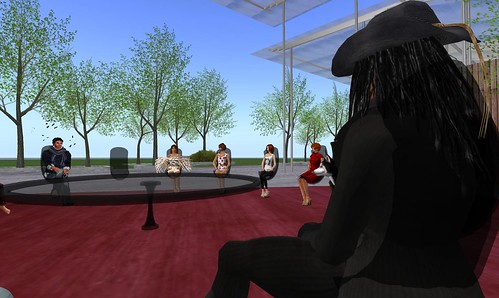
On August 30, authors Tom Boellstroff and Celia Pearce met to discuss their book, Ethnography & Virtual Worlds: A Handbook of Method.  The transcript of their voice interview with AJ Kelton is now available here.

Pearce, Boellstroff, and their coauthors have accomplished something important with this work. The ethics of working in virtual worlds should be paramount for anyone who calls him or herself an ethnographer. As I have opined here before, many folks in Second Life call themselves "educators," but what does that mean?

Whatever one's institutional affiliation or lack of it,  when doing research on human subjects, even those behind avatarian masks, two our VWER guests find essential the following points. The ideas were paraphrased by our transcribers, including me. Any faults are then our own, not Tom's and Celia's.

The Dangers Amateur "Ethnography"
  • "There is a danger…folks calling themselves researchers and publishing screen names of subjects" (Tom)
  • "one (person doing research) had sexual and romantic relationships (with subjects)" (Celia)
  • "One must have good research design and take care when generalizing. So there is no difference (between face-to-face and virtual research)" (Tom).
  • Both Tom and Celia use their real-life names in parts of their profiles to let subjects know who they really are. They do not use ALTs to conduct research.
  • "The popularity of people claiming to be ethnographers can undermine our work" (Tom)
One person at the meeting claimed that the point just made "sounds a bit elitist," and I'd prefer to say "no, it's merely professional." Anyone can turn a wrench or even replace parts on a car, but it takes a lot of professional training today to become a professional mechanic. The same is true for researchers.

Anonymity of Subjects:
  • In Indonesia, because gay men are ostracized, I often get pseudonyms from those I interview. This does not invalidate the research…and we cannot assume the same online " (Tom)
  • "My research ethics committee wanted paper signed copies and I could not do that, so this was new for the committee to get their head around" (Celia).
The book will provide benchmarks for all of us. I hope it starts a long and much-needed conversation as more and more virtual worlds emerge and researchers visit them. Even ones that be dressed as pirates, like Celia, and have that in their profiles! Avast!


Monday, June 13, 2011

Annual Report Time

bradbury_005
Location: Microsoft Word

How do you capture the coolness of working with virtual worlds while using the most boring piece of software imaginable?

For the past four years, that has been my challenge, just in time for my 1 July deadline.

This year, the Usher Project in Jokaydia Grid has some of the same committee members excited about the grant and the potentials for literary study.

I'd be curious to see how other faculty with annual evaluations, rather than tenure, report their work in virtual worlds.  I hope that all of my evaluators will take time to look at a simple wiki with Viv Trafalgar's video of the Usher project that existed in Second Life, to give some sense of what will happen in a different virtual world where I'll have more creative freedom.

Without incentives and rewards, this work will never move forward in academia. It has long been that way for other technologies that are easier to master.

One day, we'll have smart paper with working videos embedded, or my committee will read e-texts on tablets. That's one day, not today.