Showing posts with label teaching. Show all posts

Tuesday, April 15, 2025

The CCCC and Refusing AI: A Rebuttal

A long dark hallway in a hospital

Funny thing about academic conferences; they always go smoothly but when I'm not at them, I frequently have bad dreams about attending these meetings. These involve getting lost in long, dark hallways, finding that my room in the conference hotel no longer exists or is flooded, taking the wrong Metro train and ending up in another town at the time I'm supposed to be speaking. In one nightmare, I ended up driving my rental car on an ever-worsening road. Soon the car and I were pinned in on all sides by tall trees as the sun set.

After CCCC 2025 this month, however, I am having a bad dream of the waking sort.

I was gravely disappointed by an address given by the current chair at the Conference on College Composition and Communication. The chair's remarks at the conference echoed her and her co-authors' sentiments in "Refusing GenAI in Writing Studies: A Quickstart Guide," a thoughtful document but one, in its own way, that could prove as dangerous to our work as educators as could Ethan Mollick's overly enthusiastic book Co-Intelligence. 

17 April Update: A transcript of the Chair's talk at the conference has been published. It's worth a read but remains, on my first reading, aligned with the ideas in the post linked above.

Of many disagreements I have with the authors' stance, this section struck me as one of its most misinformed moments:

we must be careful of uncritically accepting the notion that GenAI in its current form will inevitably be widely taken up in the corporate sector and we must therefore prepare students for that time now.

That's pretty much an insult to those of us in the field who are trying to grapple with what AI may mean for our schools and students. We have been anything but uncritical, yet as the adult professionals taking my current class tell me, the inevitable has already occurred. Companies are racing to implement AI at many levels; the authors' statement smacks of Ivory-Tower isolationism.

In future posts, I hope to critique other aspects of the refusal guide. The statements about marginalized students, for instance, ignore how powerfully AI can assist neurodivergent writers as well as those from disadvantaged backgrounds. For now, however, I want to focus on why we writing professionals must be at the table as AI becomes an inevitable part of our curricula. 

We don't know the pace of that change; AI may hit a reverse salient in its development. One potential setback appears in Matteo Wong's article in The Atlantic; an industry expert claims that AI firms are misleading the press and public about how rapidly their models are improving. Essentially, companies may be fudging data on benchmark tests used to assess AI performance, as compared to human test-takers. 

If true, we could have Ethan Mollicks' first model of an AI future: today it is "as good as it gets."

I'd welcome that pause, so we in education could catch up.

Lead or Be Led?

Whatever the trajectory of AI's evolution, we writing professionals have always engaged in a service enterprise. Or is that simply the voice of a (semi) retired and non-tenured writing-center director? All three of the authors are tenure-stream faculty. Yet as I'll explain, that privilege does not protect them or their programs from institutional changes.

Writing programs are not owned by writing directors or even faculty; they belong to an institution and can be shifted around or simply cut much more easily than can an academic department. I saw this happen at a state university nearby; first-year writing was taken from English and placed in a new unit that answered to the Provost. The two tenured writing faculty stayed in English, teaching other things, until they retired. Not long after, the school's writing center moved out of English as well.

How we hire and promote administrators in higher education varies by institution, but in my experience, many newcomers have advanced degrees in fields such as Higher-Education Management and lack the classroom experience of my colleagues. We cannot expect them to appreciate the rarefied culture of the professional scholar, the culture that informs the CCCC's nay-saying. That said, these same administrators are not necessarily flinty-hearted villains. 

Many I meet are very concerned, and rightly so, about how AI changes our work as institutions or may threaten higher education as we understand it. At the same time, students and their future employers expect us to provide training in effective communication, and today that includes using AI. Of course to me, best use means employing AI wisely, reflectively, and ethically.

In consequence, I fear that if we in writing do not lead on AI, we will be lead. It is therefore imperative to get ahead of institutional or governmental fiat and be leaders on our campuses, as we shape policy about AI usage. I also fear more than ever, seeing the Quickstart Guide, that senior scholars might, from good intentions, usher in what I have called "The Dark Warehouse University," a dystopian, outsourced future for all but the most elite institutions of Higher Ed.

Toward a Rebuttal: A Quickstart Guide For The Wary Adopter

  1. Faculty must experiment with AI to learn its affordances and pitfalls. They must test new models and advise administration about their potential for good or ill, regarding how students learn and acquire critical-thinking, research, and writing skills.
  2. Students must learn to use AI in reflective, ethical, and critical ways, if they wish to add value to its output. If they cannot add value, many of them will not have jobs when they graduate into AI-centric workplaces.
  3. Resistance by the tenure-stream faculty may be principled but it also further erodes the position of general education, particularly the Humanities, at a time of rising autocracy and attacks on higher education in the US.
  4. Corporate capitalism drives the US economy and though this author does not like that fact, most of our institutions of higher education could not exist without that economy. We need to understand what drives it, reveal and resist its excesses where feasible, yet acknowledge that our students need to actually find work, a good deal of it in corporate settings.
  5. We in Writing Studies should lead as champions of ethical, pedagogically effective AI usage. Such an approach would include cases for when we do not wish to employ the technology as well as learning how and when it hampers learning such as developing critical-thinking skills or detecting misinformation by humans or AI.
  6. We must, as the Quickstart Guide states, teach students the environmental costs, labor practices, and biases involved in building, training, and using AI. At the same time, with colleagues from Computer Science, we should partner to build better AI, just as our campuses pioneered Web applications and technologies such as synchronous conferencing in writing classes.

A former CCCC chair, Cindy Selfe, prudently called upon us to study the technologies that others want us to use in the classroom (2008). Cindy can get after me if I have this wrong, but the current CCCC approach to AI smacks me as a "peril of not paying attention" to a technology far more influential than our writing classrooms and centers. Isabella Buck, in her keynote speech at the 2024 Conference of The European Writing Centers Association, noted how AI creates new content, for good or ill; our prior networked technologies merely shared existing information. Dr. Buck called for us to "future proof" our centers.

I began exploring new tech in the 90s; Cindy and her partner Dickie were mentors to me at a critical point in my development as a teacher and writer. I learned from them to test technologies warily, sometimes playfully too, before bringing them into the classroom. 

That spirit of wary, serious play is sorely lacking from the 2025 CCCC leadership's call to refuse AI.

References:

Essid, Joe (2023). "Writing Centers & the Dark Warehouse University: Generative AI, Three Human Advantages," Interdisciplinary Journal of Leadership Studies: Vol. 2, Article 3.
Available at: https://scholarship.richmond.edu/ijls/vol2/iss2/3

Selfe, Cindy (2008). “Technology and Literacy: A Story about the Perils of Not Paying Attention.” Eds. Michelle Sidler, Richard Morris, and Elizabeth Overman Smith. Computers in the Composition Classroom: A Critical Source Book. Boston: Bedford/St. Martin’s,  93-115.

image source: Creative-Commons image from freepix

Monday, July 15, 2013

Usher 2013: What the Students Would Change

Location: Pushing back from keyboard

Note: To my readers who have followed the blog, it will go fairly quiet now, with perhaps an occasional post from time to time. I'm not in-world enough in SL or OpenSim to justify more, and my other writing beckons.

Thanks for all your comments and ideas over the years.

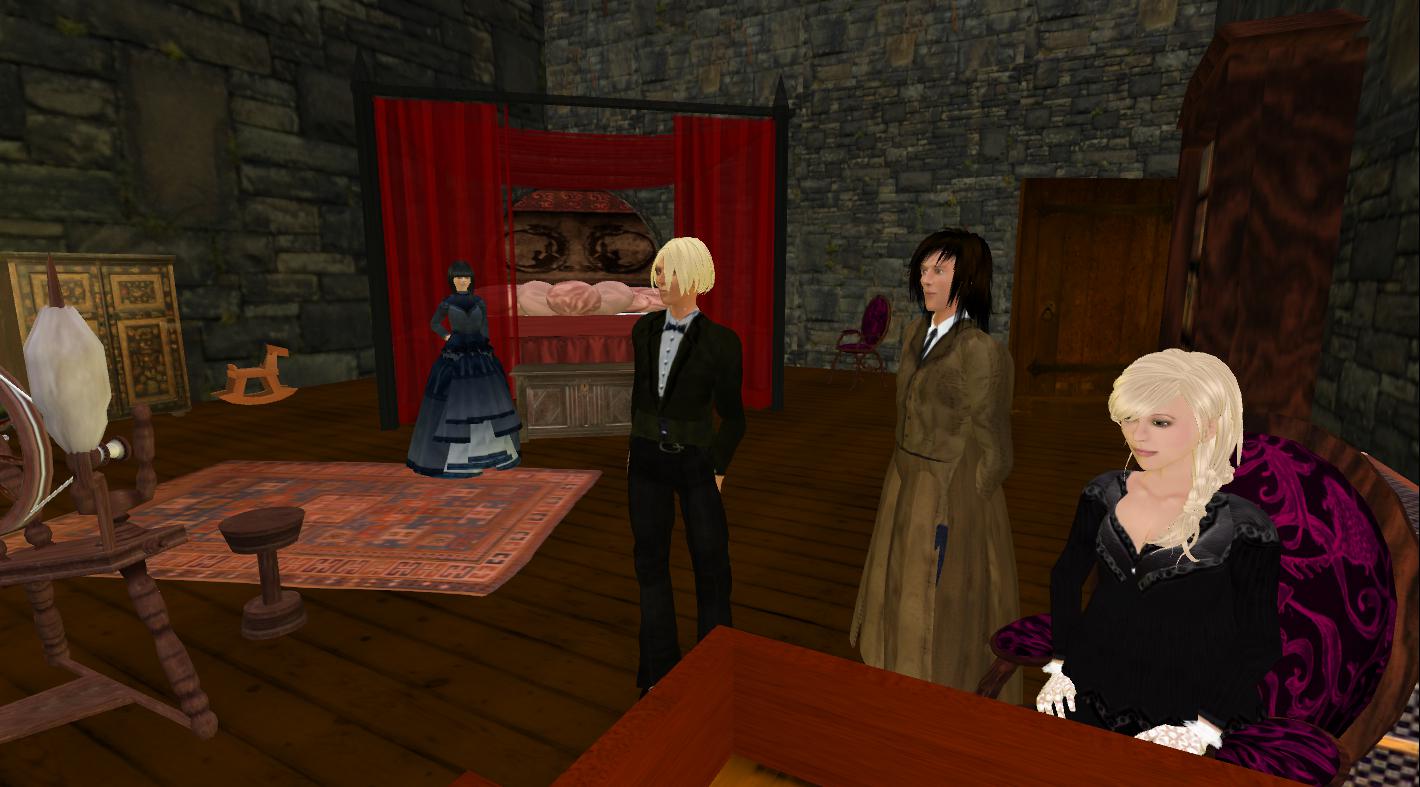
My students had a lot to say about my final experiment with virtual worlds. I'd suggest these critical remarks, following what they liked, may help others playing with interactive fiction using virtual worlds or other technologies.

As you read them, you'll notice conflicting desires. I suspect the most popular sort of interactive literary experience will steer between constraint and complete freedom. I'll leave that up to others to try.

Too Much or Too Little Freedom?
  • Although the freedom of virtual simulation enables a more personal experience with the story, the freedom is to the detriment of the author’s intent. By providing so much freedom in the story, the meaning behind the story gets lost. In addition, the agency given to the avatars permits characters to get lost, die, or make another mistake that removes them from the storyline.
  • One thing that was detrimental about having so much freedom was the fact that we could go anywhere we wanted even when we were not supposed to. There were several times that I ended up In a room I wasn’t supposed to find, or followed Madeline upstairs when she was trying to do something secretively. That may have been a glitch in the software, or we may have just been too clever, but it made the experience a little confusing.
  • Having read the story prior to the interactive experience, I felt that the simulation lacked depth because it did not hold the same meaning that Poe intended it to, which I find to be an injustice to the great author. In fact, the storyline in my experience not only lacked depth but also action because most of the simulation was dialogue among the avatars. Though the conflict in Poe’s story involves a live burial and revenge, the conflict in my simulation simply had to do with Madeline’s doctor not being exactly who Roderick thought he was. This ultimately led the online story to not be extremely engaging.
  • Even though the story was quite interesting, the final outcome was limited – Madeline either lives or dies. A simulation of a story with broader plot and more characters might also result in better experience. 
  • If I could fix anything about the way this final was conducted, I would make the simulation contain more action. We reached a certain point where I got bored with the large amount of conversation and the lack of more engaging activity. Maybe in the future, this final exam simulation could contain a battle of some sort. The characters could fight a ghost trying to attack them or a doctor trying to take Madeline away for experimenting, or have some other type of fun and unexpected action-based conflict.
The Setting
  • I thought the setting could have been improved. The House of Usher is supposed to be a scary place, however the larger, open rooms, bright Victorian furniture, and wider hallways failed to frighten. I would have liked to see the house’s hallways and rooms more damp, dark, and crowded. This virtual house also wasn’t as effective as Poe’s writing because a depiction of the setting makes it evident that Poe’s descriptions are now clichéd. 
Adding Interaction and Giving Out the Clues:
  • More accessible clues would have certainly been helpful: perhaps hints to secrets hidden around the house or scavenger hunt-type clues. At a certain point during the simulation, I felt stuck given the information that I currently had and was not sure how to proceed—notes that led me to specific locations would have helped keep me on the move. In addition to this, interactive items would have been more than welcome and probably a lot of fun. I felt useless in the crypt when I was being shot at by the doctor and did not have a weapon. The ability to use objects, especially weapons, would definitely have made me feel more integrated into the story. The more that a character can physically do, the more lifelike a simulation feels.
  • I also think that searching for clues and interacting with the house could have been a bigger component. Speaking with the actors playing Roderick and Madeleine was an important and interesting part of the experience, but got a little repetitive and boring during the first half of the simulation.
  • I think that the clues that we found were not really helpful in the simulation because they did not really direct us to a solution in any way. There were also too many of them that did not pertain to the plot. Instead Roderick and Madeline could give us clues to help us find the Easter eggs within the simulation
Final Top-Hat Tip

One sad coda to my work of 6 years with virtual worlds: not a single student mentioned the Usher project in their formal class evaluations. In fact, I believe that the time spent preparing for Usher hurt my other teaching, and thus my evaluations overall.

It will be a long time, if ever, that I use this technology with undergraduates. I don't expect SL to thrive again in the way that it was thriving when this blog began, in its original format, in 2007. That said, I wish those in SL's niche-universe good luck. If something like SL becomes popular with the somewhat jaded and very careerist students I teach, I'll give it another go.

Until then, so long and thanks for all the prims.

Wednesday, May 1, 2013

Leaving Las Vegas: 6 Years in Virtual Worlds, Farewell

VWER 25 April 2013
Location: Grading Finals

During the Spring Semester of 2007, this fool rushed into Second Life, something he felt would not only change education but the world beyond. Virtual worlds looked like a utopian technology with lots of zealous folks ready to evangelize the masses.

Six years later, grading what may be my last-ever student projects about virtual worlds and somewhat wiser, this educated fool wonders why SL did not change the world or even higher ed. I've written elsewhere about why SL failed to become that "3D Web" of yore.  Meanwhile, the bandwagon has moved on, the cheerleaders yelling "hurrah!"and "higher education will never be the same!" for MOOCs.

I'll sum up what I've learned about utopian narratives and would-be transformative technologies here, based on not only the last 6 but the last 25 years of studying and writing professionally about technological change, especially that which generates legions of enthusiasts.
  1. Look past the message to the messenger
  2. Wait for results unless you are an entrepreneur or venture capitalist
  3. Be a trailing-edger
  4. Find community locally, not just online
  5. Consider what students have in their hands
Lesson one: Look past the message to the messenger

I first head about Second Life in a story from Wired. That is not a sedate or juried publication; it's the Popular Mechanics of the digital era. Ever the sucker for flying cars and moon bases, I decided "I need to get in early with this technology," not considering that one company, with a closed platform not built for education, held the cards. I trusted the vision of Magic Koolaid provider, Philip Rosedale. Linden Lab's corporate culture and Rosedale's wandering vision both disappointed this educator, along with many colleagues.

Who is pushing MOOCs today? College faculty members? Technologists who embrace the new without considering pedagogy of large classes with little or no contact with faculty? Right-wing lawmakers eager to dilute the power of those "tenured radicals" supposedly in charge of Higher Ed? Boards of Visitors eager to promote a school "brand" without a clear sense of what it will do to curriculum, staffing, or the long-term value of that "brand"?

Ask yourself, and take a deep breath before jumping on the band wagon.

I do wish I'd looked past the euphoria about virtual worlds in 2007 to see who was cheering most loudly.

Lesson Two: Wait for results, unless you are an entrepreneur or venture capitalist

I was not in virtual worlds for the money. As noted just now, I wanted to be in on "the next Web," as many were then pitching SL. In 1993, when I first saw a moving weather-pattern on the Mosaic browser in Dickie and Cindy Selfe's lab at Michigan Tech, I knew I was seeing something historic. In 2007 I thought so again, without applying the very critical-thinking skills I teach my students.

From 2003-06 or so, it made sense for venture capitalists to take a bet on this new technology. It might have become the next Web. Educators, however, need to always place sound pedagogy ahead of tech, which is a suspicious I have about the euphoria over MOOCs at the moment. I saw that same brand of enthusiasm for MOOs in the late 80s and early 90s, literary hypertext a bit later, glove-and-goggle VR from the 80s to the present, and of course, virtual worlds.

While one might reasonably claim that virtual worlds are going to become significant culturally, I'd suspect lots of Magic-Koolaid drinking by an educator who claimed SL will ever again be more than a niche-product in years to come. AJ Kelton of VWER rightly called SL "The AOL of virtual worlds" to the disdain of several Linden Lab staff. AJ was correct, and the Lab staff in question now work elsewhere, after being fired during the first stages of Second Life's ongoing and palpable decline.

Bottom line for me: waiting to see if SL lived up to its hype would have cost me nothing in 2007, and would have saved me time. Had I first taken a class in-world in 2009, I'd have been ready for the myriad frustrations and technical issues that bedeviled a product that seemed very much in Beta up to that point.

Lesson Three: Be a trailing-edger

During the summer I spent with the Selfes and their grad students at Michigan Tech, Richard "Dickie" Selfe, co-founder of that school's CCLI humanities lab, along with wife and fellow scholar Cynthia Selfe, once told me only to adopt trailing-edge tech for teaching and learning. The Selfes were among a group of 1980s pioneers with personal computing in the classroom, and Dickie's lab at MTU was a playful space, with stuffed animals, a coffee machine, snacks, and weekend gaming sessions with Doom and similar titles.  I'm sure that at Ohio State they continue this practice, so influential to young scholars of writing pedagogy in writing-intensive curricula.

At every step, while the Selfes liberally experimented with leading-and-bleeding-edge applications, in the classroom they proceeded more carefully with undergraduates. The older technologies were stable, easier to support, and grounded in best practices for teaching.

My experiences in 2007-8 in SL, and then in 2011 with OpenSim's Jokaydia Grid, taught me the dangers of being on the bleeding edge. My students and I bled. Only Jokay's personal help saved the final exam in 2011, but it left a bitter taste in my mouth for teaching with OpenSim. As for SL, only by 2009 was it stable enough for a class to appreciate. That class was, ironically, my last one to focus on the technology, rather than using it for a single project.

Today, SL as a product is fairly stable, and critical and scholarly work about virtual worlds has emerged to guide our pedagogy. One would be far better off starting today as a SLer with students, given these two changes. Those on the bleeding edge, however, get cut by it.

Lesson Four: Find community locally, not just online

My years with the Virtual Worlds Education Roundtable have been good ones, and I cherish the faculty contacts I have made there. That said, the weekly meetings and constant advice did not compensate for a lack of interest in virtual worlds on my campus. With other innovations, from our Writing Consultants program to First-Year Seminars, we meet in person and I have lunch with folks in the flesh. There is no substitute.

Our technologists all had avatars before I did, but they never convinced more than a handful of faculty to try SL. The learning curve, the oddness of avatar-based education on a residential campus, and the lack of incentives for faculty all worked against us.

In the end, SL was an experiment that failed at Richmond. When Linden Lab renewed the 50% discount for education (if you ask the right person!) we declined. Why spend even $150 monthly for a product that might be used once every few years by one faculty member? Meanwhile, our technologists have other more tasks, from supporting Blackboard and other meat-and-drink software to  new initiatives with mobile apps.

Mobile may turn out to be the "new shiny object" for education, but it's not a niche application for students. As for MOOCs? I will wait to see comparative studies of students' learning outcomes in them and outside them. That should have been done for virtual worlds.

Lesson Five: Consider what students have in their hands

The transition to smart phones as students' primary communications tools has changed everything for us. While laptops abound, students use them like big phones: never plugging in the AC adapters, perching them in nooks where Millennnials gather to collaborate, plastering them with stickers to personalize them. I suspect that with a better keyboard, students would do their content creation on fast tablets, since we have ubiquitous and fast wireless everywhere on campus.

None of that I could have foreseen in 2007, since I did not even slow down enough to consider how poorly SL would run on many laptops, especially those not hard-wired to an Ethernet port or plugged into a AC outlet.

Even with desktop connections, students loathe SL's lag. I saw that last week in the finals. Perhaps server-side baking from Linden Lab will make SL run better on what my students still use for content creation--laptops--though not on phones, where virtual worlds simply cannot display with any sort of grandeur.

But by then, Iggy will have left the virtual building.

Coda:

I'm thankful for an experiment of six years, even if the experiment failed. At least virtual worlds generated two publications for me, as well as a forthcoming anthology I'm co-editing with some chapters about virtual worlds. I don't write the rules, but publications and teaching evaluations are the currency of academia, despite the best wishes of utopians that it be otherwise.

It is always possible that my teaching load will shift again, and my Chair and Department will call on me to teach my course about the history, culture, and future of Cyberspace. In such an event, Iggy and his students will be back. Look out.

Wednesday, April 24, 2013

Finale for Usher & Teaching in Virtual Worlds?


Location: Virtual House of Usher

Is it to be "that's all, folks," in the immortal words of Porky Pig?  In twenty minutes, I start what may be my last-ever work with students inside a virtual world.

We'll see what the future brings, but for now, I'm betting on the Pig. Here's the final scoreboard from the students. Three students not only found eggs but solved the quest therein. Nicely done, Gunters!  Divij in particular came on strong with his work to lift the curse from his "bad egg."


Wednesday, January 9, 2013

Channeling My Inner Geek

Location: Google Sites

Once again, I'm stepping into the fray to teach first-year students in my seminar Cyberspace: History, Culture, and Future. I get my share of geeks in the course, which is wonderful fun. Today I worked on an "about me" disclosure for the syllabus. It will be a romp, with Ernest Cline's Ready Player One and the Second Life House of Usher simulation as a final exam project.

Setting the tone is everything for such a class, from scaring off lazy-bones who won't want to exert themselves and luring in my fellow geeks. I think my description, that follows, does pretty well. I only forget to add that "Han shot first" to solidify my geek cred.

About Me 

I'm a Richmonder by birth and a lifelong geek, free-lance writer, hobby farmer, model-builder, and non-computer gamer (board games and role-playing games). I lived in Spain after college and have traveled a good deal overseas, especially in the U.K. In Spain I was attacked by a pack of wild dogs while reading James Joyce. Knowledge of Jack London's Call of the Wild saved my life, whereas Joyce provided no help at all. I now advocate that everyone read a lot.

In terms of my tastes in futurism, it's either dark stuff like Cyberpunk and post-apocalypse or, on the brighter side, Star Trek (original series) not Star Wars, please, save for Lucas' original films I & II. I'm decent with graphics, basic Web design and HTML coding, and hacking farm and older computer hardware. I fool around with cars, some of them quite fast, and I used to street race until it nearly killed me enough times to make my brain mature.

I listen to a lot of music, often loud and mostly on CDs or vinyl; I also rip tunes from these tactile media and make playlists, though I find ripped music on tiny devices tinny. I'm fond of first-gen Metal, Glam Rock, old-time music, some Americana, traditional country, and electronica by artists like Brian Eno. I don't have time for most TV or pop culture of the present era. I am easily bored but if interested in something, I will recall every detail for years. I cannot code my way out of nested loop. Facebook is for saying respectful things to family and stupid things to my friends. I am not very professional online.

The best student evaluation I ever got read (about a lit course on Invented Worlds) "this class is crazy, but Doctor Essid is just the man for the job."

Though in terms of birth-year I should be a Boomer, I find that generation smug and entitled. I was young enough to think I could ride my bike to Woodstock, and Vietnam was something that adults fretted about (until my older brother got drafted). After seeing America peak in 1969 with the Apollo 11 landing (I'm serious) I watched the slow slide of things, coming of age in the dreadful 70s with other Gen Xers, when everything sucked except Led Zeppelin.

As I grow older and crankier, and though I have published an article about Millennials and online engagement, I find your generation's online habits bizzarre, overly serious, and frightening. Worst of all, I consider most of you addicted to those little boxes in your palms constantly. I have a flip phone and don't text. If I don't know who is calling by voice, I also do not answer.

Stay the hell off my lawn, too.

Unless you have read Jack London when I call the dogs out on you. Hint: find the alpha and challenge.