Wednesday, August 28, 2013

VWER Educators Discuss the Linden Discount

Location: Back in Second Life, Briefly

On August 15, I guest moderated the VWER meeting and decided it was time to chat about the new tier discount in SL, to see what others think or are doing.

The complete transcript of our meeting can be found here. Meanwhile, it's safe to say that a few "wants" emerged from our meeting, even as Linden Lab reinstates its discount:
  • An educational continent: this was on the Linden radar in 2010, before the company suddenly fired its staff who supported education.  We'd get a lot of synergy from proximity, and we'd also be able to rent parcels smaller than an entire sim, in a setting with others like us.
  • Linden staff tasked to support education: As in "full-time and on-call." The software vendors I deal with, as I pay them far less annually than what we'd pay in discounted Linden tier, have these helpers by the phone during US business hours. Many at the VWER meeting felt that Linden Lab could afford concierge service for education, too.
  • An educational portal online: It's just an embarrassment to show educators and administrators the socially focused SL Web site, let alone the racy content of Marketplace. We need something that looks like education, not reality TV.
  • Fixing permissions for group builds: We need a new level of permissions so that student builders (who graduate) can not only transfer content to a team but cede "Creator" setting so the content can be exported, backed up, and linked for builds.  While we are at it, how about some off-world backups of the IP we create?
Great ideas, all. I am not holding my breath.

Though I personally think it's too late to bring education back to SL, or even reversing the continuing loss of land-mass in the once popular virtual world, if the Lindens are serious about it, these steps would help.  There are other choices out there beyond OpenSim; Educators now can export virtual-worlds content to worlds employing Unity 3D content.

Tuesday, August 6, 2013

What Rod Humble Saw

Location: Linden Lab Secret Facility

Now we know the CEO's experience with the Oculus Rift. I think the new-projects team went right out to Vesuvio and got plastered.

Monday, July 15, 2013

Usher 2013: What the Students Would Change

Location: Pushing back from keyboard

Note: To my readers who have followed the blog, it will go fairly quiet now, with perhaps an occasional post from time to time. I'm not in-world enough in SL or OpenSim to justify more, and my other writing beckons.

Thanks for all your comments and ideas over the years.

My students had a lot to say about my final experiment with virtual worlds. I'd suggest these critical remarks, following what they liked, may help others playing with interactive fiction using virtual worlds or other technologies.

As you read them, you'll notice conflicting desires. I suspect the most popular sort of interactive literary experience will steer between constraint and complete freedom. I'll leave that up to others to try.

Too Much or Too Little Freedom?
  • Although the freedom of virtual simulation enables a more personal experience with the story, the freedom is to the detriment of the author’s intent. By providing so much freedom in the story, the meaning behind the story gets lost. In addition, the agency given to the avatars permits characters to get lost, die, or make another mistake that removes them from the storyline.
  • One thing that was detrimental about having so much freedom was the fact that we could go anywhere we wanted even when we were not supposed to. There were several times that I ended up In a room I wasn’t supposed to find, or followed Madeline upstairs when she was trying to do something secretively. That may have been a glitch in the software, or we may have just been too clever, but it made the experience a little confusing.
  • Having read the story prior to the interactive experience, I felt that the simulation lacked depth because it did not hold the same meaning that Poe intended it to, which I find to be an injustice to the great author. In fact, the storyline in my experience not only lacked depth but also action because most of the simulation was dialogue among the avatars. Though the conflict in Poe’s story involves a live burial and revenge, the conflict in my simulation simply had to do with Madeline’s doctor not being exactly who Roderick thought he was. This ultimately led the online story to not be extremely engaging.
  • Even though the story was quite interesting, the final outcome was limited – Madeline either lives or dies. A simulation of a story with broader plot and more characters might also result in better experience. 
  • If I could fix anything about the way this final was conducted, I would make the simulation contain more action. We reached a certain point where I got bored with the large amount of conversation and the lack of more engaging activity. Maybe in the future, this final exam simulation could contain a battle of some sort. The characters could fight a ghost trying to attack them or a doctor trying to take Madeline away for experimenting, or have some other type of fun and unexpected action-based conflict.
The Setting
  • I thought the setting could have been improved. The House of Usher is supposed to be a scary place, however the larger, open rooms, bright Victorian furniture, and wider hallways failed to frighten. I would have liked to see the house’s hallways and rooms more damp, dark, and crowded. This virtual house also wasn’t as effective as Poe’s writing because a depiction of the setting makes it evident that Poe’s descriptions are now clichéd. 
Adding Interaction and Giving Out the Clues:
  • More accessible clues would have certainly been helpful: perhaps hints to secrets hidden around the house or scavenger hunt-type clues. At a certain point during the simulation, I felt stuck given the information that I currently had and was not sure how to proceed—notes that led me to specific locations would have helped keep me on the move. In addition to this, interactive items would have been more than welcome and probably a lot of fun. I felt useless in the crypt when I was being shot at by the doctor and did not have a weapon. The ability to use objects, especially weapons, would definitely have made me feel more integrated into the story. The more that a character can physically do, the more lifelike a simulation feels.
  • I also think that searching for clues and interacting with the house could have been a bigger component. Speaking with the actors playing Roderick and Madeleine was an important and interesting part of the experience, but got a little repetitive and boring during the first half of the simulation.
  • I think that the clues that we found were not really helpful in the simulation because they did not really direct us to a solution in any way. There were also too many of them that did not pertain to the plot. Instead Roderick and Madeline could give us clues to help us find the Easter eggs within the simulation
Final Top-Hat Tip

One sad coda to my work of 6 years with virtual worlds: not a single student mentioned the Usher project in their formal class evaluations. In fact, I believe that the time spent preparing for Usher hurt my other teaching, and thus my evaluations overall.

It will be a long time, if ever, that I use this technology with undergraduates. I don't expect SL to thrive again in the way that it was thriving when this blog began, in its original format, in 2007. That said, I wish those in SL's niche-universe good luck. If something like SL becomes popular with the somewhat jaded and very careerist students I teach, I'll give it another go.

Until then, so long and thanks for all the prims.

Friday, May 24, 2013

House of Usher 2013: What the Students Liked

Location: Far from virtual worlds

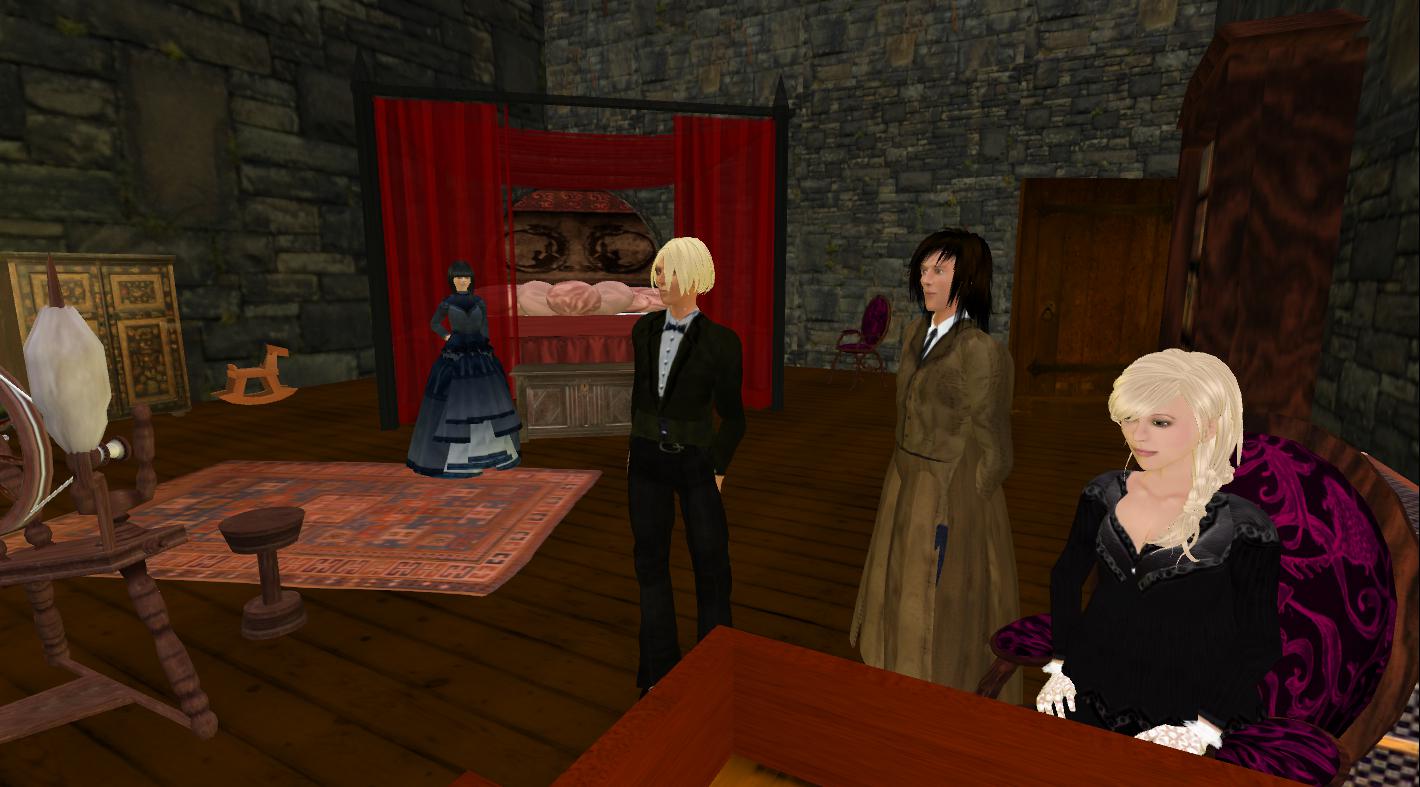
For what will most likely be my final teaching experience with virtual worlds, I tried to add depth as requested by the last group, in Spring 2011. Notably, I added more clues, plus a real-life scavenger hunt / mystery on campus. Second, I added a combat system and some dangers to the House of Usher.

I want to share the experiences and advice of the class this year, but I will do so in two posts.

First, what students had to say went well. Each bullet point comes from a different student.

As others with more support and energy than I have build virtual-worlds simulations, I hope this feedback will guide them. It was fun, but, frankly, too much work give how my job is structured. I doubt I would take on a project like this again, if I had to build it all from scratch.

Be that as it may, thanks to my actor-volunteers and students.

Immersion:
  • I felt that speaking on the screen, rather than with our mouths made the simulation more immersive. It made the simulation feel a little more game-like and controlled. Though we could say whatever we wanted, we had to be careful with our words, because it was up to the reader entirely to decide the tone of our words.
  • Unlike the short story, the simulation did also provide me with an extra way to see into the characters’ minds: diary entries and notes. One particular example of this is a note written by Madeline, which states, “I do not think that Roderick is correct in providing me with Laudanum. I fear that it will not assist me with this malady of walking about at night. I would prefer to lock my door." In reading this, my player discovered a distrust of Roderick that Madeline does not make public. Playing as a character in a simulation allows for more direct access to the other characters themselves, though it remains impossible to fully delve inside of their minds.
  • The amount of detail that went into the virtual house eased the immersion into the world of Poe. Because of the elaborate design of the virtual world, I was able to notice any important hint or clue that could help me with my task. For example, by reading the letters and journals that Madeline and Roderick wrote, I gained a lot of information about their respective illnesses and Madeline’s doctor. In addition to the copious amount of detail that the virtual setting offered, it also allowed me to create my own story.
  • I was sucked into the recreation of the Fall of the House of Usher to the degree that it felt ‘abnormal’ being in the real world. There were many factors that allowed for such an amazing experience. To begin with, the ‘cast’ of the story in the virtual world was dressed in authentic looking attire which one might have worn during the 19th century. Other than a few slipups, the characters conversed (through chat) in a manner similar to what one might expect from the people of the era.
Simulation Vs. Media With Deterministic Endings
  • For the vast majority of us who read stories or watch movies for fun today, these art works are onetime thing – rarely do we watch a movie or read a story again. Developing simulation for movies and stories might change this. If a story is, for instance, simulated with multiple outcomes, the audience will try and change the end of the story from the original work, possibly to avoid a danger their favorite character faces in the original story. This might require more than a single attempt.
  • This technique of storytelling has been employed in many video games over the years. In the Mass Effect trilogy for example the players actions could change the outcome and would be carried over three games something not possible in a two hour movie or even a long book. The atmosphere of the original [story] is kept in the simulation along with the added mystery of the final outcome.
  • What I found impressive in the simulation was its small details. For instance, you need to say a password as the code to open the door in crypt. Though this advanced technology was not available at that time, it was particularly interesting when you typed in the password in the chat column and the door opened. You could virtually sit down, drink absinthe, and light a candle. The horrific sound tracks in the game really exaggerated the melancholy and dark atmosphere, which is something the film and original novel did not have.
  • In “The Fall of the House of Usher” there was a lot of mystery surrounding the characters. Roderick’s actions were completely unexplained and readers finished the story with more questions than they started with. The interactive experience gave some insight into why the characters acted in certain ways. Unlike a movie, the student is not watching one person’s interpretation of a story. Instead, the student’s interpretation is combined . . . . with the teacher’s interpretation.
Augmented Reality: The Egg-Hunt
  • I believe that the scavenger hunt that we went on to get the eggs added to the experience of the final by adding the mystery or giving an insight into what we would see in the final. The hunt could be considered the prologue to the final.